
 Live Science Plus


Antikythera mechanism: Ancient celestial calculator
The device tracked the motions of the sun, moon and five planets.


The Antikythera mechanism is an ancient shoebox-sized device that is sometimes called the world's oldest computer for its ability to perform astronomical calculations.
Discovered by sponge divers off the Greek island of Antikythera in 1901, the remains of the mechanism are now preserved in the National Archaeological Museum in Athens. Only 82 fragments, consisting of about one-third of the original mechanism, survive today, researchers wrote in a 2021 study published in the journal Scientific Reports. It was built around 2,200 years ago.
What did the Antikythera mechanism do?
The mechanism was capable of performing different calculations, and it could help track the motions of the sun, moon and five of the planets; it could even tell when athletic competitions, such as the Olympics, were set to take place, the researchers wrote. "It was a mechanical computer of bronze gears that used ground-breaking technology to make astronomical predictions, by mechanizing astronomical cycles and theories," the team wrote in the journal article.

Since the discovery of the Antikythera mechanism, scholars have been trying to understand the device. And although they have made considerable progress, many questions remain unanswered. For example, researchers still aren't sure who made it. Some scholars have posited that the Greek inventor Archimedes (287 B.C. to 212 B.C.) was the mechanism's creator, but this is uncertain. The inscriptions on the mechanism are written in Greek.
Whoever made the device would have had to know a great deal about astronomy, metallurgy and mechanology, Aristeidis Voulgaris, team leader of the Functional Reconstruction of Antikythera Mechanism (Frame) project, told Live Science in an email. This project aims to reconstruct what the mechanism originally looked like and gain a better understanding of it. They also would have needed "great hand dexterity," he noted.

An engraving illustration of the last hour of Archimedes, the mathematician who died in 212 B.C. or 211 B.C. when the Romans captured Syracuse, Sicily.
The recovered fragments of the mechanism contained writing and inscriptions, and over the past two decades, scientists have been able to read more of these Greek inscriptions using high-tech imaging methods, such as 3D X-ray scanning. This has enabled them to learn more about how the mechanism worked.
CT scans "revealed inscriptions describing the motions of the sun, moon and all five planets known in antiquity and how they were displayed at the front as an ancient Greek cosmos," the researchers wrote in the Scientific Reports article. The mechanism used "cycles from Babylonian astronomy, mathematics from Plato's Academy and ancient Greek astronomical theories," the researchers wrote.
Get the world’s most fascinating discoveries delivered straight to your inbox.
The mechanism represents "a level of technology exceeding anything else of the kind for which we have either physical remains or detailed descriptions from antiquity," Alexander Jones, a professor of the history of the exact sciences in antiquity at New York University's Institute for the Study of the Ancient World, wrote in his book "A Portable Cosmos: Revealing the Antikythera Mechanism, Scientific Wonder of the Ancient World" (Oxford University Press, 2017).
What did the Antikythera mechanism look like?

More pieces of the Antikythera Mechanism at the Archaeological Museum in Athens.
The authors of the Scientific Reports article found that someone viewing the front of the mechanism would have seen dials that showed the movements of the moon, sun, lunar nodes (points where the moon's orbit crosses the ecliptic, the path the sun appears to take through the constellations), Mercury, Venus, Mars, Jupiter and Saturn, as well as the Zodiac calendar.
The back of the mechanism had dials showing the Metonic cycle (a 19-year cycle after which the phases of the moon occur on the same days of the year), the Callippic cycle (a period of 76 years, equal to four Metonic cycles), the Olympiad cycle (when the Olympics were held every four years), the Saros cycle (a period of more than 18 years between lunar eclipses) and the exeligmos (a period of more than 54 years, or three Saros cycles).
Between the front and back of the mechanism were a vast array of gears, designed in such a way that all the dials would depict the correct timing of all the cycles.
"Suppose a user of the Antikythera Mechanism wants to check eclipse predictions for a particular month some years ahead. The user winds the mechanism forwards to the desired date, as shown on one of its calendars," Tony Freeth, a researcher with the Antikythera Mechanism Research Project, wrote in a paper published in 2014 in the journal PLOS One.
Antikythera mechanism shipwreck

This massive marble head found by the latest excavations at the Antikythera wreck site is thought to represent the Greek demigod Heracles.
Though the ship that held the Antikythera mechanism was discovered more than a century ago, the wreck has not been fully excavated. The size of the ship that carried it is unclear and just how widely the artifacts are dispersed is also somewhat uncertain. Its location and depth make it hard to excavate, according to the Woods Hole Oceanographic Institution (WHOI). The site is at an angle on the seafloor around 130 to 165 feet (40 to 50 m) below the surface, meaning it's too deep for scuba divers to excavate for long but too shallow to be investigated by remotely operated vehicles, according to the WHOI.
Despite these difficulties a new program of excavation is being carried out by a team of archaeologists and new artifacts continue to be found, shedding light on what the ship, which likely sank around 65 B.C. was like.Their finds include a bronze arm that was once attached to a statue, a board game, possible remains of an ancient throne, and a marble statue head of Hercules, Live Science previously reported.
Researchers have noted that many of the artifacts were luxury goods intended for the wealthy. So far, the recent excavations have not uncovered any new remains of the mechanism.
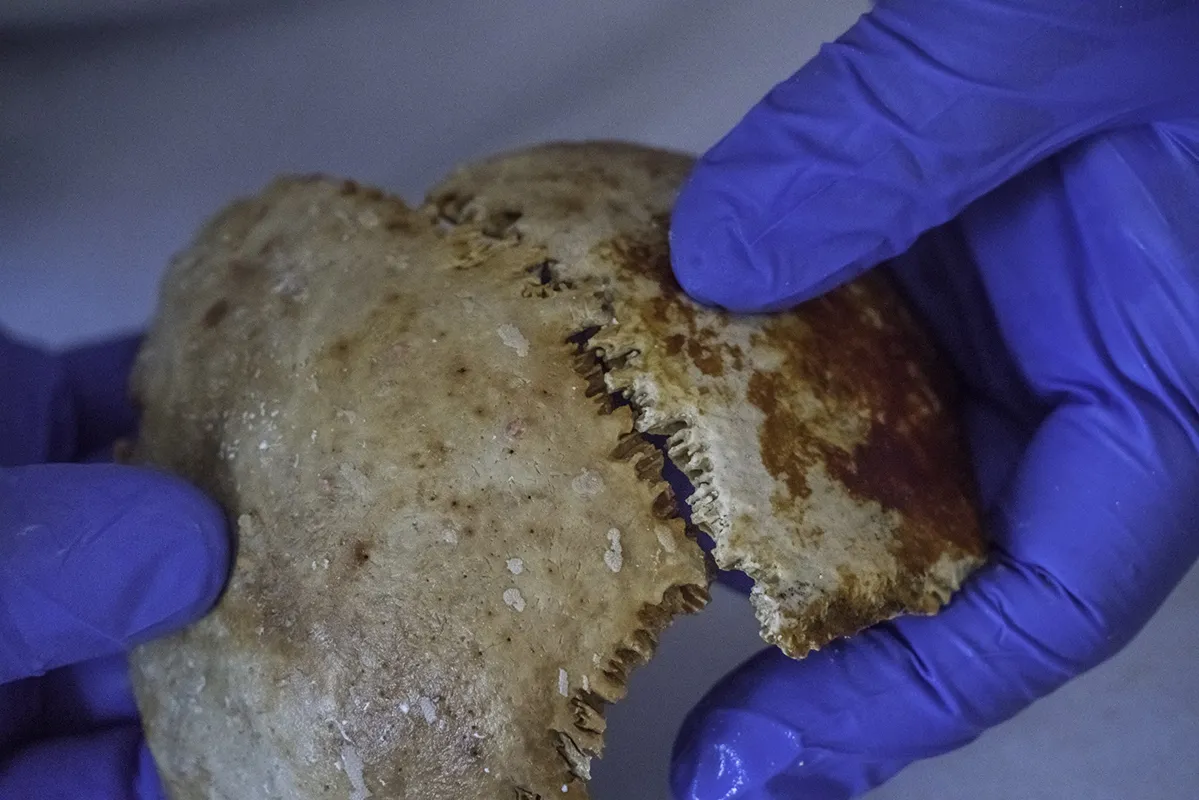
Excavations in 2016 at the Antikythera shipwreck found a nearly intact skull, including the cranial parietal bones.
In 2016, archaeologists unearthed the ancient skeleton of a male at the shipwreck, Live Science reported at the time. Recently, scientists have been trying to extract DNA to learn more about the man.
Researchers still aren't sure why the mechanism was on the ship in the first place. "This was not an object one would casually subject to the risk of travel," Jones wrote in his book. While the mechanism may not have been a one-of-a-kind device, it would surely have been something of considerable value. One possibility is that a technician was transporting the device to its intended owner, Jones wrote, noting that a storm likely caused the ship to sink, taking the mechanism down with it. Where the ship came from and where it was going to is a subject of ongoing research and debate among scholars.
Antikythera mechanism's 'start date'
Scholars are still debating the Antikythera mechanism's exact "start date," the earliest date on which all calculations made on the mechanism are based. Research published in March 2022 on the preprint server arXiv proposed Dec. 22, 178 B.C. as the mechanism's start date. Researchers noted that on that day, there was a lunar eclipse, followed by the winter solstice, followed by a festival dedicated to the goddess Isis. While Isis was an Egyptian goddess, she was highly regarded in Greece at this time.
However, other teams of scholars have proposed May 12, 204 B.C. as the most likely start date, noting that on that day, a lunar eclipse would have been visible in Greece, and that this date is closer to the life of Archimedes. It's possible that he or someone who worked in his workshop could have built this device.
Additional resources
- Members of the Antikythera Mechanism Research Project have published many papers on the mechanism and how it worked.
- Excavations at the shipwreck are ongoing and more information can be found on the project website.
- The mechanism is now in the National Archaeological Museum in Athens.
Bibliography
Freeth, T. et al. (2021) "A Model of the Cosmos in the ancient Greek Antikythera Mechanism" Scientific Reports 5821
https://doi.org/10.1038/s41598-021-84310-w
Freeth, T. (2014) "Eclipse Prediction on the Ancient Greek Astronomical Calculating Machine Known as the Antikythera Mechanism" PlosOne
https://doi.org/10.1371/journal.pone.0103275
Jones, A. (2017) "A Portable Cosmos: Revealing the Antikythera Mechanism, Scientific Wonder of the Ancient World" Oxford University Press
Voulgaris, A. et al (2022) "The Initial Calibration Date of the Antikythera Mechanism after the Saros spiral mechanical Apokatastasis" arXiv
https://arxiv.org/abs/2203.15045
Originally published on Live Science.

Owen Jarus is a regular contributor to Live Science who writes about archaeology and humans' past. He has also written for The Independent (UK), The Canadian Press (CP) and The Associated Press (AP), among others. Owen has a bachelor of arts degree from the University of Toronto and a journalism degree from Ryerson University.