













Jupiter: Facts about the biggest planet in our solar system
Discover interesting facts about Jupiter, its many moons, and whether the gas giant and its moons could host extraterrestrial life

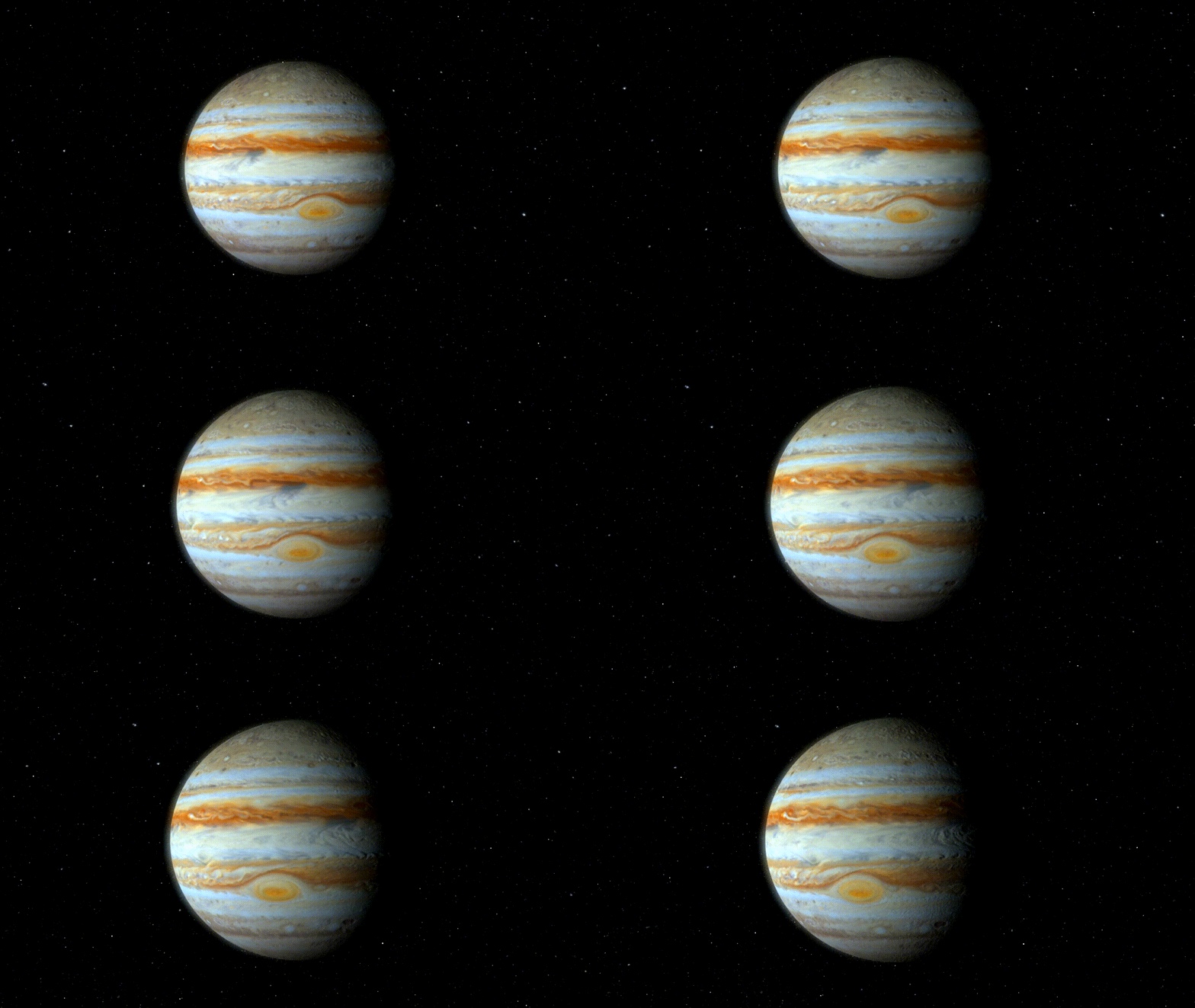
QUICK FACTS ABOUT JUPITER
How far it is from the sun: an average distance of 484 million miles (779 million km)
How big it is: 86,900 miles across (139,900 km), or 11 times wider than Earth
How many moons it has: 101 officially recognized moons
Jupiter is the largest planet in the solar system and the fifth planet from the sun. The gas giant features beautiful banded cloud layers, a set of thin, dusty rings, the famous Great Red Spot and dozens of moons. Jupiter is also the oldest planet in the solar system, having formed 4.6 billion years ago. Read on to learn more about the raging storms on Jupiter's surface, the expeditions to explore Jupiter and its moons, and whether any life could exist around the faraway planet.
5 fast facts about Jupiter
- Jupiter is named after the Roman king of the gods, also known as Zeus.
- A year on Jupiter lasts 11.86 Earth years.
- Jupiter has the shortest day in the solar system, lasting just 10 hours.
- Jupiter is the fourth-brightest object in Earth's sky, after the sun, the moon and Venus.
- 1,000 Earths could fit inside Jupiter.
Everything you need to know about Jupiter
What is Jupiter made of?
Jupiter doesn't actually have a surface. Instead, the planet is mostly just a swirling mixture of gases with three layers. These gases are mostly hydrogen and helium. The bright, banded colors on Jupiter's outer surface are likely plumes of sulfur- and phosphorus-containing gases that rise up from the planet's warmer interior. Because the planet spins very fast, completing a single day in less than 10 hours, its outer atmosphere separates into long belts of brighter and darker material, much like an extreme version of Earth's jet streams.
Deeper inside Jupiter, internal pressures are so high that electrons are squeezed off of hydrogen atoms. This creates a powerful electricity-conducting metal that fuels Jupiter's enormous magnetic field — the second-largest in the solar system, after the sun's. The planet might have a core of solid material or a thick, dense "soup," made mainly of partially-dissolved iron and silicon, that could be up to 90,000 degrees Fahrenheit (50,000 degrees Celsius).
Jupiter is known for its vicious storms. The Great Red Spot is a single storm that has lasted at least 300 years, and data from NASA's Juno probe suggest that the storm goes down 300 miles (480 kilometers) into the planet's atmosphere — or about 40 times as deep as the Mariana Trench on Earth. The Great Red Spot has been shrinking over the past decades. It's currently about 15,400 miles (23,300 km) across, but it used to be thousands of miles wider.
The Great Red Spot has even been seen eating other, smaller storms. Near Jupiter's south pole, there is also a dramatic hexagonal storm about the size of Texas.

This image of Jupiter's iconic Great Red Spot and surrounding turbulent zones was captured by NASA's Juno spacecraft as it performed its 12th close flyby of Jupiter. The color-enhanced image is a combination of three separate images taken on April 1, 2018.
Have humans explored Jupiter?
Humans have launched many uncrewed expeditions to explore Jupiter and its moons. The Pioneer 10 and 11 spacecraft, launched in March 1972 and April 1973, were the first to sweep past Jupiter, gathering information about its intense radiation belts and snapping a few early photos. Next, the Voyager 1 and 2 probes, both of which left Earth in 1977 and reached Jupiter in 1979, gathered amazing photos and data of the giant planet. They revealed Jupiter's faint and dusty ring system, the presence of volcanic activity on its moon Io and some previously unknown moons.
NASA's dedicated Jupiter mission,Galileo, began orbiting the enormous planet in December 1995. Galileo studied Io and Jupiter's icy moon Europa in depth and released a probe that fell into Jupiter's atmosphere.The agency's latest dedicated Jupiter spacecraft is called Juno, which has been in orbit since July 2016. Juno passes over the planet's polar regions every 53.5 days and has studied its powerful magnetic field and bright auroras, among other things.
In October 2024, NASA launched a probe called Europa Clipper to study the icy moon and its subsurface ocean, which many scientists think could hold life. The European Space Agency's Jupiter Icy Moons Explorer (JUICE) mission, launched in 2023, will also explore Europa, as well as two other large Jupiter moons: Ganymede and Callisto.

NASA's Galileo probe passing over one of Jupiter's 16 moons in 1989.
How many moons does Jupiter have?
Jupiter has 101 known moons, and thousands of other small objects orbit the giant planet. Ganymede is the biggest moon in the solar system and is larger than the planet Mercury.
Some of Jupiter's other moons are also gigantic worlds. Callisto has dramatic craters and may host a liquid ocean beneath its thick shell of ice. Europa has a similar ice and ocean structure, but its frozen outer shell is much thinner. And brightly colored Io is the most volcanically active body in our solar system.
Could there be life on Jupiter?
Astronomer and science communicator Carl Sagan once speculated about the possibility of jellyfish-like organisms staying afloat using helium gas in Jupiter's atmosphere, but most researchers nowadays don't hold much hope for living organisms flitting about on the gas giant.
NASA considers Jupiter's moon Europa, which is covered in a shell of ice that surrounds an enormous body of liquid water, to be one of the likeliest places to find extraterrestrial life in the solar system. Europa may have giant ice spikes on its surface, though, making landing on the frozen world potentially difficult.
Are there other names for Jupiter?
As one of the brightest objects in the night sky, Jupiter has been known about since ancient times, so it has many names from different cultures. For the ancient Greeks, Jupiter was known as Phaethon, which means "blazing star." The Babylonians referred to the giant planet as Marduk, the patron deity of the city of Babylon. Other ancient names for Jupiter include Brhaspati (Sanskrit), Tzedek (Hebrew), Muxing (meaning "Star of Wood" in Mandarin) and Mushtari (Arabic).
Jupiter pictures

Great Red Spot
Jupiter's Great Red Spot is actually a massive storm that has been active for hundreds of years. This photo of the Great Red Spot was taken by Voyager 1 in 1979.

Ganymede
Ganymede is the largest moon in the entire solar system.

Io
Jupiter's colorful moon Io is full of volcanic activity.

Europa
Icy Europa is Jupiter's fourth-largest moon, and one of the best candidates in the solar system to find extraterrestrial life.

Europa Clipper
An illustration of the Europa Clipper orbiting Europa, with Jupiter in the background.
View Original

View Original
View Original
View Original
View Original
Get the world’s most fascinating discoveries delivered straight to your inbox.

Adam Mann is a freelance journalist with over a decade of experience, specializing in astronomy and physics stories. He has a bachelor's degree in astrophysics from UC Berkeley. His work has appeared in the New Yorker, New York Times, National Geographic, Wall Street Journal, Wired, Nature, Science, and many other places. He lives in Oakland, California, where he enjoys riding his bike.
- Marilyn Perkins Content Manager
You must confirm your public display name before commenting
Please logout and then login again, you will then be prompted to enter your display name.