















The sun: Facts about the bright star at the center of the solar system
The sun is the solar system's central star and supports all life on Earth.

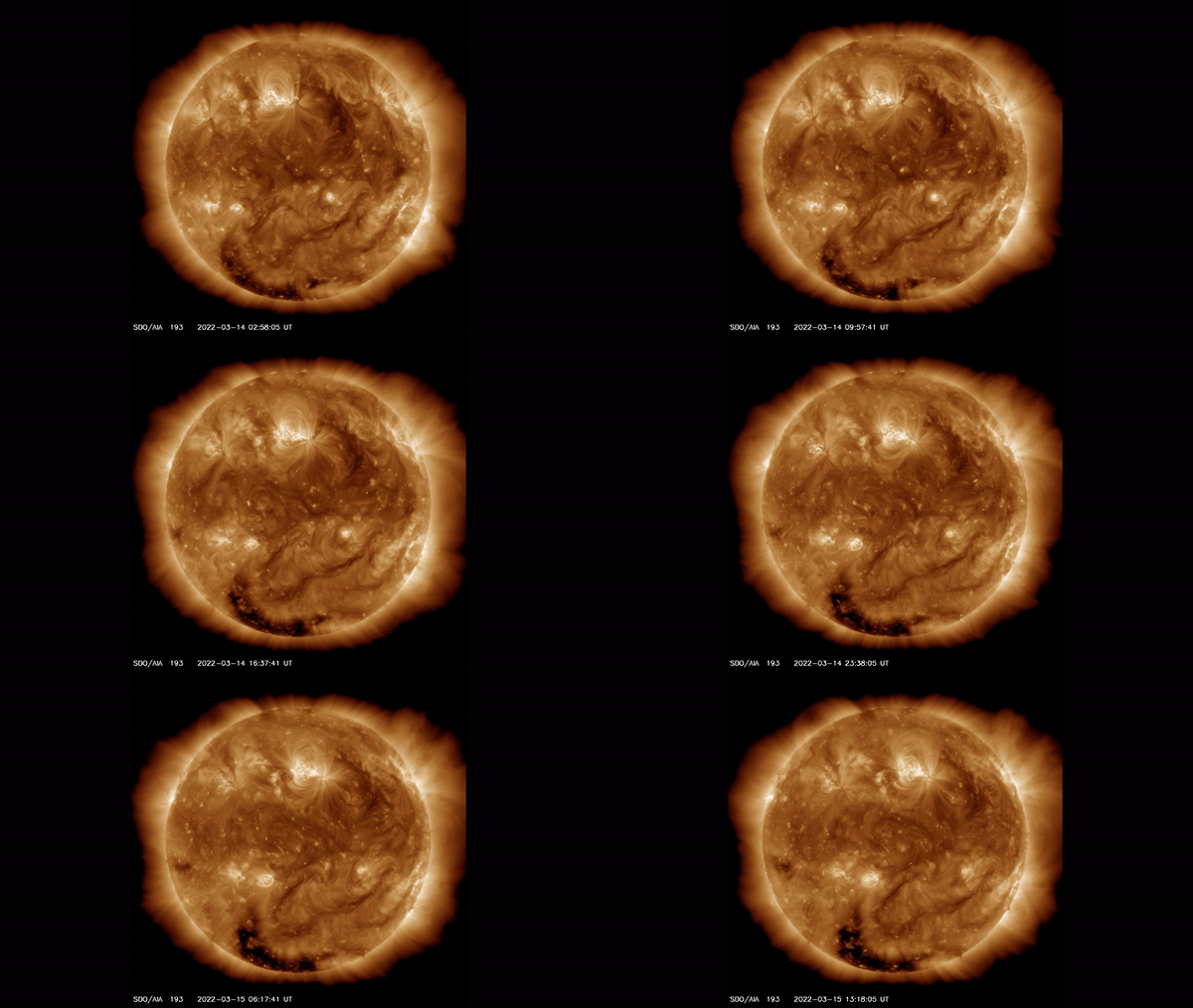
The sun is a yellow dwarf star in the center of the solar system, and it is the largest, brightest and most massive object in the system.
The sun formed around 4.5 billion years ago. At that time, the area of the Milky Way galaxy that would become the solar system consisted of a dense cloud of gas — the remnants of an earlier generation of stars. The densest region of this cloud collapsed and gave rise to the protostar that would become the sun. As this young protostar grew, planets, moons and asteroids formed around it from what remained of this raw material, bound in orbit to their parent star by its immense gravity.
At the heart of the sun, this same force sparked nuclear fusion that powers the star. The heat and light from this nuclear reaction enabled life on Earth to evolve and prosper. However, this reaction will eventually lead to the sun’s demise, as the sun will eventually run out of nuclear fuel.
Is the sun a star?

The Hertzsprung Russell diagram, which astronomers use to categorize a star's current stage of existence. Through the center runs the main sequence, where our sun sits. In billions of years, our star will migrate to the giant branch, and after a billion years here it will move to the white dwarf section of the diagram at the lower left.
Despite its importance to humans and all life on Earth, our yellow dwarf star is quite average. In comparison to other stars, both the sun's mass of around (2 x 10³⁰ kilograms) and its diameter of around 865,000 miles (1.392 million kilometers) are fairly typical — astronomers have observed many smaller stars as well as stars with hundreds of times this mass.
One thing that really sets the sun apart from other stars is the fact that it is alone in space. The majority of stars — up to 85% — exist in binary systems with a companion star, while many other stars exist in systems with even more stars, according to the Australia Telescope National Facility.
What is the sun made of?

An artist's concept of the sun being observed by NASA's Parker Solar Probe.
The sun is in the period of a stellar body's life in which it fuses hydrogen to create helium. The difference in mass between the hydrogen atoms and the daughter helium atom is released as energy — the heat and light that sustain our planet. This is called the main sequence.
Before the main sequence stars like the sun exist as what is known as protostars, gathering mass from their surroundings and growing to the mass required to initiate fusion.
Like all main-sequence stars, the majority of the sun's mass is made up of hydrogen, with some helium and traces of heavier elements , which are referred to as the metallicity or “Z” of a star (the astronomical definition of a metal is "any element heavier than helium").
Get the world’s most fascinating discoveries delivered straight to your inbox.
The ratio of the sun's mass is 73% hydrogen, 25% helium, and 2% metals. The generations of stars that preceded the sun would have had smaller ratios of metals than this, enriching their galaxies with heavier elements upon their deaths.
The larger a star is, the more rapidly it burns through its hydrogen content; some of the largest stars — such as those with masses 40 times that of the sun — have lifetimes as short as a million years compared to the Sun's main-sequence lifetime of around 10 billion years, according to Swinburne University of Technology in Australia.
How hot is the sun?

An illustration of the sun's layers. Temperatures vary in different parts of the sun and its atmosphere.
The sun’s core reaches temperatures of 27 million degrees Fahrenheit (15 million degrees Celsius). The majority of hydrogen in the sun’s core exists as ionized plasma because the conditions there are hot and violent enough to strip electrons from the constituent atoms.
Yet the core of the sun and this powerful engine is out of sight. The deepest part of the sun that we see on Earth is the photosphere, which loosely passes as a "surface" for this ball of plasma. The temperature of the photosphere ranges from around 6,700 F to 14,000 F (3,700 C to 7,700 C).
Above the photosphere is the loose, tenuous atmosphere of the sun, known as the corona. The corona isn't visible from Earth under ordinary conditions as the light it emits is overwhelmed by that of the photosphere. The corona, however, represents one of the most significant mysteries surrounding the sun.
Scientists’ theoretical models of stars suggest they should become hotter as one moves towards their center — as is seen in regions of the sun between the photosphere and core, called the chromosphere and the transition region, where temperatures rise sharply to 900,000 F (500,000 C), according to NASA.
Yet, the corona at a temperature of around 900,000 F or more, is actually many times hotter than the photosphere 1,300 miles (2,100 km) below it.
What powers the sun?

The Daniel K. Inouye Solar Telescope's first published image of the sun is the highest-resolution image of our star to date.
The main source of radiant energy from the sun is a fusion process called the proton-proton chain (p-p chain). In the sun the most dominant of these reactions is the ppI chain. Occurring as gravitational pressure in the sun's core, it is great enough to force together atomic nuclei of hydrogen, overcome their positive charge and create heavier atoms.
The overall effect of the ppI chain is to take four hydrogen atoms and fuse them to create a helium atom, two positrons, two neutrinos and two gamma-ray photons — representing the majority of the sun's radiative energy.
Because the core of the sun is rich in loose electrons, the two positrons are quickly annihilated, while the gamma rays bounce around the dense interior of the star for some time before they escape, meaning that the daughter particle of this process that escapes first is the incredibly low-mass, chargeless neutrino.
The sun produces solar neutrinos in such abundance that around 100 billion of them pass through a thumbnail-size area of your body every second, according to Fermi National Accelerator Laboratory.
This shows that the sun is consuming a lot of hydrogen to sustain its luminosity of 3.846 × 1026 Watts so how long before it runs out, and what happens then?
When will the sun die?

The red giant star Camelopardalis. Our sun will eventually become a red giant, and as it expands it will engulf its nearest planets, including Earth.
The sun is around halfway through its main-sequence lifetime and has been fusing hydrogen for around 4.5 billion years. Our star is locked in a perpetual battle, as outward radiation pressure provided by nuclear fusion balances inward gravitational forces. When the hydrogen at the heart of the sun is exhausted in around 5 billion years, there will no longer be a force opposing the inward force of gravity.
The center of the sun will undergo a gravitational collapse, compressing to a densely compact core. This will trigger the fusion of helium into even denser elements like carbon, nitrogen and oxygen.
While this happens, the sun’s outer shells will experience an opposite effect, as the heat generated by these new fusion processes causes them to expand outwards, according to NASA. This is bad news for the inner planets of the solar system — including Earth.
As the sun enters this phase and becomes what is known as a red giant,, its outer shell will puff up and expand out to around the orbit of Mars, consuming the inner planets, including Earth. The red giant phase is not the final state of the sun, however.
Will the sun become a black hole?

This NASA illustration depicts a solitary black hole in space, with its gravity warping the view of stars and galaxies in the background.
For stars with a mass of around at least 20 times that of the sun, this process of collapse and the triggering of fusion will repeat itself many times, synthesizing progressively heavier elements up to the atomic mass of iron.
Eventually, this results in a powerful cosmic explosion called a supernova, and the massive star undergoes a final gravitational collapse to become a neutron star or a black hole — an object so dense that in its near vicinity not even light can escape its gravitational influence.
For stars with the mass of our sun, however, the outer layers that swell during the red giant phase become a surrounding planetary nebula, but they are shed after approximately 1 billion years. This exposes the star’s smoldering core, which is by this point in a dense state of existence called a white dwarf.
As a white dwarf, our sun dims, and the material it shed in its death throes forms what is known as a planetary nebula around it, a slightly confusing name as it has little to do with actual planets. This material will eventually spread further from the stellar remnant and goes on to form the building blocks of the next generation of stars and planets — thus ensuring our star's role in the universe's stellar life cycle.
Additional resources
The Solar Parker recently became the first human-built craft to "touch" the outer atmosphere of the sun. One of its primary missions will be to determine why the corona is so many times hotter than the photosphere. You can learn more about the probe and its mission on NASA's YouTube channel. https://www.youtube.com/watch?v=LkaLfbuB_6E&t=88s
How do clouds of gas and dust undergo the gravitational collapse that will transform them into stars like the sun? The James Webb Space Telescope team gives an explanation. https://www.youtube.com/watch?v=L2d7joOgVLg
And on the topic of gravitational collapse. Khan Academy explains the processes that transform stars more massive than our sun into neutron stars and black holes. https://www.youtube.com/watch?v=UhIwMAhZpCo
Bibliography
Sun Fact Sheet, NASA Goddard Flight Center, Accessed 03/05/22 https://nssdc.gsfc.nasa.gov/planetary/factsheet/sunfact.html
Main Sequence Lifetime, Swinburne University of Technology, Accessed 03/05/22 https://astronomy.swin.edu.au/cosmos/m/main+sequence+lifetime
Binary Stars, Australia National Telescope Facility, Accessed 03/05/22, https://www.atnf.csiro.au/outreach/education/senior/astrophysics/binary_intro.html#:~:text=Actually%20most%20stars%20are%20in,distances%20of%20binaries%20vary%20enormously
Green. S. F., Jones. M. H., "An Introduction to the Sun and Stars," Cambridge University Press, [2015].
Aging to Gianthood, NASA, Accessed 03/05/22 [https://exoplanets.nasa.gov/life-and-death/chapter-6/]
Why the Sun Won't Become a Black Hole, NASA, Accessed 03/05/22, https://www.nasa.gov/image-feature/goddard/2019/why-the-sun-wont-become-a-black-hole
Layers of the Sun, NASA, Accessed 03/05/22, https://www.nasa.gov/mission_pages/iris/multimedia/layerzoo.html
The Hertzsprung-Russell Diagram, New Mexico State University, Accessed 03/05/22, http://astronomy.nmsu.edu/geas/lectures/lecture23/slide02.html

Robert Lea is a science journalist in the U.K. who specializes in science, space, physics, astronomy, astrophysics, cosmology, quantum mechanics and technology. Rob's articles have been published in Physics World, New Scientist, Astronomy Magazine, All About Space and ZME Science. He also writes about science communication for Elsevier and the European Journal of Physics. Rob holds a bachelor of science degree in physics and astronomy from the U.K.’s Open University