Get the world’s most fascinating discoveries delivered straight to your inbox.
You are now subscribed
Your newsletter sign-up was successful
Want to add more newsletters?
Join the club
Get full access to premium articles, exclusive features and a growing list of member rewards.
An account already exists for this email address, please log in.
'Never been seen before': First images from new ISS solar telescope reveal subtle 'fluctuations' in sun's outer atmosphere
NASA's new "CODEX" telescope has snapped its first photos of the sun's outer atmosphere, revealing previously imperceptible changes that could help scientists better predict potentially dangerous space weather events.
A mini solar telescope strapped to the side of the International Space Station (ISS) has captured its first images, revealing subtle changes in our home star's outer atmosphere that have never been seen before.
NASA's Coronal Diagnostic Experiment (CODEX) is a small solar telescope attached to the outside of the ISS. It is a coronagraph, meaning that it blocks out the solar disk to allow the telescope to focus on the sun's atmosphere, or corona, in unprecedented detail — mimicking the way the moon blocks the sun's visible surface during a total solar eclipse on Earth. The occulting disk blocking out the sun's light is around the size of a tennis ball and it is held in place by three metal arms at the end of a long metal tube, which also cast distinctive shadows in the resulting images.
CODEX arrived on the ISS on Nov. 5, 2024, on board a SpaceX Dragon cargo capsule, Live Science's sister site Space.com previously reported. It was affixed onto the station's hull by the robotic arm, Canadarm2, on Nov. 9, according to NASA.
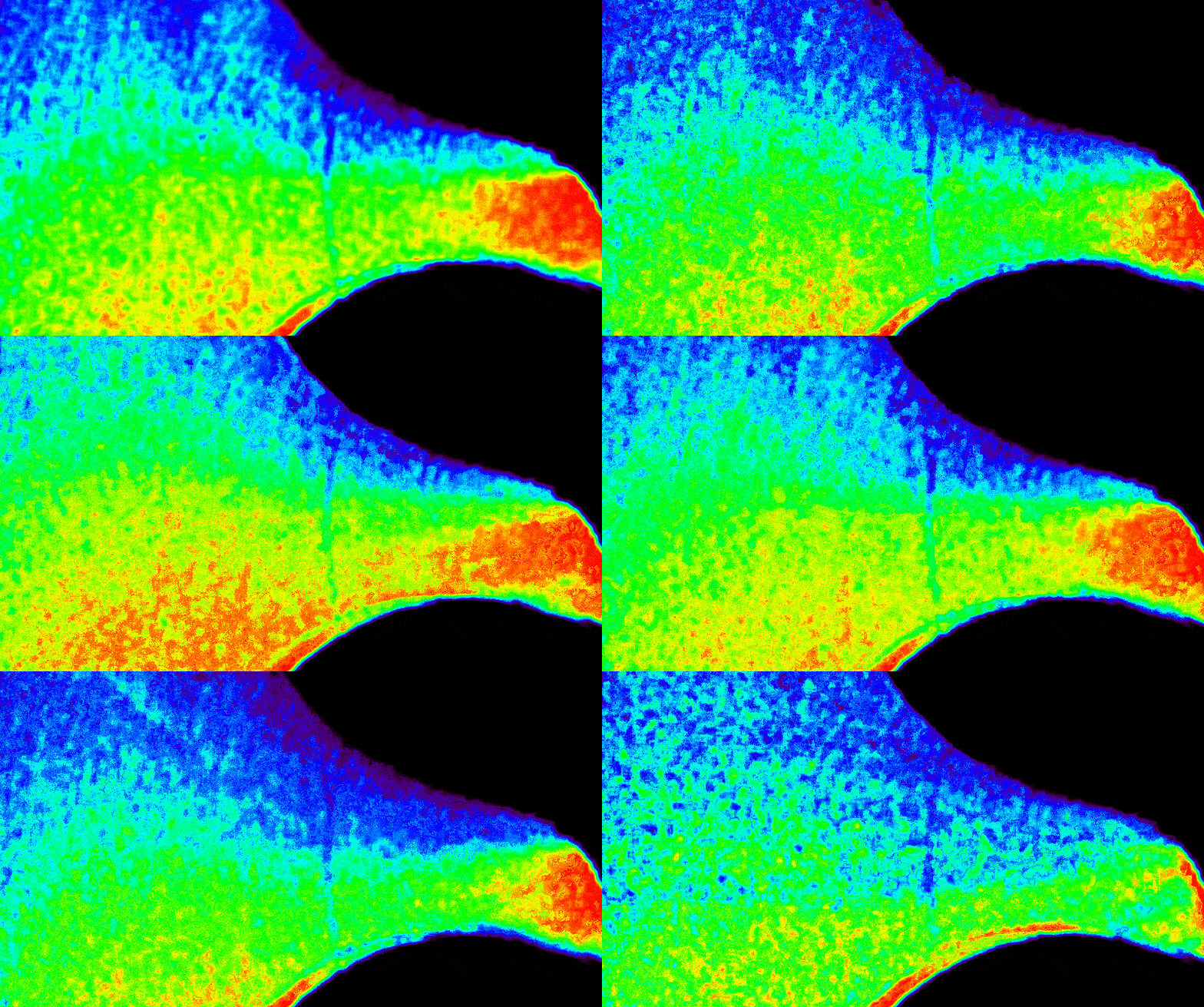
The first photos from CODEX were released on June 10 at the 246th meeting of the American Astronomical Society in Anchorage, Alaska. They include footage of temperature fluctuations in the outer corona, captured over the span of several days, and a photo of giant "coronal streamers" shooting out of the sun.
"The CODEX instrument is doing something new," Jeffrey Newmark, a heliophysicist at NASA's Goddard Space Flight Center in Maryland and the principal investigator for CODEX, said in a statement. "These are brand new observations that have never been seen before, and we think there's a lot of really interesting science to be done with it."
The first full coronagraph image shows "coronal streamers" shooting through the corona. Researchers want to know how events like these influence the sun's outer atmosphere.
(Image credit: NASA/KASI/INAF/CODEX)
The main goal of the new telescope is to discover how the superhot particles constantly streaming out of the sun, known as the solar wind, interact with the sun's outer atmosphere. "Previous coronagraph experiments have measured the density of material in the corona, but CODEX is measuring the temperature and speed of material in the slowly varying solar wind flowing out from the Sun," Newmark said.
Sign up for the Live Science daily newsletter now
Get the world’s most fascinating discoveries delivered straight to your inbox.
Mission scientists also want to understand how solar wind gets heated to such high temperatures — up to 1.8 million degrees Fahrenheit (1 million degrees Celsius), which is around 175 times hotter than the sun's surface, according to Space.com.
To do this, the telescope measures the sun using four narrow-band filters, two for temperature and two for speed. "By comparing the brightness of the images in each of these filters, we can tell the temperature and speed of the coronal solar wind," Newmark said.
CODEX will be able to study the corona in varying levels of detail.
(Image credit: NASA/KASI/INAF/CODEX)
In the last few weeks, Earth has experienced two significant geomagnetic storms, which were both triggered by coronal holes: First, on June 13, when a sizeable storm triggered auroras in up to 18 U.S. states; and more recently on June 25, when a slightly weaker disturbance briefly lit up the night skies.
This flurry of activity is the result of solar maximum, the most active phase of the sun's roughly 11-year sunspot cycle. This chaotic peak is now likely coming to an end, meaning less explosive outbursts in the future. However, some experts believe that solar wind could remain unpredictable for several years as the sun's localized magnetic fields vie for dominance in a period dubbed the "solar battle zone." Therefore, the CODEX instrument has likely switched on at the optimal time.
"We really never had the ability to do this kind of science before," Newmark said. "We're excited for what's to come."
Harry is a U.K.-based senior staff writer at Live Science. He studied marine biology at the University of Exeter before training to become a journalist. He covers a wide range of topics including space exploration, planetary science, space weather, climate change, animal behavior and paleontology. His recent work on the solar maximum won "best space submission" at the 2024 Aerospace Media Awards and was shortlisted in the "top scoop" category at the NCTJ Awards for Excellence in 2023. He also writes Live Science's weekly Earth from space series.
You must confirm your public display name before commenting
Please logout and then login again, you will then be prompted to enter your display name.