Get the world’s most fascinating discoveries delivered straight to your inbox.
You are now subscribed
Your newsletter sign-up was successful
Want to add more newsletters?
Join the club
Get full access to premium articles, exclusive features and a growing list of member rewards.
An account already exists for this email address, please log in.
Parker Solar Probe captures closest-ever photos of the sun during record-breaking flight
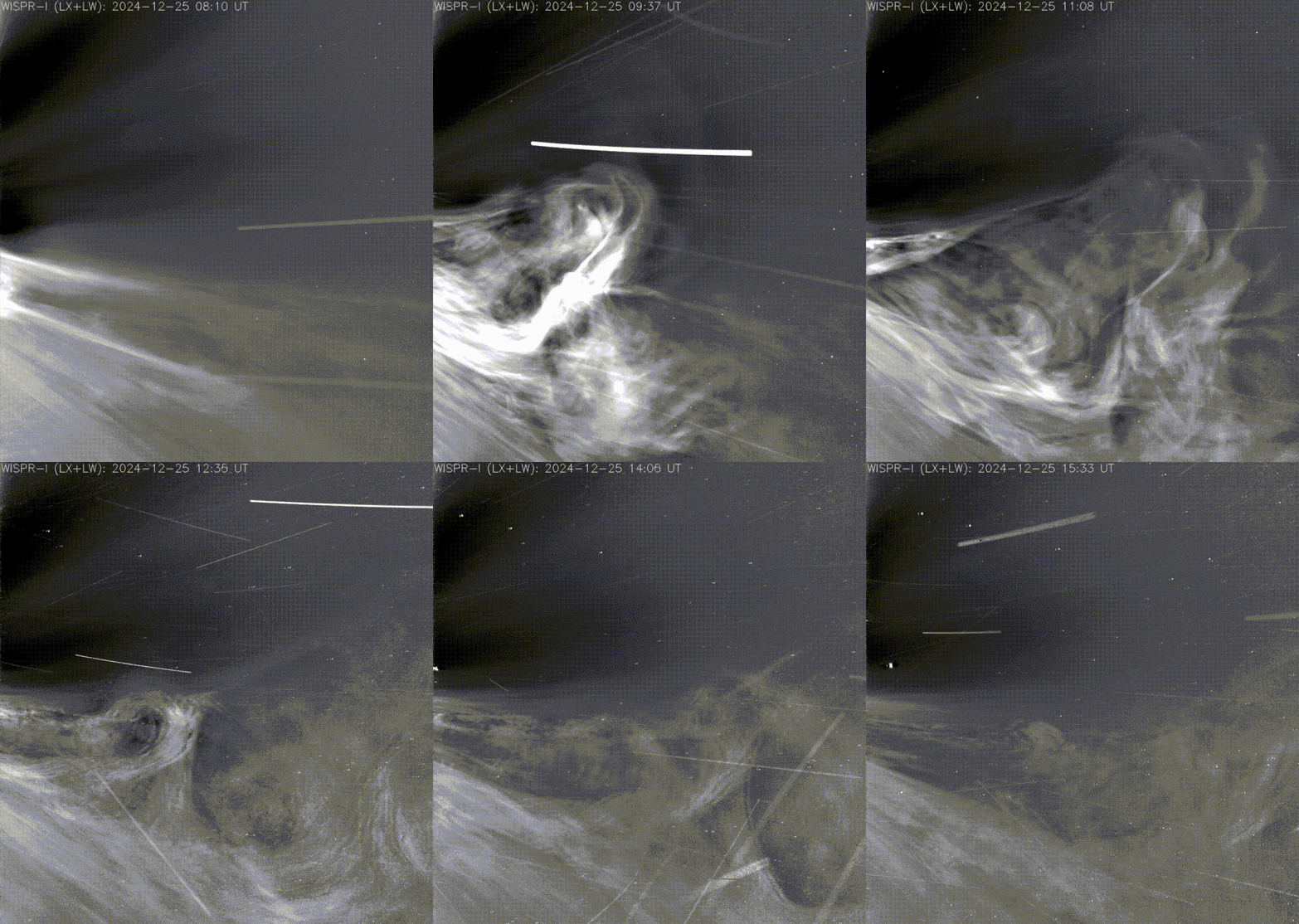
During a record-smashing flight through the sun’s corona in Dec. 2024, NASA’s Parker Solar Probe captured the closest-ever images of our home star. Now, NASA has finally revealed what the daredevil probe saw.
Three stills from the Parker Solar Probe’s groundbreaking footage of the corona reveal the formation of coronal mass ejections (yellow) — enormous balls of plasma flung off of the sun and into the solar system.
(Image credit: NASA/Johns Hopkins APL/Naval Research Lab)
NASA has released the closest-ever photos of the sun, taken by the Parker Solar Probe at just 3.8 million miles (6.1 million kilometers) from the star's surface. The new images reveal important features in the solar wind that will help scientists understand the origins of this mysterious space weather phenomenon and its effects on life on Earth.
The solar wind is the constant stream of charged particles — mainly protons and electrons — released by the sun's outer atmosphere, known as the corona. This torrent of matter speeds through the solar system at more than a million miles an hour, combining with magnetic fields and material jettisoned from the sun to create auroras, strip planetary atmospheres, and generate electric currents that can interfere with power networks on Earth. Understanding and predicting this space weather is vital to protecting astronauts and spacecrafts, and minimizing the disruptions to infrastructure sometimes caused by strong solar activity.
Launched in 2018, the Parker Solar Probe is the first spacecraft to have entered the sun's corona. Equipped with an array of scientific instrumentation including the Wide Field Imager for Solar Probe (WISPR) and Solar Wind Electrons Alphas and Protons (SWEAP), the unmanned ship braves blistering heat and fierce radiation to provide researchers on Earth with detailed data about the sun and its close surroundings.
In its record-breaking flybyof the sun on December 24th last year, the Parker Solar Probe captured images showing how this wind behaves shortly after leaving the corona and, crucially, recorded collisions between unpredictable bubbles of plasma and magnetic fields called coronal mass ejections (CMEs).
"In these images, we're seeing the CMEs basically piling up on top of one another," said Angelos Vourlidas, the WISPR instrument scientist at the Johns Hopkins Applied Physics Laboratory in apress release. "We're using this to figure out how the CMEs merge together, which can be important for space weather."
There are two types of solar wind: fast solar wind travels at up to 800 kilometres per second, creating a relatively uniform torrent of matter. Meanwhile slow solar wind is denser and more unpredictable, blowing in gusts rather than a constant stream.
Get the world’s most fascinating discoveries delivered straight to your inbox.
Around Earth we tend to experience solar winds as more of a consistent breeze. But earlier data from the Parker Solar Probe revealed that these gusts ramp up in intensity closer to the sun, with additional turbulence in the form of zigzagging magnetic fields called switchbacks at distances of 14.7 million miles (23.6 million km) from the surface. These switchbacks are thought to originate from magnetic funnels created by visible patches on the sun's exterior and, in 2024, scientists declared the fast solar wind is partially powered by this phenomenon.
However, the slow solar wind — its denser and more variable sibling — has remained more of a mystery.
Parker Solar Probe's view of solar wind gushing out of the corona
(Image credit: NASA/Johns Hopkins APL/Naval Research Lab)
"The big unknown has been: how is the solar wind generated, and how does it manage to escape the Sun's immense gravitational pull?" Nour Rawafi, the project scientist for Parker Solar Probe at the Johns Hopkins Applied Physics Laboratory, said in a statement. "Understanding this continuous flow of particles, particularly the slow solar wind, is a major challenge, especially given the diversity in the properties of these streams — but with Parker Solar Probe, we're closer than ever to uncovering their origins and how they evolve."
Previous observations had suggested there were potentially two types of slow solar wind — Alfvénic, which has small magnetic switchbacks, and non-Alfvénic, which doesn't. In its latest pass, the Parker Solar Probe was finally able to confirm this long-held hypothesis. Furthermore, the new detailed pictures are helping scientists to understand the origin of each of these distinct phenomena — the Alfvénic wind possibly comes from coronal holes on cooler regions of the corona while non-Alfvénic winds could be released from hot magnetic loops called helmet streamers. "We don't have a final consensus yet, but we have a whole lot of new intriguing data," said Adam Szabo, Parker Solar Probe mission scientist at NASA's Goddard Space Flight Center in Greenbelt, Maryland in the statement.
The probe will continue to collect data as it orbits the sun and is expected to next pass its perihelion — the closest point to the sun's surface — on the 15th of September.
Victoria Atkinson is a freelance science journalist, specializing in chemistry and its interface with the natural and human-made worlds. Currently based in York (UK), she formerly worked as a science content developer at the University of Oxford, and later as a member of the Chemistry World editorial team. Since becoming a freelancer, Victoria has expanded her focus to explore topics from across the sciences and has also worked with Chemistry Review, Neon Squid Publishing and the Open University, amongst others. She has a DPhil in organic chemistry from the University of Oxford.
You must confirm your public display name before commenting
Please logout and then login again, you will then be prompted to enter your display name.