













Scientists uncover the largest crater on Earth under 100,000 years old
The impact crater is the second discovered in China.

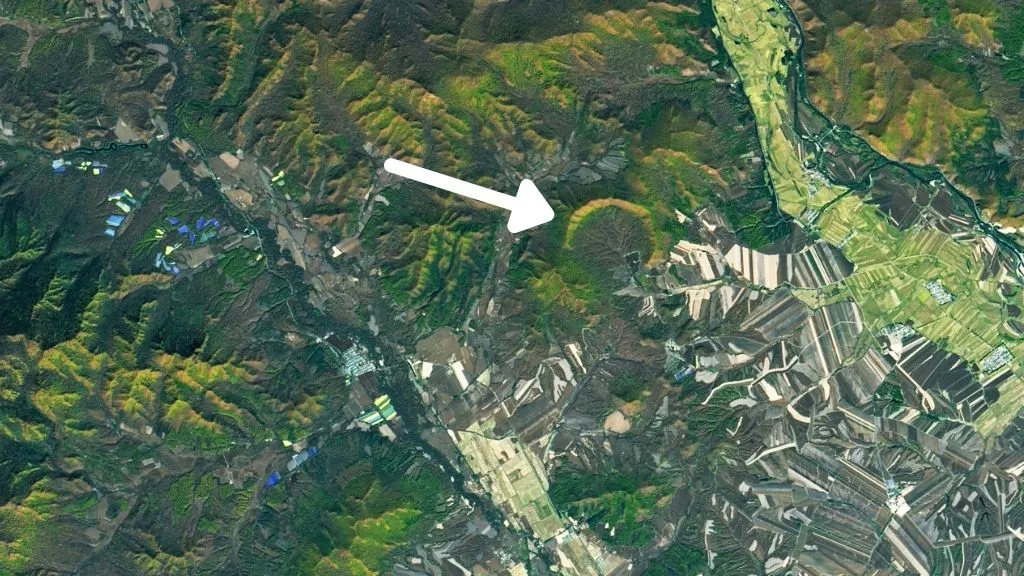
A crescent-shaped crater in Northeast China holds the record as the largest impact crater on Earth that formed in the last 100,000 years.
Prior to 2020, the only other impact crater ever discovered in China was found in Xiuyan county of the coastal province of Liaoning, according to a statement from the NASA Earth Observatory. Then, in July 2021, scientists confirmed that a geological structure in the Lesser Xing'an mountain range had formed as a result of a space rock striking Earth. The team published a description of the newfound impact crater that month in the journal Meteoritics and Planetary Science.
The Yilan crater measures about 1.15 miles (1.85 kilometers) across and likely formed about 46,000 to 53,000 years ago, based on radiocarbon dating of charcoal and organic lake sediments from the site, the NASA statement says. Researchers collected these sediment samples by extracting a drillcore from the center of the crater, Forbes reported.
Related: Crash! 10 biggest impact craters on Earth
Beneath more than 328 feet (100 meters) of layered lake and swamp sediments lay a nearly 1,000-foot-thick (320 m) slab of brecciated granite, which is granite made up of many rocky fragments cemented together in a matrix, the team found. This rock bears telltale scars of having been struck by a meteorite.
For example, fragments of the rock show signs of having melted and recrystallized during the impact, as the granite rapidly heated and then cooled off. Other fragments of the rock escaped this melting process, and instead contain "shocked" quartz that shattered in a distinct pattern when the space rock crashed down, according to Forbes.
The team also uncovered teardrop-shaped glass fragments and pieces of glass pierced with tiny holes made by gas bubbles; both of these features also indicate that a high-intensity impact took place there, according to the NASA statement.
Get the world’s most fascinating discoveries delivered straight to your inbox.
RELATED CONTENT
A portion of the Yilan crater's southern rim is missing, so the geological structure looks crescent-shaped from above, the Global Times reported. Such crescent-shaped impact craters are relatively rare on Earth, Chen Ming, one of the authors of the article and a research fellow from the Guangzhou Institute of Geochemistry, told the Global Times. In October 2021, the Landsat-8 satellite captured a striking snapshot of the crater's northern rim, and scientists are now investigating how and when the southern rim disappeared, according to the NASA statement.
The so-called Meteor Crater in Arizona previously held the record for largest impact crater less than 100,000 years old; it's about 49,000 to 50,000 years old and measures 0.75 miles (1.2 km) in diameter. The Xiuyan crater, by comparison, measures 1.1 miles (1.8 km) across, but its age is unknown, Forbes reported.
Originally published on Live Science.

Nicoletta Lanese is the health channel editor at Live Science and was previously a news editor and staff writer at the site. She is a recipient of the 2026 AHCJ International Health Study Fellowship, with a project focused on antibiotic stewardship practices in Japan and the U.S. They hold a graduate certificate in science communication from UC Santa Cruz and degrees in neuroscience and dance from the University of Florida. Beyond Live Science, Lanese's work has appeared in The Scientist, Science News, the Mercury News, Mongabay and Stanford Medicine Magazine, among other outlets. Based in NYC, she also remains involved in dance and performs in local choreographers' work.