Get the world’s most fascinating discoveries delivered straight to your inbox.
You are now subscribed
Your newsletter sign-up was successful
Want to add more newsletters?
Join the club
Get full access to premium articles, exclusive features and a growing list of member rewards.
An account already exists for this email address, please log in.
One of America's biggest meteor craters is 100 million years younger than we thought — and coincided with a global extinction event
Analysis of tiny zircon crystals buried within the 10-mile-wide Ames crater in northwest Oklahoma suggests that the submerged structure dates back to 370 million years ago, during the Frasnian-Famennian mass extinction event.
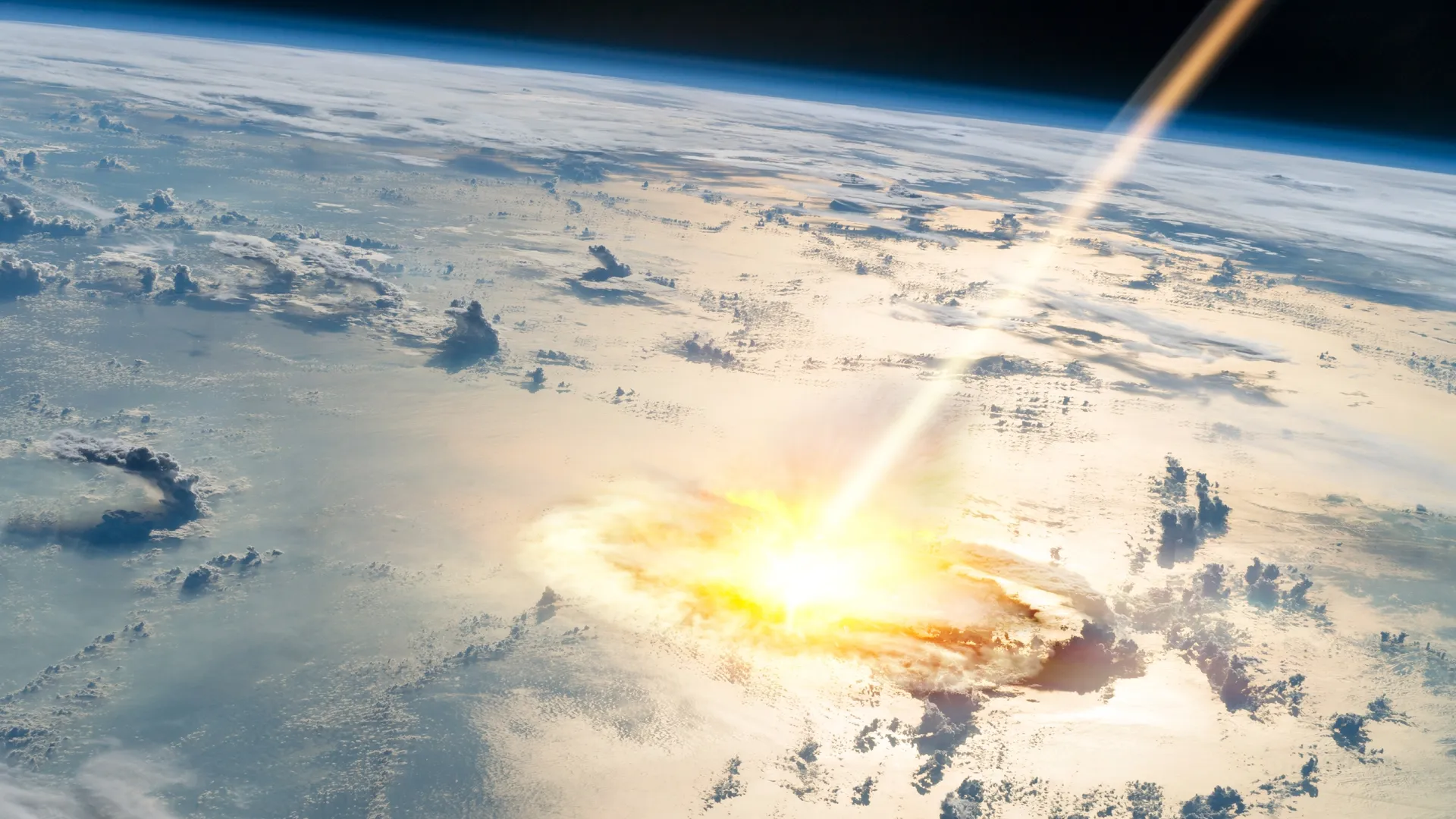
The Ames crater was created when an Eiffel Tower-sized space rock, traveling at more than 70,000 mph, slammed into a shallow sea covering modern-day Oklahoma. Seafloor sediments filled the resulting depression, so there is no visible sign of the crater at the surface today.
One of America's largest meteor craters is around 100 million years younger than scientists thought, which means the ancient impact coincided with — and potentially contributed to — one of the biggest global extinction events in Earth's history, according to a new study.
The underground impact structure, known as Ames crater, is located in northern Oklahoma and is named after a small town that sits above the submerged crater. At around 10 miles (16 kilometers) wide, it is the fourth-largest impact structure in the U.S.
Ames crater was created when an Eiffel Tower-size space rock slammed into our planet at more than 70,000 mph (110,000 km/h). At the time, the region was covered in a shallow ocean, and the crater was subsequently buried beneath layers of seafloor sediment. Therefore, there are no visible signs of the crater at the surface today. It was only discovered in 1991, when oil prospectors accidentally drilled into it.
Until now, researchers thought Ames crater dated to the Ordovician meteor event around 467 million years ago. During this period, an unusually high number of large space rocks smashed into Earth, likely due to the fragmentation of a single parent body somewhere in space. Scientists found fossils of marine animals in and around the crater that date to around the time of that event.
But in the new study, published July 7 in the journal Meteoritics and Planetary Science, researchers analyzed fracture patterns within tiny rocky fragments known as zircon crystals that were embedded in the underground crater. This revealed that the impact actually occurred 370 million years ago, around 97 million years after the Ordovician meteor event.
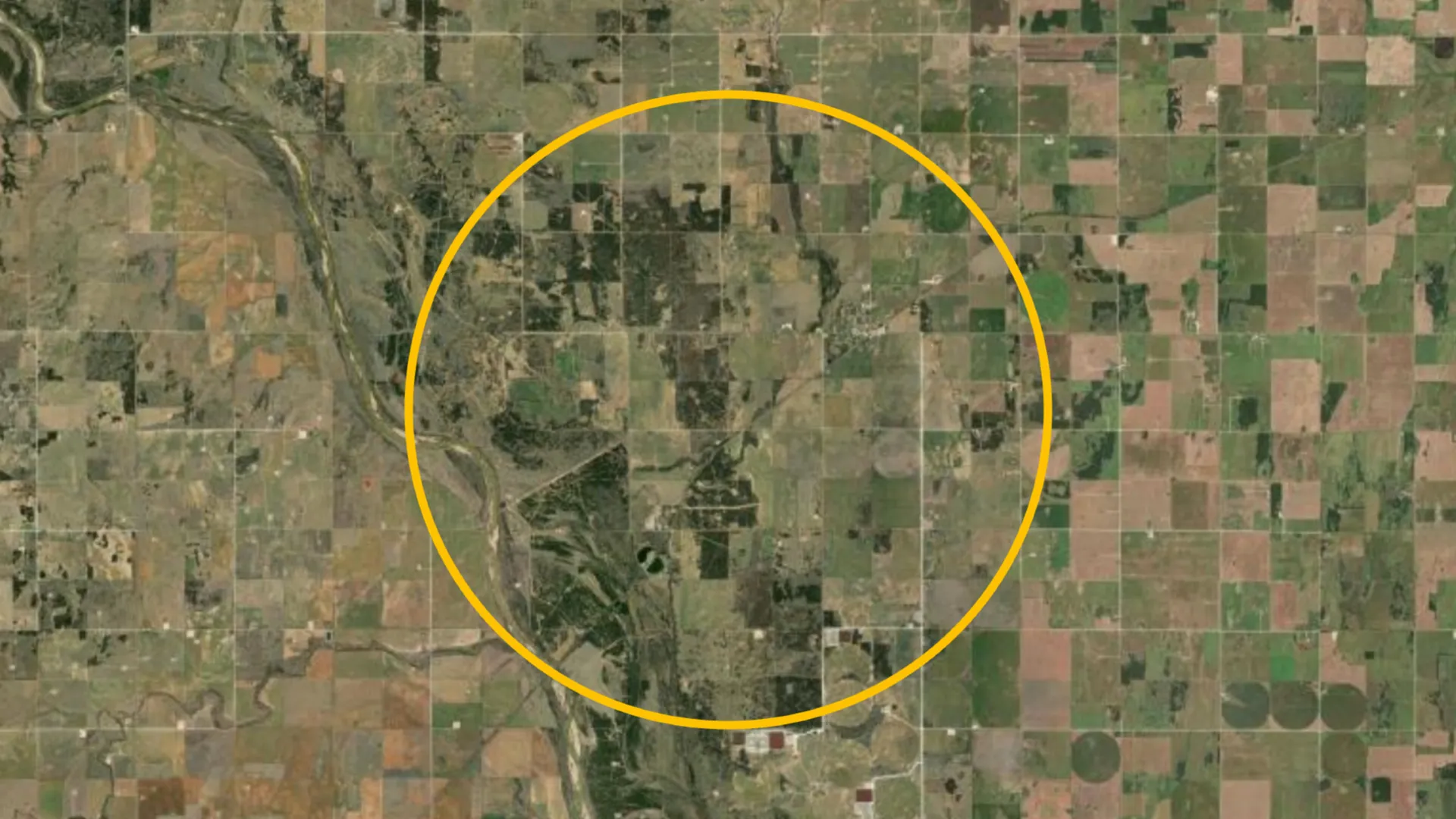
There are no visible signs of the Ames crater today. However, scientists have been able to map out its size and shape using ground-penetrating radar. This circle represents the rough outline of the the submerged structure.
(Image credit: EarthExplorer/USGS/Landsat with annotations Harry Baker)
"No matter what technique we used, it was coming back to this younger signal," study first author Elizabeth Catlos, a geologist and planetary scientist at the University of Texas at Austin, said in a statement.
Reading crystals
Zircon crystals are tiny pieces of a superdurable mineral known as zirconium silicate. These crystals are scattered throughout most of Earth's rock formations, including most of the oldest known rocks on our planet. The near-industructible crystals are extremely useful to geologists because their internal structure preserves evidence of being exposed to extreme conditions, such as high temperatures and intense pressures.
Sign up for the Live Science daily newsletter now
Get the world’s most fascinating discoveries delivered straight to your inbox.
Analyzing zircon crystals is now one of the primary methods of dating ancient meteor craters, and the technique has led to several other impact dates being revised. For example, in July, researchers in Australia revealed that the North Pole Dome crater was around 500 million years younger than initial studies predicted, and in 2025, experts found that the impact that birthed Scotland's Stac Fada Member structure happened around 200 million years later than earlier research estimated.
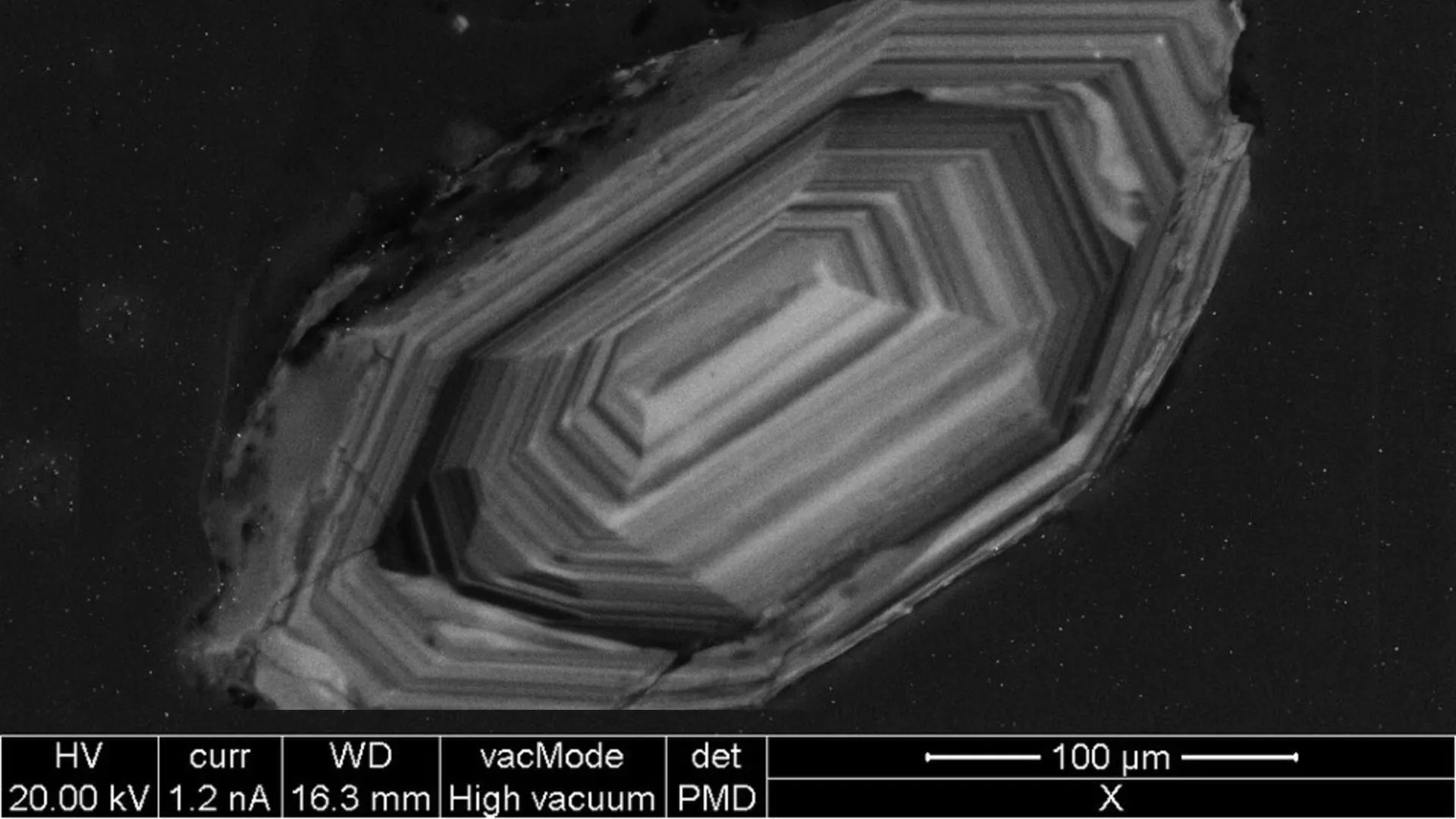
The internal structure of zircon crystals preserves evidence of being exposed to extreme conditions, such as high temperature and pressure, making them ideal for exploring ancient impacts. This photo, captured during a completely unrelated study, shows one such crystal under an electron microscope.
(Image credit: Emmanuel Roquette via Wikimedia)
"These small crystals allow us to go back in time and learn about the major changes to Earth's ancient landscapes," study co-author Danny Stockli, a geologist and dean of the Jackson School of Geosciences at the University of Texas at Austin, said in the statement. "It would be great to do this for more of the meteor impact sites across the continent so we could get a more accurate timeline for these major events."
"This is where the impact belongs"
The crater's new age takes it firmly out of the Ordovician meteor event and places it into the Frasnian-Famennian mass extinction event, also known as the Kellwasser event or the Late Devonian mass extinction.
During the Frasnian-Famennian event, which began around 372 million years ago and lasted for several million years, as much as half of all marine life went extinct as Earth's oceans were depleted of oxygen. The die-off, which was most likely triggered by global cooling due to increased levels of volcanic activity, is often cited as one of the five major extinction events in Earth's history.
The researchers emphasized that the Ames impact was not the cause of the Frasnian-Famennian event. However, they noted that the fallout from the impact, which would have injected huge clouds of dust into the air, may have contributed to the atmospheric cooling effect in the region.
It is an important reminder that the ability to accurately date specific events like this can inform our understanding of wider global patterns and trends, the researchers wrote.
"With this research, we're basically taking a major pawn out of the Ordovician Meteor Event and dumping it into the Frasnian-Famennian event, and saying, 'This is where this impact belongs,'" Catlos said.
The new study was dedicated to co-authors Andrew Parisi and Michael Brookfield, who sadly died before it was published.
Article Sources
Catlos, E. J., Parisi, A. F., Brookfield, M. E., Erickson, T., Gulick, S. P., Schmitt, A. K., Stockli, D. F., Miggins, D. P., Ruchte, B., & Cloos, M. (2026). The Ames impact structure, Oklahoma: New radioisotopic constraints and implications for North American impact chronology. Meteoritics and Planetary Science, 61(8), 2103–2139. https://doi.org/10.1111/maps.70191
Harry is a U.K.-based senior staff writer at Live Science. He studied marine biology at the University of Exeter before training to become a journalist. He covers a wide range of topics including space exploration, planetary science, space weather, climate change, animal behavior and paleontology. His recent work on the solar maximum won "best space submission" at the 2024 Aerospace Media Awards and was shortlisted in the "top scoop" category at the NCTJ Awards for Excellence in 2023. He also writes Live Science's weekly Earth from space series.
You must confirm your public display name before commenting
Please logout and then login again, you will then be prompted to enter your display name.