














Why are there so many marsupials in Australia?
Australia is home to hundreds of marsupials, including koalas, kangaroos and wombats. But how did these marsupials get to Australia?

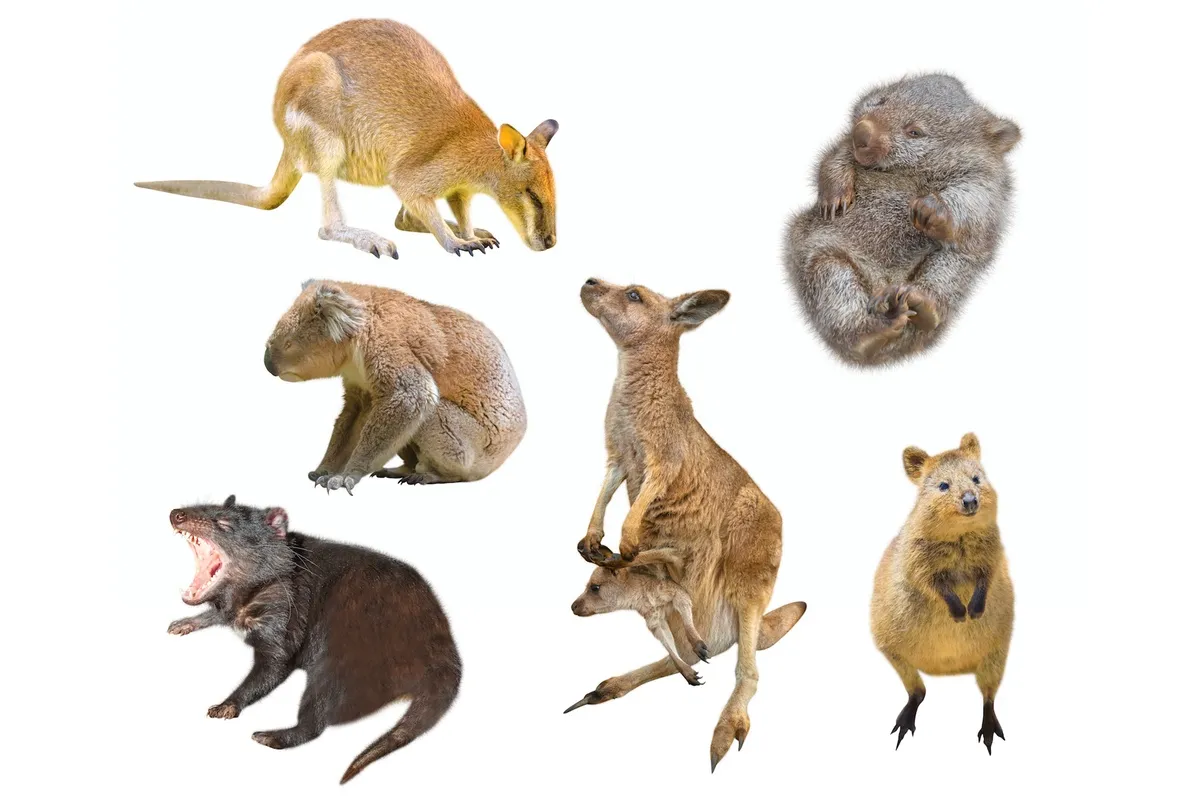
Australia is the kingdom of marsupials, home to furry kangaroos, koalas and wombats. The continent has so many marsupials, it raises a question: Did these pouch-bearing mammals arise Down Under?
The answer is an unqualified (or "un-koalafied") no. Marsupials were around for at least 70 million years before they made it to Australia, according to Robin Beck, a professor of evolutionary biology at the University of Salford in the United Kingdom.
"Marsupials absolutely, categorically did not originate in Australia," Beck told Live Science. "They are immigrants."
Unlike placental mammals — such as humans, dogs and whales — marsupials give birth to relatively underdeveloped young that continue to grow substantially in the mother's pouch.
"The young are born alive, but they're very poorly developed," Beck told Live Science. "They basically crawl to their mother's nipple, which is often in a pouch, and they basically clamp on the nipple and stay there, feeding on their mother's milk for long periods of time — usually, several months."
Marsupial homeland
The oldest known fossils of marsupial relatives are actually from China, dating to around 120 million years ago, during the Early Cretaceous. This shows that the split between marsupials and placental mammals must have occurred before this date, most likely somewhere in the Northern Hemisphere, Beck said.
These ancient marsupial relatives appeared to flourish in what was then the northern supercontinent Laurasia, which included what is now North America, Europe and Asia. More than 70 of these species have been discovered to date, all of which are now extinct, Beck said.
Feed your curiosity with an exclusive mystery every week, solved with science and delivered direct to your inbox before it's seen anywhere else.
It's unclear why these marsupials did well. But about 66 million years ago — around the time the nonavian dinosaurs went extinct — marsupials made their way down to South America. At that time, North and South America weren't connected as they are today. But the two continents were very close, and a land bridge or a series of islands may have linked them. This connection allowed all kinds of animals to expand their stomping grounds.
Once in South America, marsupials and their close relatives had a field day, diversifying like crazy within 2 million to 3 million years after arriving, Beck said. For instance, marsupials and their close relatives evolved into bear- and weasel-size carnivores, and several even evolved saber teeth. Others evolved to eat fruits and seeds.

The marsupial relative Thylacosmilus had saber teeth.
"What's happening in South America is they're evolving to fill the kinds of niches that in the northern continents certainly were filled by placental mammals," Beck said.
Many of these marsupials went extinct between then and now, but South America is still a marsupial hotspot today. There are more than 100 species of opossum, seven species of shrew opossum and the adorable monito del monte (Dromiciops gliroides), whose Spanish name translates to "little monkey of the mountain."
Within the past million years, one South American opossum species traveled north and now lives in North America. This species, the Virginia opossum (Didelphis virginiana), is the only marsupial that lives north of Mexico today, Beck said.
Also, opossums belong to a different order than possums. Possums are native to Australia and New Guinea, are closely related to kangaroos, and have a number of anatomical differences, such as enlarged lower incisors, that the South American opossum lacks, Beck said.
So, how did marsupials get from South America to Australia?
Journey Down Under
Until about 40 million to 35 million years ago, both South America and Australia were connected to Antarctica, forming one giant landmass. At that time, Antarctica wasn't covered with ice; it was a temperate rainforest and "not a bad place to live," Beck said.
It appears that marsupials and their relatives bounded down from South America, strode across Antarctica and wound up in Australia, Beck said. There's even fossil evidence: On Antarctica's Seymour Island, there are fossils of marsupials and their relatives, including a close relative of the monito del monte, Beck said.
The oldest fossil marsupials from Australia are found at a 55 million-year-old site called Tingamarra, near the town of Murgon in Queensland, Beck said. Some of the fossil marsupials at Tingamarra are similar to those in South America. For instance, Chulpasia — an extinct genus of tiny, fruit-eating marsupials from Peru — is a close relative of another fossil marsupial found at Tingamarra, Beck said.
Yet another Tingamarra marsupial, the insect-eating Djarthia, may be the ancestor of all living Australian marsupials, or close to it, Beck said.

An illustration of the early Australian marsupial, Djarthia (lower right), which lived about 55 million years ago.
Then, there's a big gap in the Australian fossil record. After the Tingamarra marsupials, the next-oldest marsupial fossils on record are 25 million years old. "What we see then is clearly there's been a huge amount of diversification within Australia," Beck said. "By that time, we see koalas, we see relatives of wombats, we see relatives of bandicoots." Basically, all of the major Australian marsupial groups are present by 25 million years ago, he said.
Again, it's unclear why marsupials thrived in Australia. But one idea is that when times were tough, marsupial mothers could jettison any developing babies they had in their pouches, while placental mammals had to wait until gestation was over, spending precious resources on their young, Beck said.
Another idea is that there were no placental mammals competing with the marsupials in Australia. But this idea is now contradicted by a fossil tooth that belongs to a placental mammal or placental-mammal relative discovered at Tingamarra. This finding indicates that placental mammals were on the continent as far back as 55 million years ago, Beck said.
Today, there are 269 marsupial species alive in Australia, 141 marsupial species in Central and South America and just one (the Virginia opossum) in North America, according to the Mammal Diversity Database. In essence, the marsupials' ancestral geography has flipped.
"Where things are today is not necessarily an indication of where they were millions of years ago," Beck said.
Editor's note: This article was originally published on March 3, 2019, and it was updated on Oct. 20, 2026, to include a new study about the marsupial relative that was found in China.

Laura is the managing editor at Live Science. She also runs the archaeology section and the Life's Little Mysteries series. Her work has appeared in The New York Times, Scholastic, Popular Science and Spectrum, a site on autism research. She has won multiple awards from the Society of Professional Journalists and the Washington Newspaper Publishers Association for her reporting at a weekly newspaper near Seattle. Laura holds a bachelor's degree in English literature and psychology from Washington University in St. Louis and a master's degree in science writing from NYU.
You must confirm your public display name before commenting
Please logout and then login again, you will then be prompted to enter your display name.