Live Science Plus


Marvel at This Glittering 'Galaxy' Inside a Fly's Testicles

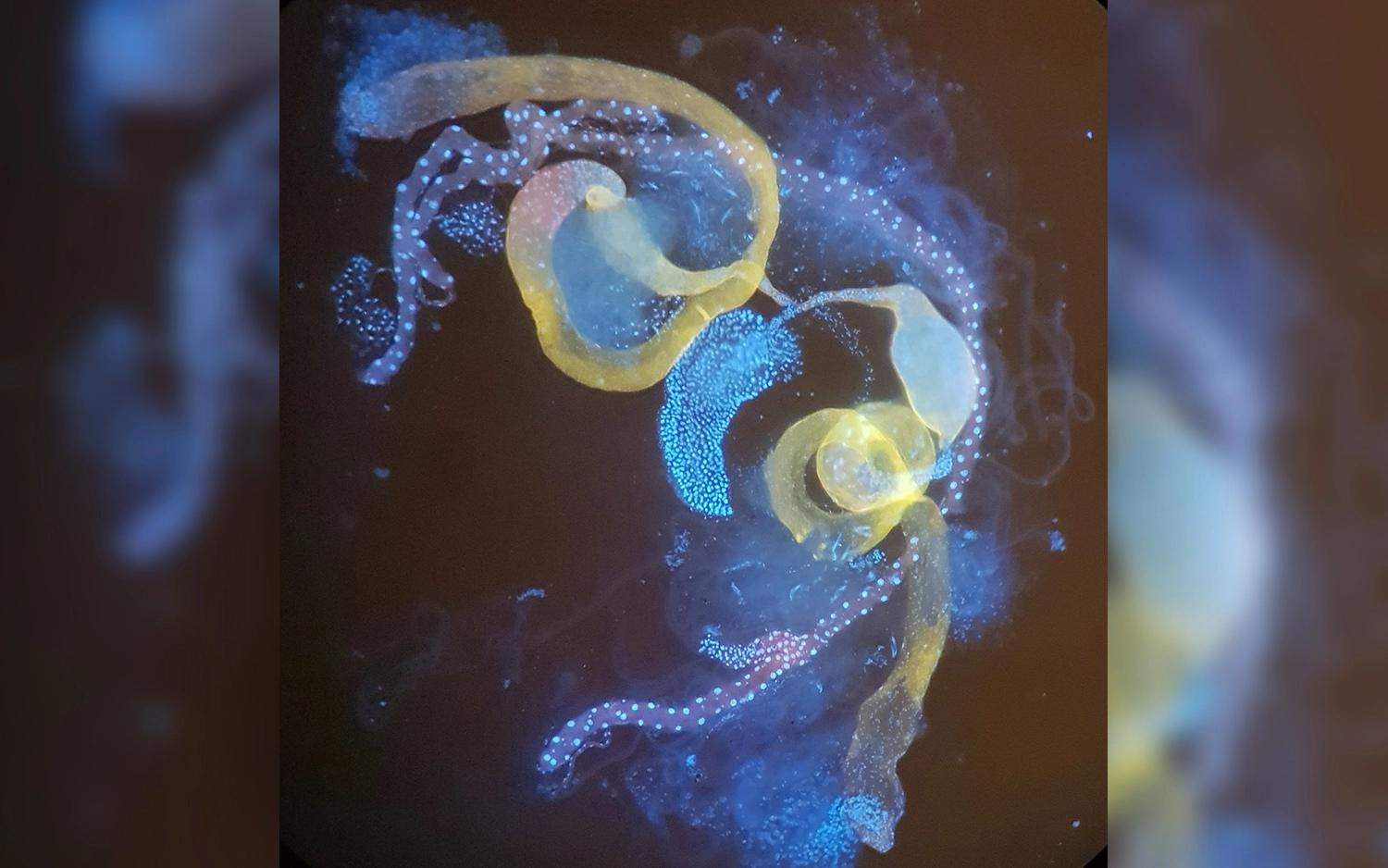
An out-of-this-world photo that was recently shared on Twitter resembles a galaxy of sparkling stars wrapped inside a colorful nebula.
But in reality, it's a fluorescent image of a male fruit fly's sex organs.
The image was captured by biologist Ben Walsh, a doctoral candidate in the Department of Evolution, Ecology and Behaviour at the University of Liverpool in the United Kingdom. He stained the testes of a dissected fruit fly with fluorescent dye to illuminate the organs' structures, which he then captured through a microscope using the camera on his iPhone, Walsh told Live Science in an email. [Magnificent Microphotography: 50 Tiny Wonders]

In the tweet, posted on Feb. 13, Walsh commented that the fruit fly testicles "kinda look like a galaxy." He later explained to Live Science that the yellow structures, which were "long and thin and coiled around themselves," were the testes' tissue wall.
"The blue clouds coming out of them at various points are sperm — in places, you can see bundles of sperm and even some individual heads," he said in the email.
When stretched out, each half of the testes measures over 0.08 inches (2 millimeters), "which is pretty much the whole length of the fly!" Walsh said. Fruit flies have the longest known sperm among all animals, but why they need such lengthy sperm is still a mystery, he added.
Walsh's research investigates how climate change affects fertility; he recently co-authored a study exploring the impacts of extreme temperatures on animal, plant and fungi reproduction, published Jan. 9 in the journal Trends in Ecology and Evolution.
His current work with fruit flies — which led to the image shared on Twitter — examines how temperature affects males' ability to produce viable sperm, a process known as spermatogenesis.
"By dissecting testes of the fruit fly Drosophila melanogaster and staining them with fluorescent dye, we can actually see bundles of sperm inside the testes, which allows us to count the number of sperm at different points of spermatogenesis," Walsh explained. This could reveal clues about what disrupts the flies' normal sperm production.
This isn't the first time the tiny organs and internal structures of a fruit fly have been revealed in illuminating images. Researchers recently developed a technique to capture images of fruit fly brains, creating stunning 3D images and animations that displayed the intricate interplay of neurons in a brain no bigger than a poppy seed, Live Science previously reported.
But even a single photo of fruit fly testes can generate wonder and astonishment, judging by the awed Twitter responses to Walsh's post. One bemused commenter took Walsh's joking galaxy analogy even further, writing, "What if our universe is contained in the left testicle of a fly in a greater dimension?"
To which Walsh tweeted in reply, "Then we're about to go places, because flies have a LOT of sex."
- Human Parasites Under the Microscope
- Award-Winning Microscope Images
- Tiny Life Revealed in Stunning Microscope Photos
Originally published on Live Science.