













Mount Vesuvius & Pompeii: Facts & History
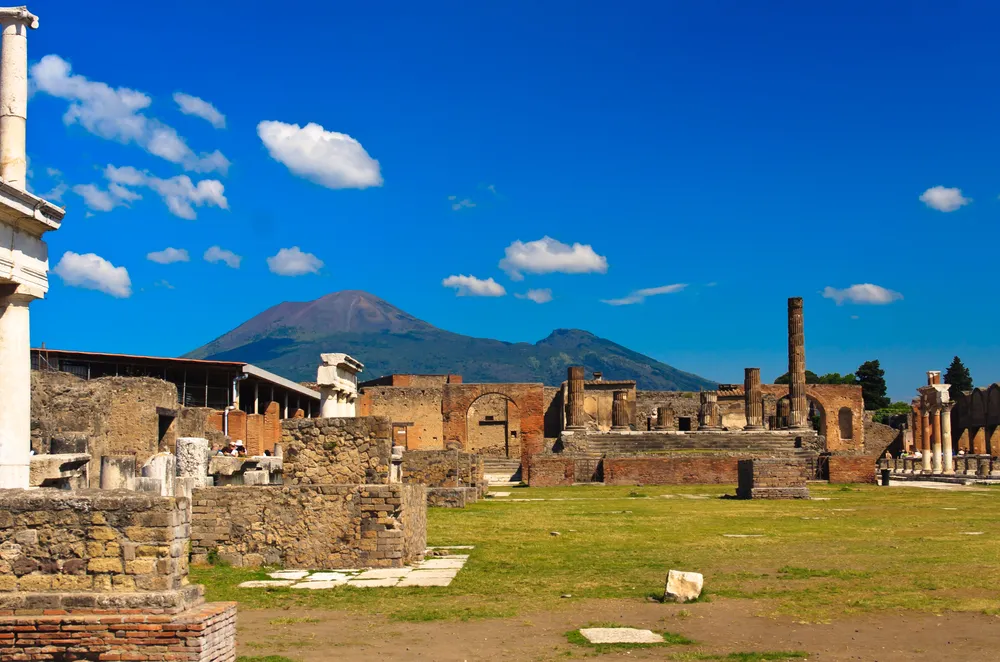
Mount Vesuvius, on the west coast of Italy, is the only active volcano on mainland Europe. It is best known because of the eruption in A.D. 79 that destroyed the cities of Pompeii and Herculaneum, but Vesuvius has erupted more than 50 times.
Mount Vesuvius facts
Vesuvius in 2013 was 4,203 feet (1,281 meters) tall. After each eruption, the size of the cone changes, according to Encyclopedia Britannica. The volcano also has a semicircular ridge called Mount Somma that rises to 3,714 feet (1,132 m). The valley between the cone and Mount Somma is called Valle del Gigante or Giant's Valley.
Mount Vesuvius is considered to be one of the most dangerous volcanoes in the world because of its proximity to the city of Naples and the surrounding towns on the nearby slopes.
The volcano is classed as a complex stratovolcano because its eruptions typically involve explosive eruptions as well as pyroclastic flows. A pyroclastic flow is a high-density mix of hot lava blocks, pumice, ash and volcanic gas, according to the U.S. Geological Survey. Vesuvius and other Italian volcanoes, such as Campi Flegrei and Stromboli, are part of the Campanian volcanic arc. The Campanian arc sits on a tectonic boundary where the African plate is being subducted beneath the Eurasian plate.
Under Vesuvius, scientists have detected a tear in the African plate. This "slab window" allows heat from the Earth's mantle layer to melt the rock of the African plate building up pressure that causes violent explosive eruptions. In the past, Mount Vesuvius has had a roughly 20-year eruption cycle, but the last serious eruption was in 1944.
Pompeii
Mount Vesuvius destroyed the city of Pompeii, a city south of Rome, in A.D. 79 in about 25 hours, according to History. Because the city was buried so quickly by volcanic ash, the site is a well-preserved snapshot of life in a Roman city. There is also a detailed account of the disaster recorded by Pliny the Younger, who interviewed survivors and recorded events in a letter to his friend Tacitus. [Related: Pompeii 'Wall Posts' Reveal Ancient Social Networks]

Pompeii was established in 600 B.C. and was slowly recovering from a major earthquake that rocked the city in February of A.D. 62. The shallow quake, originating beneath Mount Vesuvius, had caused major damage to the springs and piping that provided the city's water. Reconstruction was being carried out on several temples and public buildings. Seneca, a historian, recorded that the quakes lasted for several days and also heavily damaged the town of Herculaneum and did minor damage to the city of Naples before subsiding. The major quake was followed by several minor shakes throughout the following years. [Image Gallery: Pompeii's Toilets]
Get the world’s most fascinating discoveries delivered straight to your inbox.
Because seismic activity was so common in the area, citizens paid little attention in early August of 79 when several quakes shook the earth beneath Herculaneum and Pompeii. People were unprepared for the explosion that took place shortly after noon on the 24th of August. Around 2,000 residents survived the first blast.

Pliny the Elder, a Roman author, described the massive debris cloud. "It resembled a (Mediterranean) pine more than any other tree. Like a very high tree the cloud went high and expanded in different branches … sometimes white, sometimes dark and stained by the sustained sand and ashes." In Pompeii, ash blocked the sun by 1 p.m. and the people tried to clear heavy ash from rooftops as it fell at a rate of about 6 inches (15 centimeters) an hour. [Image Gallery: Preserved Pompeii — Photos Reveal City in Ash]
Shortly after midnight, a wall of volcanic mud engulfed the town of Herculaneum, obliterating the town as its citizens fled toward Pompeii. About 6:30 a.m. on the following morning, a glowing cloud of volcanic gases and debris rolled down Vesuvius' slopes and enveloped the city of Pompeii. Most victims died instantly as the superheated air burned their lungs and contracted their muscles, leaving the bodies in a semi-curled position to be quickly buried in ash and thus preserved in detail for hundreds of years.
Far away in Misenum, approximately 13 miles (21 kilometers) from Pompeii, Pliny the Younger, the 18-year-old nephew of Pliny the Elder, and his mother joined other refugees escaping the earthquakes rocking their city. They observed, "the sea retreating as if pushed by the earthquakes." This was probably caused by a tsunami at the climax of the eruption, which gives us the time frame for historical record. Pliny writes of "black and horrible clouds, broken by sinuous shapes of flaming wind." He describes people wheezing and gasping because of that wind; the same wind that doomed the people of Pompeii.
It is believed that around 30,000 people died from the eruption of Vesuvius in 79.
WWII eruption
On March 17, 1944, a two-week-long eruption began with lava from the summit of Mount Vesuvius. In an article by Life Magazine, Giuseppe Imbo, director of the Mt. Vesuvius Observatory, is quoted as saying, "A marvelous thing, my Vesuvius. It covers land with precious ash that makes the earth fertile and grapes grow, and wine. That's why, after every eruption, people rebuild their homes on the slopes of the volcano. That is why they call the slopes of Vesuvius the compania felix — the happy land."
During the eruption, soldiers and airmen of the 340th Bomber Group were stationed at the Pompeii Airfield just a few miles from the base of the volcano. Diaries record the awesome sights and sounds they witnessed in this latest major eruption. Guards wore leather jackets and "steel pot" helmets to protect themselves from rains of hot ash and small rocks. Tents collapsed or caught fire when hot cinders were blown over them.
Sgt. Robert F. McRae wrote in his diary on March 20, 1944, according to the American Geosciences Institute, "As I sit in my tent … I can hear at four- to 10-second intervals the loud rumbling of the volcano on the third day of its present eruption. The noise is like that of bowling balls slapping into the pins on a giant bowling alley. To look above the mountain tonight, one would think that the world was on fire. The thickly clouded sky glows like that above a huge forest fire. Glowing brighter as new spouts of flame and lava are spewn from the crater. As the clouds pass from across the top of the mountain, the flame and lava can be seen shooting high into the sky to spill over the sides and run in red streams down the slopes. ... Today it is estimated that a path of molten lava 1 mile long, half a mile wide, and 8 feet deep is rolling down the mountain. Towns on the slopes are preparing to evacuate. Our location is, apparently, safe. At any rate no one here, civilian or Army authorities, seems too much worried. Lava has not started to flow down this side of the mountain as yet but is flowing on the other side toward Naples."
On March 22, they were forced to evacuate, leaving behind 88 Allied aircraft. After the volcano subsided, they returned on the 30th to find the planes were a total loss. Engines were clogged by ash, control panels were useless tangles of fused wire, canopies had holes from flying rock or were etched to opacity by wind driven ash.
One airman of the 489th Bomber Squadron complained in his diary when Axis Sally broadcast a radio show dedicated to the "survivors" of the Vesuvius eruption (actually the most severe human casualty was a wrist sprained during the evacuation). She told all of Europe that "Colonel Vesuvius" had destroyed all of them. The diarist was justifiably proud of the work he did with his fellows in recovery. By April 15, the planes had been replaced and the 340th Bomber Group was back to full strength and ready to fly missions from their new base.
Though no soldiers were killed, 26 Italian civilians died and nearly 12,000 were displaced by the 1944 eruption, according to the American Geosciences Institute.
Current status
Since 1944, there have been hundreds of minor earthquakes in the region around Mount Vesuvius. The most serious earthquake rocked Naples in October 1999. The magnitude-3.6 quake was felt as far as 15 miles (24 km) from the base of the volcano and was of the same magnitude as a quake that occurred 17 years prior to the last truly major explosion that devastated Naples in 1631.
In 2016, excavations on the outskirts of Pompeii revealed more victims of the volcanic eruption. Archaeologists discovered the remains of four people, including one teenage girl, in the ruins of a shop, according to a statement from the Soprintendenza Pompei, the Italian authority in charge of managing the ancient site.
Additional reporting by Alina Bradford, Live Science contributor
Additional resources
- BBC: Pompeii: Portents of Disaster
- Italy Magazine: Hiking Mount Vesuvius
- Smithsonian Magazine: Ancient Scrolls Blackened by Vesuvius Are Readable at Last