It's quick and easy to access Live Science Plus, simply enter your email below. We'll send you a confirmation and sign you up for our daily newsletter, keeping you up to date with the latest science news.
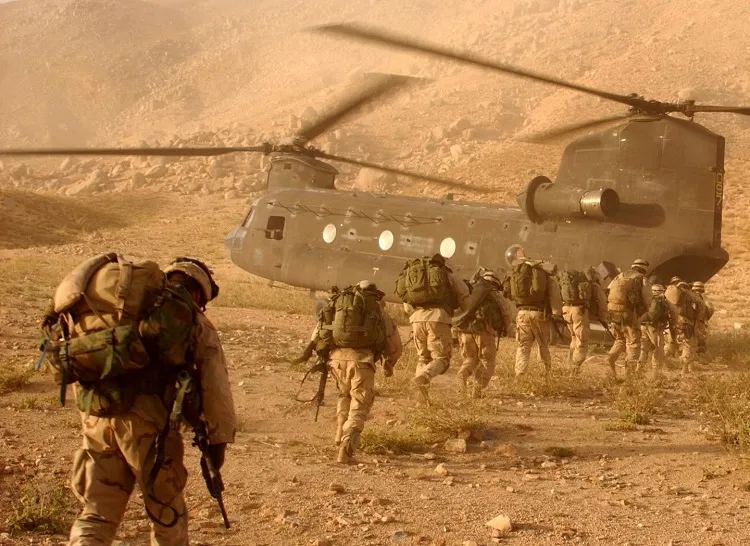
Twelve years ago, a U.S. military rescue mission in Afghanistan went horribly wrong. A Chinook helicopter carrying U.S. troops failed to receive a crucial radio message and was shot down over the snow-covered peak of Takur Ghar.
But the radio failure was not caused by malfunctioning equipment. Instead, a giant, 62-mile-long (100 kilometers) "plasma bubble" made up of clouds of electrically charged particles was responsible for the communication blackout, new research suggests.
Michael Kelly, a researcher at the Johns Hopkins University Applied Physics Lab (APL), in Laurel, Maryland, started to put the pieces together after reading a journalist's account of the Battle of Takur Ghar. He suspected the radio failure was caused by a little-known space weather effect caused by these mysterious plasma bubbles. [10 Surprising Ways Weather Has Changed History]
During daylight hours in the upper atmosphere, radiation beaming down from the sun rips electrons from their atoms. But once the sun sets, the electrons start recombining with their atoms. This recombination process happens faster in the lower atmosphere because there are heavier particles there, and electrons recombine faster with molecules than they do with single atoms. Since the plasma in this part of the atmosphere is less dense, it rises and burrows into the denser plasma above. This causes giant bubbles of charged particles to form, similar to the way air bubbles rise from a submerged diver.
Plasma bubbles made of clumps of charged particles form in the upper atmosphere and can scramble radio frequencies.
(Image credit: NASA)
The huge bubbles of charged particles are invisible, but they can bend and warp radio waves. In 2002, the Chinook helicopter was flying over Afghanistan in the spring, which is the height of plasma bubble activity, Kelly said.
Military officers based in Bagram, Afghanistan, issued a fateful radio warning to the helicopter crew to stay away from al-Qaeda forces on the mountaintop, but the message was scrambled and lost. The helicopter crash-landed, and seven individuals were killed.
To figure out what went wrong, in March 2002, Kelly and a team of researchers used data from a NASA satellite mission called TIMED, which launched in 2001 to study the composition of Earth's upper atmosphere.
Sign up for the Live Science daily newsletter now
Get the world’s most fascinating discoveries delivered straight to your inbox.
"The TIMED spacecraft flew over the battlefield at about the right time," Kelly said in a statement.
Joseph Comberiate, co-author of the study and a physicist at APL, developed a method to convert the 2D images from the NASA satellite into 3D models of the plasma bubbles. The model showed that on March 4, 2002, the day of the Battle of Takur Ghar, a plasma bubble loomed above the unlucky helicopter.
Still the bubble was probably not big enough to be solely responsible for the radio communication failure, according to the researchers' model. The mountainous terrain had likely already made the radio signals weak, and the presence of the plasma bubble could have interrupted this weakened signal, causing a complete radio blackout.
In the future, the researchers hope to use the new model to predict the formation and movement of plasma bubbles. The model uses data from satellites to find the bubbles and then uses a wind and atmospheric model to predict which way the bubbles will drift.
The researchers are now studying whether the U.S. military might be able to use this tool to predict when and where radio communication could be lost.
"The most exciting part for me is to see something go from science to real, potential operational impact," Comberiate said.
The study was published Sept. 12 in the journal Space Weather.
Kelly Dickerson is a staff writer for Live Science and Space.com. She regularly writes about physics, astronomy and environmental issues, as well as general science topics. Kelly is working on a Master of Arts degree at the City University of New York Graduate School of Journalism, and has a Bachelor of Science degree and Bachelor of Arts degree from Berry College. Kelly was a competitive swimmer for 13 years, and dabbles in skimboarding and long-distance running.

 Live Science Plus