













Earth's Magnetic Field Is Weakening 10 Times Faster Now

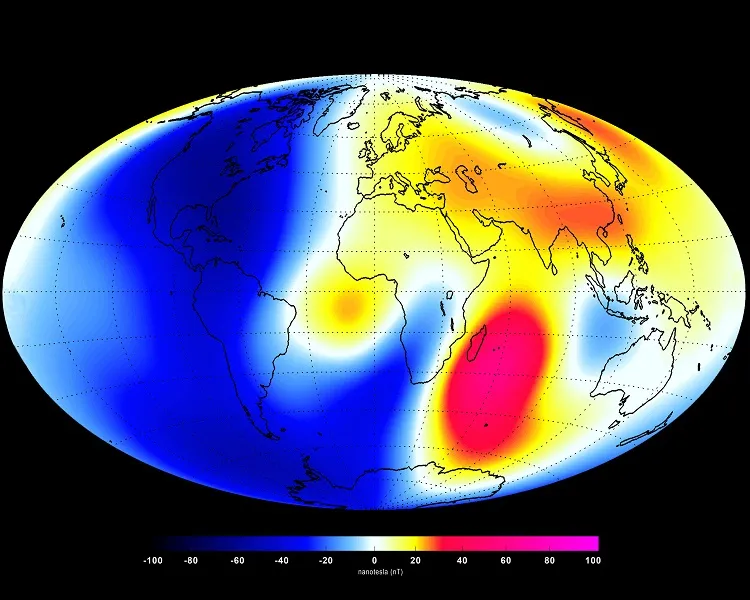
Earth's magnetic field, which protects the planet from huge blasts of deadly solar radiation, has been weakening over the past six months, according to data collected by a European Space Agency (ESA) satellite array called Swarm.
The biggest weak spots in the magnetic field — which extends 370,000 miles (600,000 kilometers) above the planet's surface — have sprung up over the Western Hemisphere, while the field has strengthened over areas like the southern Indian Ocean, according to the magnetometers onboard the Swarm satellites — three separate satellites floating in tandem.
The scientists who conducted the study are still unsure why the magnetic field is weakening, but one likely reason is that Earth's magnetic poles are getting ready to flip, said Rune Floberghagen, the ESA's Swarm mission manager. In fact, the data suggest magnetic north is moving toward Siberia.
"Such a flip is not instantaneous, but would take many hundred if not a few thousand years," Floberghagen told Live Science. "They have happened many times in the past."[50 Amazing Facts About Planet Earth]
Scientists already know that magnetic north shifts. Once every few hundred thousand years the magnetic poles flip so that a compass would point south instead of north. While changes in magnetic field strength are part of this normal flipping cycle, data from Swarm have shown the field is starting to weaken faster than in the past. Previously, researchers estimated the field was weakening about 5 percent per century, but the new data revealed the field is actually weakening at 5 percent per decade, or 10 times faster than thought. As such, rather than the full flip occurring in about 2,000 years, as was predicted, the new data suggest it could happen sooner.
Floberghagen hopes that more data from Swarm will shed light on why the field is weakening faster now.
Still, there is no evidence that a weakened magnetic field would result in a doomsday for Earth. During past polarity flips there were no mass extinctions or evidence of radiation damage. Researchers think power grids and communication systems would be most at risk.
Get the world’s most fascinating discoveries delivered straight to your inbox.
Earth's magnetic field acts like a giant invisible bubble that shields the planet from the dangerous cosmic radiation spewing from the sun in the form of solar winds. The field exists because Earth has a giant ball of iron at its core surrounded by an outer layer of molten metal. Changes in the core's temperature and Earth's rotation boil and swirl the liquid metal around in the outer core, creating magnetic field lines.
The movement of the molten metal is why some areas of the magnetic field strengthen while others weaken, Florberghagen said. When the boiling in one area of the outer core slows down, fewer currents of charged particles are released, and the magnetic field over the surface weakens.
"The flow of the liquid outer core almost pulls the magnetic field around with it," Floberghagen said. "So, a field weakening over the American continent would mean that the flow in the outer core below America is slowing down."
The Swarm satellites not only pick up signals coming from the Earth's magnetic field, but also from its core, mantle, crust and oceans. Scientists at the ESA hope to use the data to make navigation systems that rely on the magnetic field, such as aircraft instruments, more accurate, improve earthquake predictions and pinpoint areas below the planet's surface that are rich in natural resources. Scientists think fluctuations in the magnetic field could help identify where continental plates are shifting and help predict earthquakes.
These first results from Swarm were presented at the Third Swarm Science Meeting in Denmark on June 19.
Follow Kelly Dickerson on Twitter. Follow us @livescience, Facebook & Google+. Original article on Live Science.
