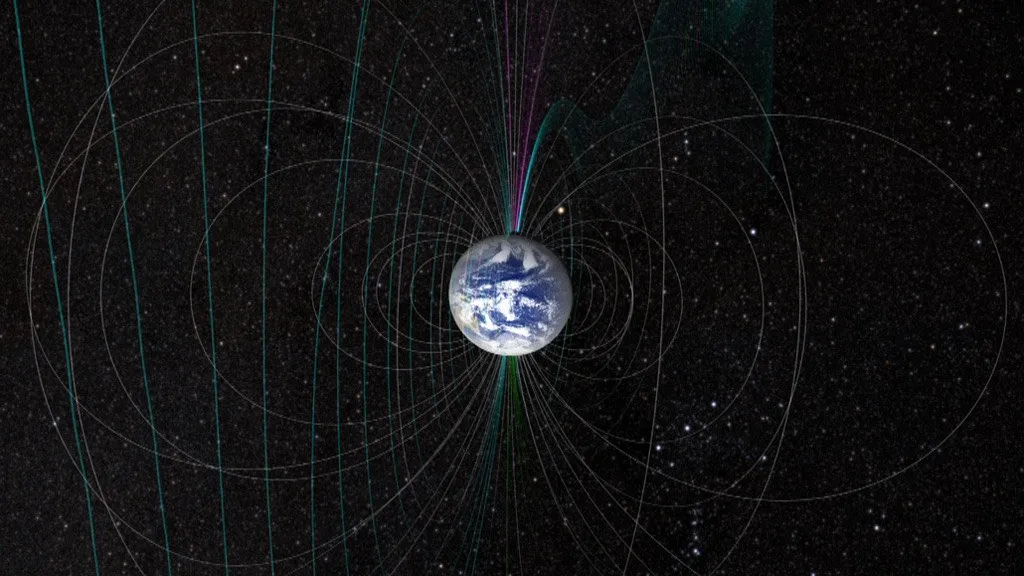
Magnets, those objects that attract or repel each other, are more than staples of your refrigerator door. They are found in just about every laptop and the force they produce protects Earthlings from some lethal radiation from space. Live Science keeps up with the most interesting discoveries related to magnets and magnetism.

-
 Earth's magnetic field has a weak spot — and it's getting bigger, putting astronauts and satellites at risk
This could be bad news for satellites and spacefarers.
planet-earth -
 Government scientists discover new state of matter that's 'half ice, half fire'
U.S. government scientists have developed a new phase of matter dubbed 'half ice, half fire,' which unites opposing electron spins in a unique magnet.
2 Commentsquantum -
 Scientists discover new, 3rd form of magnetism that may be the 'missing link' in the quest for superconductivity
Scientists have found an elusive third form of magnetism that could help solve a longstanding puzzle about superconductors.
physics-mathematics -
 We've been wrong about Uranus for nearly 40 years, new analysis of Voyager 2 data reveals
Voyager 2's 1986 flyby of Uranus, the main source of our knowledge of the icy planet, could have come at the same time as a weird plasma burst from the sun.
planets -
 Biggest black hole jets ever seen are as long as 140 Milky Ways
The largest-ever black hole jets ever seen hint that these cosmic monsters may play an even more significant role in shaping galaxies than previously thought.
black-holes -
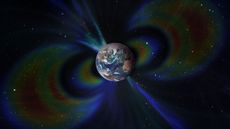 'A force more powerful than gravity within the Earth': How magnetism locked itself inside our planet
"As the magma cooled to form what is today the world's solid outer crust, magnetism was locked into minerals containing iron, such as magnetite."
physics-mathematics -
 Weird magnetic 'skyrmion' quasiparticle could be used as a bit in advanced computing memory
Scientists want to replace electrons with so-called 'nanobubbles' — or skyrmions — to store data more densely and efficiently in advanced memory components that would replace RAM and flash storage.
computing -
 Ultrafast laser-powered 'magnetic RAM' is on the horizon after new discovery
Researchers have found an elemental physical interaction between light and magnetism that might lead to the next generation of computing memory.
electronics -
 8 ways you can see Einstein's theory of relativity in real life
Reference Relativity is one of the most famous scientific theories of the 20th century, but how well does it explain the things we see in our daily lives?
Reference


