













Why Penguins Quit Flying

Humans spent centuries conspiring to fly, so it might be hard to imagine that any creature would give up the skill, and yet penguins waddle among us. A new study helps confirm that these seabirds traded flight to become better swimmers.
Penguins have a litany of physical features that make them energy-efficient underwater. For instance, their shortened wingspans lessen drag; their dense wing bones make them less buoyant; and their bulky bodies help them stay insulated and dive deeper. Unlike other aquatic birds that paddle underwater with their webbed feet, penguins beat their wings to propel themselves far below the surface. Emperor penguins can even go to depths greater than 1,500 feet (450 meters), lasting 20 minutes on a single breath.
But stubby wings and extra pounds don't make it easy to lift off into the air. Researchers believe that at some point in penguin evolution, these diving enhancements made flying so costly that it ceased to be a sensible option for the birds, rendering them flightless. [Happy Feet: A Gallery of Pudgy Penguins]
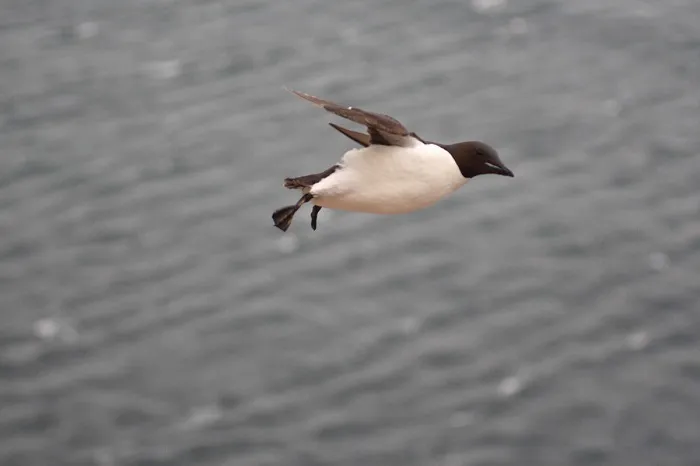
To learn more about the energy costs that eventually grounded flighted penguin ancestors, researchers looked to penguinlike seabirds in the Northern Hemisphere that still use their wings to dive and to fly. The team studied thick-billed murres in the Canadaian Arctic, outfitting them with location trackers and measuring their energy expenditure with injections of tracer isotopes, which are variations of an element with different numbers of neutrons.
They found that the double life takes its toll. The murre's flight cost was much higher than expected, the researchers said. In fact, the energy needed for flight was higher than the flight cost of any bird, surpassing the previous record-holder, the bar-headed goose, which makes a demanding migration over the Himalayas.
Compared with birds that propel themselves with their feet to swim, like pelagic cormorants, the murres used less energy when diving. The murres, however, still had higher energy costs for swimming than penguins do, the researchers said.
The study backs up the biomechanical hypothesis that birds can't be highly efficient at both swimming and diving, and it shows that murres are walking on a thin evoluntionary line between the two abilities. Study researcher Robert Ricklefs, an ornithologist at the University of Missouri, St. Louis, told Nature that murres would have to "reduce their wings or grow larger to improve their diving, and both would make flying impossible."
Get the world’s most fascinating discoveries delivered straight to your inbox.
The research was detailed this week in the journal Proceedings of the National Academy of Sciences.
Follow Megan Gannon on Twitter and Google+. Follow us @livescience, Facebook& Google+. Original article on Live Science.
