













The Brain Sees What We Don't

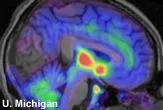
Your brain sees and does more than you know, according to a new study that points to the mysterious workings of the unconscious mind.
To come to this heady conclusion, scientists had to zap the brains of healthy volunteers (and rather brave ones, we might add) and temporarily shut down the part of the brain that processes visual information. For a fraction of a second, a pulse of energy called transcranial magnetic stimulation shut down each person's visual cortex. That's the part of the brain known to process what we see.
The volunteers stared at a computer screen during this moment of blindness while a simple image flashed for an instant.
See that?
The scientists then asked the study subjects if they had seen a horizontal or vertical line in one test, and a red or green dot in the other. All nine of them said they'd seen nothing each time.
When asked to guess what they'd seen, however, they did significantly better than 50-50.
Those who'd been blind witness to a line guessed its orientation accurately 75 percent of the time. Those who'd been shown a dot guessed its color right in 81 percent of the cases.
Get the world’s most fascinating discoveries delivered straight to your inbox.
"Even though the human primary visual cortex activity was temporarily shut down, it's clear that detailed visual information was still being processed unconsciously," said Tony Ro, a psychologist at Rice University and leader of the study.
Experts had thought all color information was processed in a certain region of the brain's thalamus, governor of all incoming sensory information. But there must be multiple pathways in the brain through which visual information flows, the results indicate.
The unconscious mind
The new study is detailed this week in the online edition of the Proceedings of the National Academy of Sciences.
It contributes to a growing pile of evidence that has yet to reveal what consciousness is.
Ro said his team's findings provide evidence for a longstanding and controversial speculation made by Sigmund Freud and others that the brain churns some information without us being aware. Freud called it "unconscious processing."
Previous studies in patients with brain damage reached similar conclusions: Patients who said they couldn't see an object could, when pressed, identify its shape and location. Researchers call the phenomenon blindsight, and some say it indicates the brain has an unconscious mode that might be at the root of transcendental experiences for which the conscious mind can't account.
Related thoughts:
- The Human Brain Seen as Master of Time
- Why Great Minds Can't Grasp Consciousness
- Study Reveals How Your Brain Sleeps
- Your Brain Remembers What You Forget
- Brain Breakthrough: Scientists Know What You'll Do
- Scientists Say Everyone Can Read Minds
- Some Imagination! How Memory Fails Us
- Only Using Part of Your Brain? Think Again

Robert is an independent health and science journalist and writer based in Phoenix, Arizona. He is a former editor-in-chief of Live Science with over 20 years of experience as a reporter and editor. He has worked on websites such as Space.com and Tom's Guide, and is a contributor on Medium, covering how we age and how to optimize the mind and body through time. He has a journalism degree from Humboldt State University in California.