















Is the brain actually 2 nervous systems smooshed together? A new study claims it is.
A recent study may reshape our understanding of brain evolution and open new avenues for studying neurological diseases.

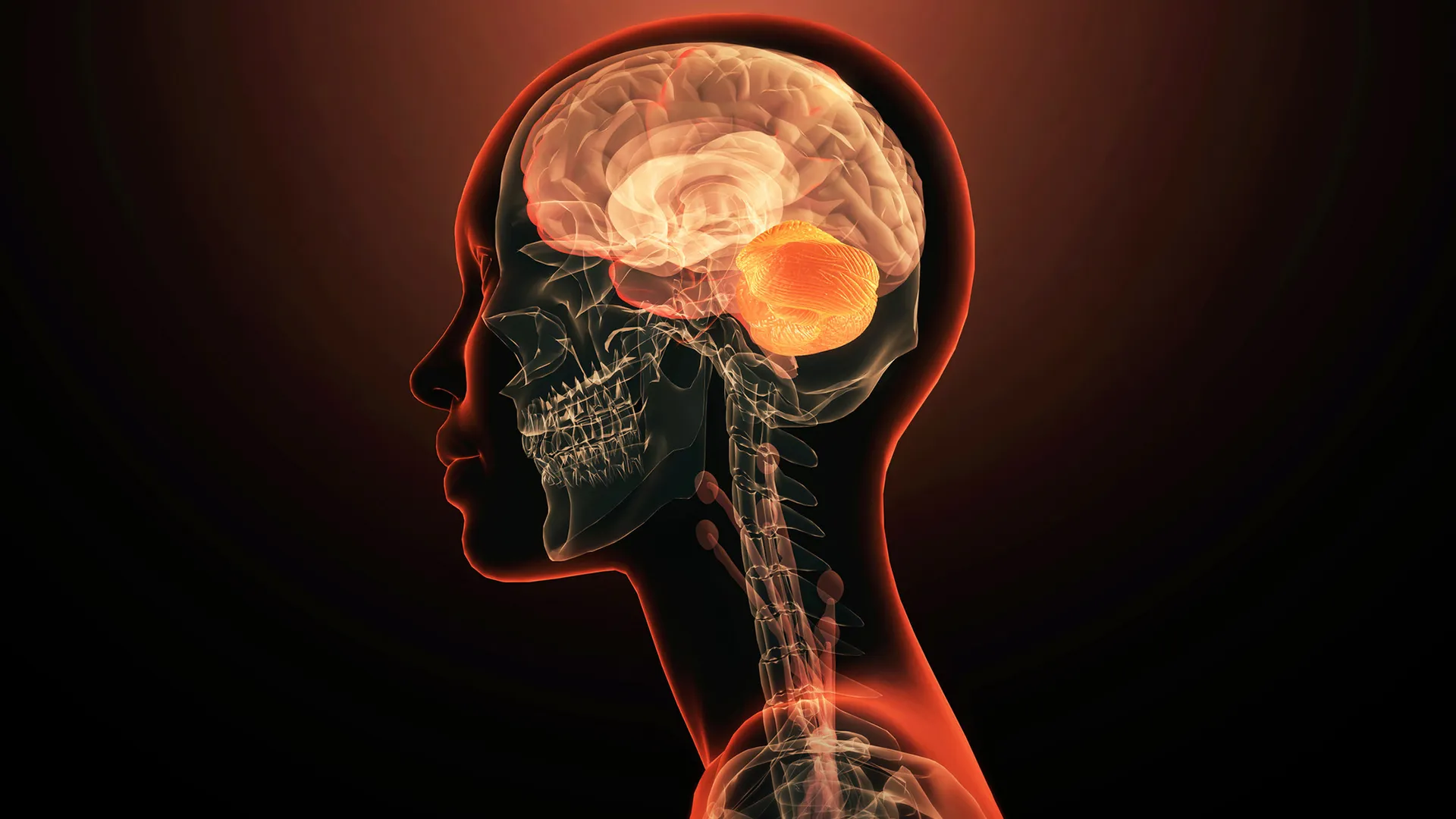
Recent research challenges a long-standing idea about how the brain develops: Rather than arising from a single source, the brain may emerge from two distinct populations of cells, the study finds.
"The brain appears as one organ," said study co-author Kyle Loh, an associate professor of developmental biology at Stanford University. "However, we discovered that the front part of the brain and the back part of the brain come from different sources, which are pushed together to create the appearance of a single organ," Loh told Live Science in an email.
The findings, published in September in the journal Nature Neuroscience, not only challenge established models of how the brain forms but may also explain why researchers have struggled to grow certain types of brain cells in the laboratory. The scientists say the work could offer new ways to investigate diseases that affect the brainstem, the "stalk" that connects the brain to the spinal cord.
Two developmental journeys
The human brain is divided into three main regions — called the forebrain, midbrain and hindbrain — that perform different but interconnected functions.
The forebrain, which includes the cerebral hemispheres, is involved in higher-level cognitive processes, such as language, planning and abstract thinking. The midbrain, the uppermost part of the brainstem, connects the forebrain and the hindbrain and acts as a key relay center for sensory information and movement control. The hindbrain — which includes the bottom of the brainstem, along with other structures — also helps to coordinate movement, as well as regulate essential functions such as breathing, sleep and heart rate.
Historically, the hindbrain has been difficult to study. One reason is that scientists have faced persistent challenges in generating functional hindbrain neurons in laboratory conditions.
To help understand why, Loh and his team looked at the early stages of embryonic development in lab mice. They focused on gastrulation, the point when cells begin to organize into structures that will later form different organs. The researchers identified two distinct populations of immature cells that would go on to give rise to nervous system tissue, including the brain.
Get the world’s most fascinating discoveries delivered straight to your inbox.
One cell population expressed a gene called Otx2, which helps to direct the early development of the forebrain and midbrain. The second group of cells expressed the gene Gbx2, which is involved in the development of the midbrain and hindbrain.
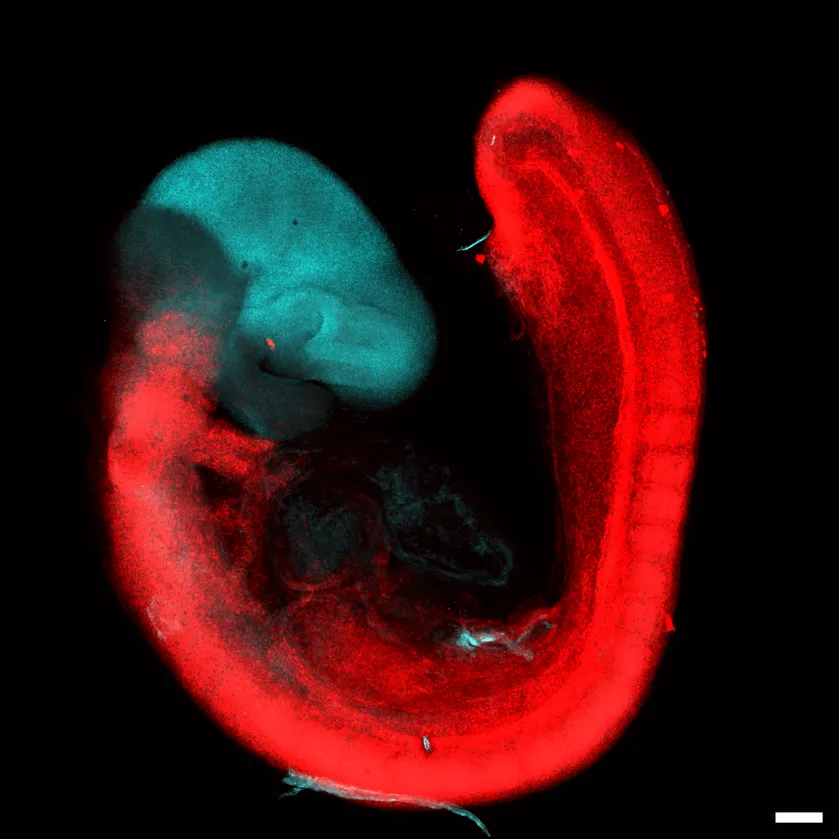
This photograph shows a 9.5-day-old mouse embryo and depicts the two separate developmental origins of the brain. The forebrain and part of the midbrain (blue) express the Otx2 gene, while the hindbrain and the rest of the midbrain (red) express Gbx2. The red cell population also extends into the spinal cord.
The functions of these genes were already known, but their distinct expression in these two groups of cells was revealed by the new research. The cell populations remained distinct as they developed into full-fledged nervous tissue, rather than overlapping.
The team also examined chromatin, the molecular structure that packages DNA tightly inside the nucleus and helps regulate which genes a cell can use. The two cell populations show different chromatin configurations, the team found, which further supports the idea that they follow separate developmental pathways.
That may help to explain why scientists' attempts to grow hindbrain neurons have been largely unsuccessful.
"Previous attempts to make hindbrain neurons likely tried to coax forebrain and midbrain progenitors into hindbrain cells, which our study shows is not possible," study co-author Rayyan Jokhai, a graduate student in Loh's lab, said in a statement.
Why it matters
Using the information uncovered in their experiments, the researchers successfully guided human stem cells to transform into functional hindbrain motor neurons, which are involved in controlling movement. Specifically, these cells produced proteins characteristic of the hard-to-grow hindbrain regions that help control muscles of the face and those involved in swallowing.
In several neurological diseases, including spinal muscular atrophy and amyotrophic lateral sclerosis, motor neurons deteriorate and affected patients can lose their ability to swallow, speak and breathe independently.
"We cannot sample living motor neurons from a patient's hindbrain to watch how these diseases attack these neurons," Loh said. "Growing these hindbrain motor neurons in a dish gives us a way to investigate these diseases." Looking forward, the team aims to use their findings to study these diseases and pinpoint new treatments.
The new findings could also reveal something fundamental about the evolution of vertebrate animals.
The study authors investigated whether the two developmental pathways were unique to humans or reflected a much older evolutionary arrangement. They turned to previously published data on other species — including macaques (Macaca), zebrafish (Danio rerio) and chickens (Gallus gallus domesticus) — and again found two distinct cell populations expressing the two key genes.
And even in acorn worms — a marine invertebrate whose evolution diverged from vertebrates about 550 million years ago — they again found these two distinct groups of cells.
Related stories
"The Stanford discovery establishes that the deep ancestry of the vertebrate brain is fundamentally modular," said Anna Di Cosmo, a professor of biology at the University of Naples Federico II in Italy who wasn't involved with the study. "The developmental separation between the anterior lineage (forebrain/midbrain) and the posterior lineage (hindbrain) is traceably ancient," Cosmo told Live Science in an email.
Loh's team speculates that these developmental trajectories seen in the womb may suggest that the two cell populations once belonged to two separate nervous systems. "Later in evolution, these two nervous systems may have been pushed together to give rise to the appearance of one integrated brain," Loh said.
However, the study doesn't reveal exactly when the two pathways arose or establish how they integrated. "It is important to emphasize that this is only an idea, and it might change as scientists learn more," Loh said.
Jokhai, R. T., Dundes, C. E., Ahsan, H. S., Kang, R. S., Salomon-Shulman, R. E. A., Rajan, A., Kim, Y. S., Stanton, L. J., Xu, C., Do, S., McDonald, B. D., López, J. M. A., Urrutia, H. A., Greenfeld, H., Wong, A., Qu, Y., Petkovic, A. S., Miao, Y., Garcia, K. C., . . . Loh, K. M. (2026). Two parallel neural ectoderm progenitors contribute to the developing brain. Nature Neuroscience. https://doi.org/10.1038/s41593-026-02433-7
See how much you know about the most complex organ in the human body with our brain quiz!

Kenna Hughes-Castleberry is the Content Manager at Live Science. Formerly, she was the Content Manager at Space.com and before that the Science Communicator at JILA, a physics research institute. Kenna is also a book author, with her upcoming book 'Octopus X' scheduled for release in spring of 2027. Her beats include physics, health, environmental science, technology, AI, animal intelligence, corvids, and cephalopods.
You must confirm your public display name before commenting
Please logout and then login again, you will then be prompted to enter your display name.