
















'We're not a competitor to fusion. We are fusion': Inside the race to harness unlimited solar power in space
Space-based solar power has the potential to meet Earth's energy needs many times over. Will it see the light of day?


The year is 2050, and as the sun sets, the night's first constellations emerge in perfect rows. But these amber-glowing arrays aren't stars at all; they're satellite clusters, harvesting the day's last rays before beaming their power back to Earth.
If it reads like science fiction, that's because it started that way. Called space-based solar power (SBSP), the concept featured prominently in the techno-utopian imaginations of 20th-century visionaries and writers. But for decades, it was dismissed — a pie in the sky proposal.
Now, as a new space race heats up, governments and private companies in China, the U.S., the U.K. and Japan are developing several projects to reassess the idea's feasibility. These include China's ZhuRi ("Chase the Sun") program, Japan's OHISAMA project, the U.K.'s Space Solar, and power-beaming experiments by Caltech and the Air Force Research Laboratory in the U.S., all of which are targeting test launches in the next five years.
Proponents say the technology has the potential to meet Earth's energy needs many times over while causing minimal harm to the environment. But first it needs to get off the ground: In the eyes of critics, space-based solar power is exorbitantly expensive, riddled with untested assumptions, and far too complex to be deployed in time for an urgent green-energy transition.
The challenges include getting the massive solar-panel-covered satellites into space; assembling them; getting those solar panels to constantly face our star; and then finding ways to convert, concentrate and transmit their collected power back to Earth.
Despite these hurdles, researchers keep returning to the idea. Perhaps because the most crucial step — generating energy in the first place — is already being done by the sun. Every second, our star fuses hydrogen atoms to expel the same energy as nine trillion atomic bombs. All that's left to do is catch it.
"We're not a competitor to fusion. We are fusion," Peter Garretson, the U.S. Air Force's former chief of future technology and an SBSP expert, told Live Science.
From science fiction to NASA proposal
The first glimmers of SBSP as a concept came from the Russian rocket scientist and astronautics pioneer Konstantin Tsiolkovsky, who, in 1923, suggested deploying space-based mirrors that could concentrate sunlight to Earth with enough intensity to boil 10 cups of coffee.

Konstantin Tsiolkovsky inside his workshop in Kaluga, Russia. Long before he became globally celebrated for his pioneering formulas on rocket design and space travel, Tsiolkovsky spent decades obsessively working on designs for a steerable, all-metal cargo airship.
Tsiolkovsky's fanciful proposal soon entered science fiction, appearing in the British writer Olaf Stapledon's 1937 novel "Star Maker" as a "gauze of light traps" that an advanced alien civilization used to focus "the escaping solar energy for intelligent use" — an idea later formalized by theoretical physicist Freeman Dyson as a Dyson sphere.
Then, in 1941, Isaac Asimov made the clearest, most famous early sketch of SBSP in his short story "Reason," in which a robot colony toils aboard a power station that collects solar energy and fires it back to Earth in the form of microwaves. Asimov provided few details on the fictional station's engineering, instead focusing on the robots' religious worship of the vessel.
But the transformation from science fiction to a concrete proposal didn't take long. In 1968, aerospace engineer Peter Glaser, a consultant and project manager for the Apollo 11 mission's distance-measuring laser reflectors, drew up an engineering design for a "solar power satellite" consisting of three key elements: a ray-collecting device, a converter and a transmitter.
Glaser's collector was a disk of photovoltaic panels that would be lifted some 22,400 miles (36,000 kilometers) off the ground. Locked in a geostationary orbit above Earth and bathed in near-constant sunlight, the satellite would harvest solar rays before converting them into microwaves to be beamed, largely unimpeded through the atmosphere, to receiving antennae on the ground. Once there, the microwaves would be converted into electricity and distributed across the grid.

A 1976 artist's illustration of a solar power satellite based upon Peter Glaser's original design.The image shows the assembly of the satellite's microwave transmission antenna.
NASA awarded Glaser a contract to study the concept further, with both domestic and international energy crises (such as the 1973 oil crisis and the 1979 Three-Mile Island nuclear accident) adding wind to his solar sails.
But Glaser's design hit technical and financial roadblocks, the most forbidding being the project's sheer size. By 1981, when the U.S. Department of Energy's four-year study of space-based solar power was released, it estimated that a "meaningful" contribution of 300 gigawatts (sufficient to power hundreds of millions of homes) would require 60 satellites, each spanning 21 square miles (55 square kilometers) and weighing 50,000 tons (45,000 metric tons). The plan was deemed unaffordable.
Later reassessments, such as a 1997 report by NASA physicist John Mankins, pointed to advances such as improved solar cells that made the concept more realistic. Yet the overall consensus remained hostile. A 2015 report released by the Strategic Studies Institute (SSI) of the U.S. Army War College stated that while SBSP systems are "technically feasible," there was "no compelling evidence that such systems will be economically competitive" with terrestrial power systems. It concluded that "the reality is that such systems always seem to be seen as just 10 years away by their advocates."
Aiming high
But a lot can change in a decade, including the cost of firing rockets. Since the SSI report, SpaceX's reusable Falcon 9 rocket has sent launch costs plummeting to around 30 times less than those of NASA's Space Shuttle, with satellites also getting cheaper due to mass production and advances to the clean rooms where they're made. And SpaceX's even bigger Starship rocket promises to more than quintuple Falcon's payload capacity, lowering prices further.

SpaceX's Starship Flight 14 launches from Boca Chica Beach, Texas on September 28 as part of its first orbital test flight.
"What you have is a cadre of people in the space community that have grown up before Starlink and SpaceX," Garretson said. "They literally could not believe that, as your launch rate goes up and you amortize your costs, [the launch cost] approaches the cost of fuel." Some took notice. A 2021 assessment commissioned by the U.K. government estimated that a 2-gigawatt, mile-wide space-based solar power array would cost 17.3 billion British pounds ($23.4 billion) and generate energy at 50 British pounds ($68) per megawatt hour over its century lifetime.
That's the equivalent output of a large power station in the U.K., with the initial costs being 39% to 49% cheaper than biomass, nuclear or the most efficient gas energy sources, according to the assessment. And while it's still 14% to 52% more expensive than current terrestrial wind and solar energy, the technology could be beamed anywhere, even to remote locations.
Based on these findings, in 2023, the U.K. government awarded 4.3 million British pounds ($5.8 million) in seed funding to a handful of companies and universities to develop SBSP further.
The U.K. report chose one satellite design as its reference architecture: CASSIOPeiA. Belonging to the U.K. SBSP company Space Solar, the satellite's design is an attempt to crack a significant challenge faced by early solar satellite blueprints: how to keep solar panels constantly aligned with the sun to maximize radiation collection.
Unlike other satellite designs, such as China's Multi-Rotary Joint Solar Power Satellite or Mankins' SPS-ALPHA, which rotate the panels or use a system of mirrors to constantly redirect sunlight onto them, CASSIOPeiA is shaped like a gigantic DNA strand.
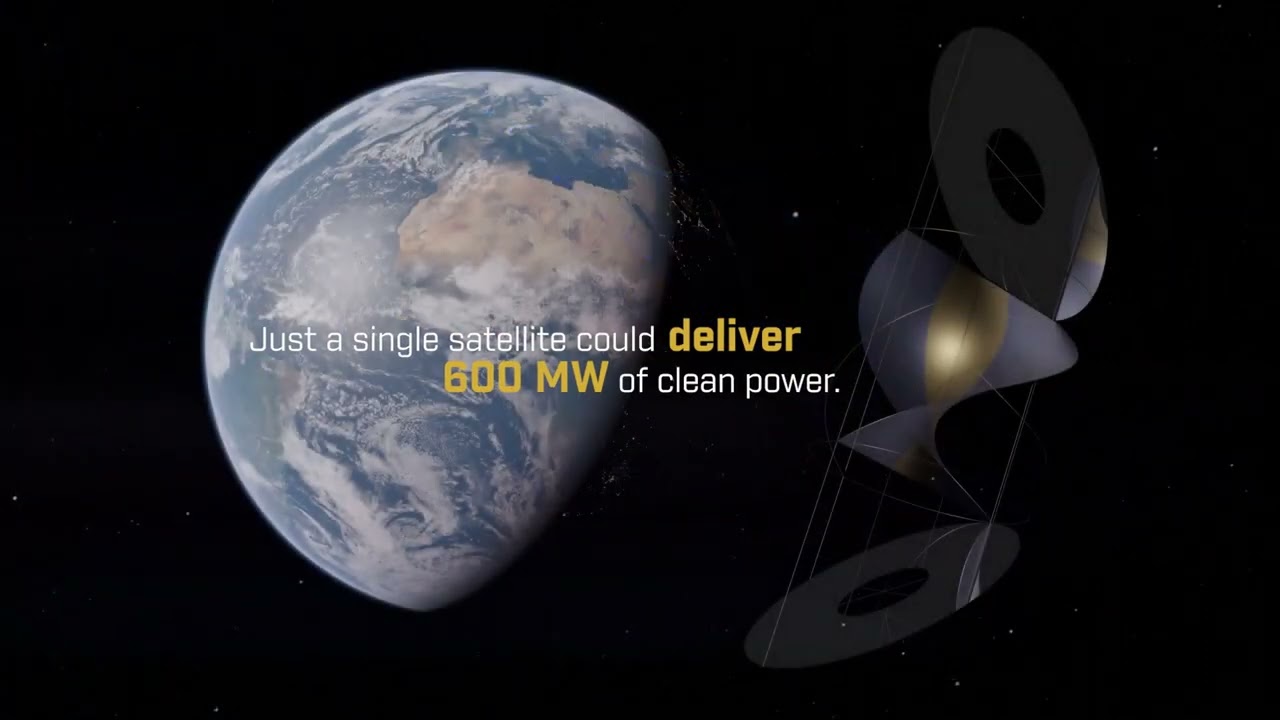
This design, alongside a sun-synchronous orbit and a slow spin, enables CASSIOPeiA to constantly receive and transmit solar energy without any heavy or failure-prone moving parts. Space Solar claims that a single CASSIOPeiA satellite, which would be about 1 mile (1.6 km) in diameter, could microwave-beam as much as 2 gigawatts of constant power to a fixed point on the ground — enough to supply a city of 2 million people.
Space Solar says that once the satellite is in space, it will be far more efficient and economical than gathering sunlight on the ground could ever be. That's because the light hitting the space-based power station isn't deflected or attenuated by the atmosphere.
"You use a lot less materials compared with terrestrial solar, and you utilize them more," Sam Adlen, co-founder and co-CEO of Space Solar, one of the funding recipients, told Live Science. "So it's 100% utilized in space rather than 10% if you're on the ground — and you've got 13 times more instant energy, so you're getting much more out of the materials."
Beaming down
However, the next step — beaming gigawatts of energy down and across tens of miles of atmosphere and through potential cloud cover — remains a major technical hurdle.
Proposed power-beaming methods are currently split between two types: lasers and microwaves. California-based startup Aetherflux, which has plans to beam power from satellites in low Earth orbit, has developed an infrared laser transmission system that it will test using a demonstration satellite launched on October 1. The microwave energy will be transmitted at around one kilowatt (enough to supply the basic electrical demands of a household).
Meanwhile, Caltech and Overview Energy, another U.S. startup, have both demonstrated respective microwave and laser-power beaming from orbit and from a plane, respectively, albeit in negligible amounts ( less than a kilowatt).
Despite their efficiency and proven ability to travel vast distances, optical beams in the infrared and near-infrared ranges are easily scattered by water droplets in the atmosphere, preventing power from being transferred on cloudy days. Persisting efficiency issues with optical power transmission also worsen at gigawatt power levels, meaning lasers are less feasible for use at the utility scale.
Microwaves, on the other hand, can be beamed at frequencies with much higher power and suffer relatively little atmospheric attenuation. That's why Space Solar, Japan's OHISAMA project and China's ZhuRi program all plan to use microwave-beaming systems. Nonetheless, microwaves have comparatively longer wavelengths, so their beams diffract more widely across longer distances. This means that even if beams are sent by transmitters hundreds of meters wide, they would need Earth-based receivers spanning dozens of square miles.

An aerial view of China's Five hundred meter Aperture Spherical Telescope, the world's largest single dish. With current technology, transmitters of this scale would need to be constructed in space in order to successfully beam microwaves to magnitudes bigger receivers.
These limitations mean that "it's going to take many years" before gigawatt-scale power beaming is achieved, Remo Proietti Zaccaria, head of the DELTA Lab at the Italian Institute of Technology, told Live Science.
Improvements in power-beaming efficiency will bring their own challenges. Even battery-powered laser pointers can blind or burn, so prototypes by laser-beaming SBSP companies like Aetherflux must be designed with that possibility in mind. They promise safety mechanisms that switch off their lasers if anything flies between the transmitter and the receiver.
"Definitely for the weapon side, this technology now can be used efficiently," Proietti Zaccaria said.
If you're imagining an orbital weapon devised by a Bond villain, you may be disappointed — even fully developed power-beaming lasers and microwaves would take a while to cook an egg, or boil Tsiolkovsky's coffees. But beaming technology could still have potent military use: Scrambling communications systems on Earth to create havoc with relatively little effort.
"If you throw even that amount of intensity of power to our antennas, you're going to freeze the electronics; that's for sure," Proietti Zaccaria said. "It's not necessary to destroy them. As long as you freeze the electronics, you've done the job."
The challenges associated with power beaming have pushed some engineers to simpler concepts. One (going full circle back to Tsiolkovsky's original proposal) envisions the deployment of space-based mirrors that reflect sunlight back to Earth after sunset, with a single reflector extending the daylight delivered onto solar panels by around 20 minutes.
This may not seem like much on its own, "but then you can increase this with multiple reflectors," Onur Celik, a researcher in space technology at the University of Glasgow, told Live Science. "If you have 10 or more of them, you can arrange them in space in such a way that you can extend this to up to two hours or so at that altitude."
"The sunlight that you deliver, if it all turns into electricity, could power thousands of homes," he concluded.
The light of day
The trillion-dollar question is whether that power will be cheaper and more efficient than that generated on the ground. The median cost of the electricity generated by SBSP as estimated by the U.K. government is 50 British pounds per megawatt hour ($68), putting it roughly in line with the costs of offshore wind and terrestrial solar power.
However, this estimate is orders of magnitude too sunny for the 2024 NASA cost report, with its projections suggesting SBSP's baseline electricity costs fall between $610 and $1,590 per megawatt hour, depending on the array design. NASA concluded that the U.K.'s median estimate was achievable only after drastic future reductions in launch and manufacturing costs.
Independent studies are also divided over feasibility. One assessment suggests that SBSP could reduce Europe's need for land-based renewable energy by up to 80%, while another counters that the costs could be 12 to 80 times more expensive than those for terrestrial alternatives. This variability exists within the studies themselves, with research published in the journal Acta Astronautica estimating that SBSP could contribute to meeting anywhere from 3% to 31% of global electricity demand, depending on possible constraints in how many satellites can safely fit into an orbit, the receiver size, and where power is beamed to.
"For the numbers we found, I don't believe that this technology could actually be employed to generate energy for Earth," said Proietti Zaccaria, a co-author of the Acta Astronautica study. If humanity had used up all available space for solar panels on Earth, "then I will tell you it would make sense, because at that point, 3%, 5%, 10% could make a difference."
Proietti Zaccaria does see use cases for SBSP schemes for future moon or Mars missions, but otherwise, "the cost for building technology of this kind is really very, very high," he said. "Vice versa, the cost nowadays of buying and installing a solar panel on the roof of any building has become extremely cheap."
Among the challenges would be ferrying the raw materials for the systems into space and then assembling them. Such a feat would make the construction of the International Space Station — currently the most complex structure built in orbit — seem like child's play. Maintaining arrays and preventing them from crashing into other satellites in Earth's increasingly crowded orbits would also take significant international coordination.

Exposures taken over just 30 minutes on a night in June 2024 show the growing crowdedness of Earth's skies.There are now roughly 20,000 active and inoperational artificial satellites in Earth's orbit, with the number expected to reach around 60,000 by 2030.
Then there are the unweighed environmental costs. All modern rockets use methane, a potent greenhouse gas, to propel them into space, and they release much of it into Earth's upper atmosphere, where its effects are the strongest.
"And so clearly, there is a question there on how launching 100,000 of these superheavy vehicles into the atmosphere will actually impact the atmosphere itself, as opposed to the benefit that we get in the next 20 years or so from having solar power from space," Matteo Ceriotti, a senior lecturer in space systems engineering at the University of Glasgow, told Live Science. "It's not entirely clear."
Ceriotti said the likeliest route for overcoming all of these difficulties come from smaller companies running, and then streamlining, proof-of-concept tests in space.
Exclusive to Live Science Pro
- 'Everything we know about space travel is going to change within a decade': The fusion breakthrough that could unlock a path to the stars
- US military confirms weapons in orbit: Why a space 'arms race' could be extremely hard to stop
- 'River in the Sky': China's doomed plan to create a 'cloud seeding corridor' tells us how far the country will go to solve its climate crisis
"Obviously, it's not something that we have ever done," he said. "So clearly, we need to start somewhere, and we need to start small."
The hopes of SBSP proponents remain unclouded by gloomy estimates. They cite several technologies, from personal computers to reusable rockets, that were once thought to be impossibly expensive, even fictitious, that are now ubiquitous and cheap. Their eyes remain fixed on demonstration missions to be launched over the next four years by the likes of Space Solar, Reflect Orbital, Aetherflux and Virtus Solis. If these missions succeed, another once-impossible idea could appear much brighter.
"The private sector is good at this, because it has to be," Sanjay Vijendran, an SBSP consultant who led the European Space Agency's now-shuttered SOLARIS project to test the feasibility of SBSP, told Live Science. "It can break the problem down to quite a small level and start to do things with today's technology and today's way of doing things, and start to show that this can be valuable."
Help us improve Live Science Pro: We're always trying to make our content better. Leave us feedback about Pro here.

Ben Turner is a U.K. based writer and editor at Live Science. He covers physics and astronomy, tech and climate change. He graduated from University College London with a degree in particle physics before training as a journalist. When he's not writing, Ben enjoys reading literature, playing the guitar and embarrassing himself with chess.
You must confirm your public display name before commenting
Please logout and then login again, you will then be prompted to enter your display name.