Gorillas Gave Humans 'The Crabs'

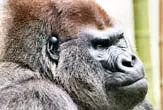
Humans caught pubic lice, aka "the crabs," from gorillas roughly three million years ago, scientists now report.
Rather than close encounters of the intimate kind, researchers explained humans most likely got the lice, which most commonly live in pubic hair, from sleeping in gorilla nests or eating the apes.
"It certainly wouldn't have to be what many people are going to immediately assume it might have been, and that is sexual intercourse occurring between humans and gorillas," explained researcher David Reed of the Florida Museum of Natural History. "Instead of something sordid, it could easily have stemmed from an activity that was considerably more tame."
Humans are unique among primates in that we host two different kinds of lice—one on our heads and bodies (Pediculus), the bane of many schoolchildren, and pubic lice (Pthirus). In comparison, chimpanzees have only head lice and gorillas only pubic lice.
Parasite history
Understanding the history of lice is important because they and other parasites yield valuable hints about the lifestyles of human ancestors and the evolution of modern humans, Reed said.
"Our own history is written in the DNA of parasites as well as ourselves, and by studying both we can come to a better, more complete understanding of our evolutionary history," Reed told LiveScience. "These lice really give us the potential to learn how humans evolved when so many parts of our evolutionary history are obscure."
Get the world’s most fascinating discoveries delivered straight to your inbox.
| Timeline of Human Evolution |
Investigating lice can also help in understanding how parasites move from one species to another, Reed added.
"If you look at emerging infectious diseases that affect humans all over the world, most have their origins on some other host before threatening humans," he said. "Studying what it takes for a parasite to be successful in switching hosts adds to our knowledge about what makes a good host for the spread of disease."
Collecting lice
In collaboration with scientists who collected lice from primates in Ugandan wildlife sanctuaries, Reed and his colleagues extracted DNA from the parasites and used fossil data from humans and gorillas to estimate how long ago these two kinds of lice shared a common ancestor.
"The hardest part was collecting the gorilla lice, and without the help of our colleagues Chris Whittier and Michael Cranfield at the Mountain Gorilla Veterinary Project, we wouldn't have been able to do this project at all," Reed said. "They monitor the health of gorillas in Uganda, Rwanda, and the Democratic Republic of Congo. Through their monitoring program they have been able to collect ectoparasites, including lice."
The researchers expected humans simply developed pubic lice on their own since this was a simpler explanation than acquiring the parasites from gorillas. However, they were proved wrong.
The evidence suggests gorilla lice began infesting humans about 3.3 million years ago. In contrast, humans and gorillas diverged in evolutionary time about 7 million years ago. The fact the lice took up residence where they did may have coincided with human loss of most hair on the rest of their bodies and the lack of any other suitable niche to live, Reed said.
The researchers detailed their findings in the latest issue of the journal BMC Biology.
Bush meat link
For this species jump to have occurred, the ancestors of humans and gorillas "must have been in the same place at the same time, which was not known before," Reed added. "The fossil record of gorillas in particular tells us very little about the gorilla lineage at the time this switch took place 3.3 million years ago."
These findings do not mean the lice were transmitted by monkey business between humans and gorillas.
"Unfortunately, even today among modern humans there's a bush meat trade where gorillas are killed for their meat," he said. "If archaic humans were butchering or scavenging those animals 3.3 million years ago, it would be a simple thing to transfer those lice from prey to predator."
"This paper makes one's imagination run wild, giving graphic new meaning to that '800 pound gorilla,'" biologist Dale Clayton at the University of Utah said in a prepared statement. "However, as the authors point out, the inferred host switch of pubic lice from gorillas to humans did not require sexual contact. Human pubic or 'crab' lice get transmitted between people on bath towels all the time. So it is easy to imagine that gorilla lice could have transmitted to humans via shared sleeping quarters, or predation, as the authors suggest."
- Mating Game: The Really Wild Kingdom
- 10 Amazing Things You Didn't Know about Animals
- Why Do People Kiss?