













Strange 'hobbit' species walked more like us than like 'Lucy,' hip bones reveal
Anthropologists studying the hip bones of Homo floresiensis have discovered that its pelvis was human-like, raising new questions about the origin of the enigmatic species.

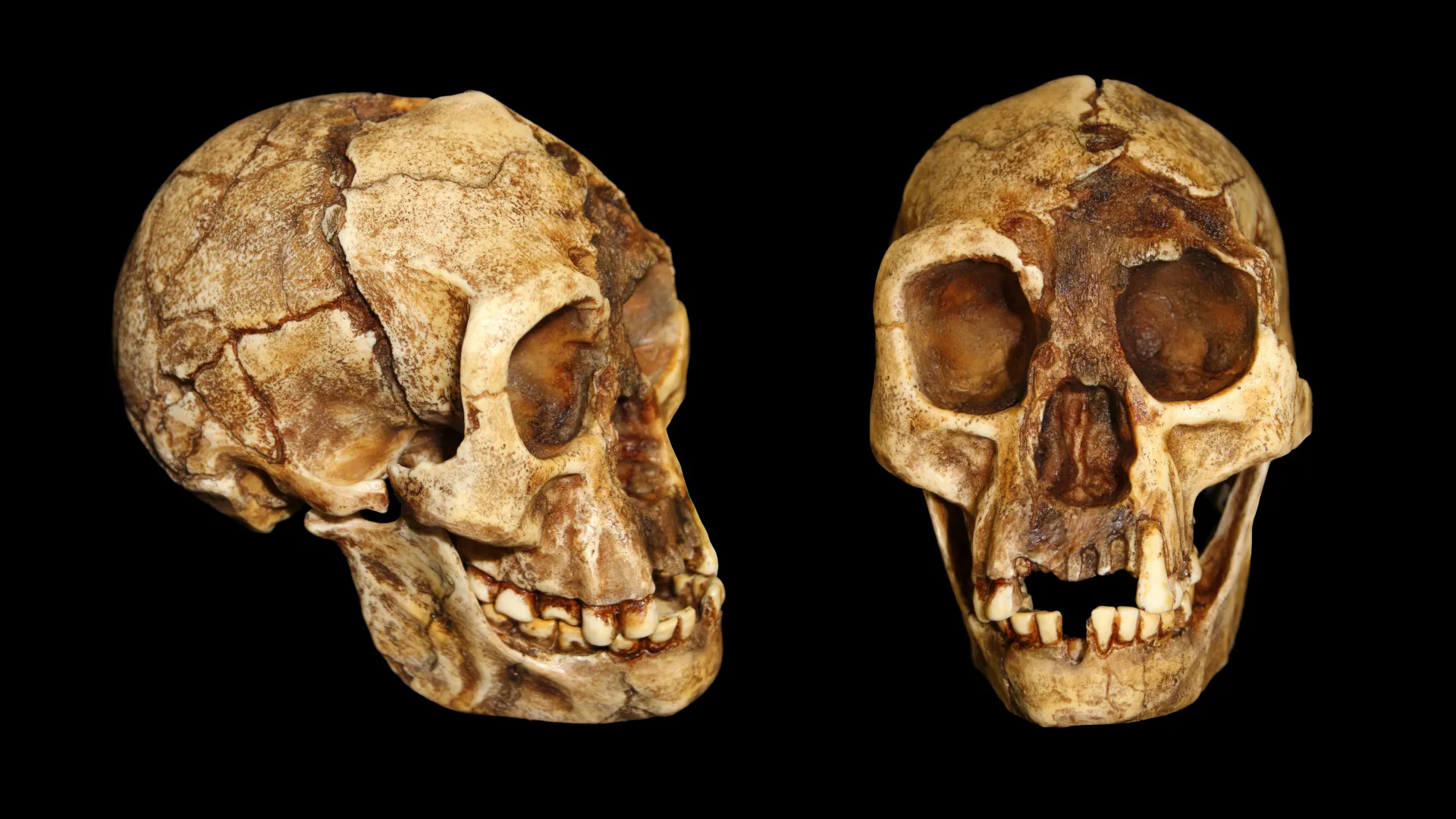
The tiny, now-extinct human relative known as a hobbit had an even more human-like body than previously thought, and probably walked upright somewhat slowly, anthropologists have discovered by studying their hip bones.
But with a more primitive walking style than modern humans and lack of hunting and cooking, the species still differs significantly from Homo sapiens — so with the new findings, the mystery of the hobbits' origins has only deepened.
"Based on just the hip bones, Homo floresiensis looks generally like humans and other genus Homo species and probably could have moved a lot like humans," Kristi Lewton, a biological anthropologist at the University of Southern California, told Live Science. But H. floresiensis "was not a particularly fast biped and was not traveling long distances," she said.
Lewton and colleagues closely studied the pelvic bones of LB 1, an adult female hobbit who was about 3.5 feet (1 meter) tall when she died between 100,000 and 60,000 years ago on the Indonesian island of Flores. They looked for clues as to whether members of H. floresiensis were more similar to other Pleistocene human species or to earlier australopithecine species, such as the iconic "Lucy". Their study was published Aug. 25 in the American Journal of Biological Anthropology.
Ever since H. floresiensis was discovered in 2003, researchers have tried to figure out why members of this species were so small and which species they evolved from. The hobbits' skeletons have a unique mixture of human-like and australopithecine-like traits, making assessment of their evolutionary ancestry challenging. For instance, the hobbits' hand bones are more similar to those found in australopithecines, but their shoulders and upper arms are more human-like.
One physical characteristic that experts have identified in H. floresiensis is known as iliac flare, or the degree to which the hip bones are flared out from the center of the trunk. A large degree of iliac flare has been linked to australopithecine anatomy and, functionally, to less efficient bipedal walking than is seen in humans. But a problem that Lewton and colleagues encountered was that different methods used to quantify the "iliac flare" of humans' relatives often produced contradictory results.
In their new study, the researchers compared hip bones from chimpanzees, gorillas, australopithecines, and both living and extinct human species. By creating a quantifiable measure of iliac flare and adding other measurements of the pelvises of these species, the researchers found that the pelvis of LB 1 was statistically similar to other Pleistocene human species, such as Homo erectus, and different from australopithecines and apes.
Get the world’s most fascinating discoveries delivered straight to your inbox.
"These results suggest that H. floresiensis likely used a form of bipedal walking that would have been markedly similar to those of humans," the researchers wrote in the study.
But the similarity of the hobbit pelvis to other human groups does not mean that their form of bipedalism was exactly the same as ours. Rather, their bones suggest the hobbits were a species "that was not traveling long distances or at fast speeds and that may have incorporated some arboreal behaviors," the researchers wrote in the study.
Caley Orr, a paleoanthropologist at the University of Colorado Denver who was not involved in the study, said "their results are consistent with a more limited quantitative comparison among fossil pelvises that my team published last year." In that work, the LB 1 pelvis also popped out as being mostly human-like, Orr told Live Science.
The new results suggest that there is considerable variability in the size and shape of the skeletons of early human groups, he added, but "what this means for the origins of the 'hobbits' remains ambiguous."
RELATED STORIES
- Diminutive species 'the Hobbit' did not hunt or control fire, deepening the mystery of its ancestry, dwarf elephant bones reveal
- The 'hobbits' may have died out when drought forced them to compete with modern humans, new research suggests
- Archaic human 'hobbits' were even shorter than we thought, 700,000-year-old teeth and bone reveal
Although Lewton and colleagues focused closely on just one part of the hobbit skeleton, they noted that their results support the two main theories of how these mysterious humans evolved.
"Most evidence points to one of the two following hypotheses," Lewton said. "Either H. floresiensis evolved from a population of H. erectus that arrived on the island of Flores and experienced insular dwarfism, or H. floresiensis derived from a small-bodied, earlier radiation of a different species of Pleistocene Homo." In other words, they may have been H. erectus that shrank over time because they lived on an island, or may have evolved from a smaller, unknown Homo species.
Genetic analyses, including studies of ancient proteins, could potentially help experts resolve the question of where hobbits came from, Lewton said. "But this question is probably not going to be resolved any time soon."
Lewton, K.L., Hammond, A.S., Alamsyah, N., Noerwidi, S., Sutikna, T., Skinner, M.M., Tocheri, M.W. (2026). Comparative morphometric analysis of the pelvis of LB 1 (Homo floresiensis). American Journal of Biological Anthropology. https://doi.org/10.1002/ajpa.70339
See how much you know about early humans with our human evolution quiz!

Kristina Killgrove is a staff writer at Live Science with a focus on archaeology and paleoanthropology news. Her articles have also appeared in venues such as Forbes, Smithsonian, and Mental Floss. Kristina holds a Ph.D. in biological anthropology and an M.A. in classical archaeology from the University of North Carolina, as well as a B.A. in Latin from the University of Virginia, and she was formerly a university professor and researcher. She has received awards from the Society for American Archaeology and the American Anthropological Association for her science writing.
You must confirm your public display name before commenting
Please logout and then login again, you will then be prompted to enter your display name.