














Russia Wildfires Not Due to Climate Change, Scientists Say
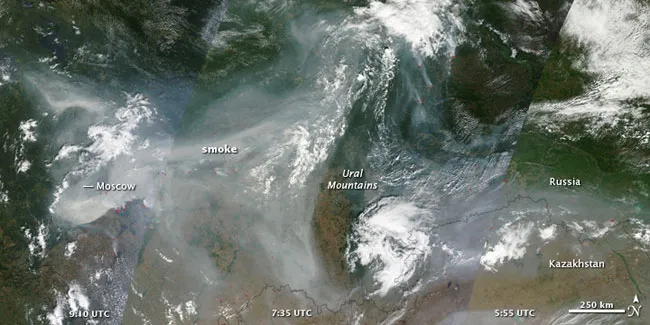
Russia's heat wave, drought and wildfires, by themselves, are not signs of global warming, according several leading climatologists — despite widely reported claims this week by a Russian scientist.
But experts agree that overall, the climate indeed shows signs of human-induced warming.
Alexander Bedritsky, the Krelim's weather adviser and president of the World Meteorological Organization, said that Russia's recent spate of extreme weather, along with other natural disasters, including the recent flooding in Pakistan and France's 2003 heat wave, taken together, "are signs of global warming," according to the Associated Press.
"I don't think they got it quite right," said climatologist Kevin Trenberth of the National Center for Atmospheric Research in Boulder, Colo. "I believe the correct interpretation is that nowadays everything has a component of natural variability and also global warming."
The difference comes up often when global warming’s proponents — or detractors — try to base an argument one way or the other on a single event.
"We can't say for sure that each event was due to human-caused climate change," said climatologist Michael Mann of Pennsylvania State University. "But the fact that the events are occurring more often, we can attribute to human-caused climate change.” [Top 10 Surprising Results of Global Warming]
So for instance, climate scientists could say a stretch of time with more intense or more frequent hurricanes is attributed to global warming, but couldn't decipher whether one of these intense hurricanes can be linked with the warming temperatures. "We are at the point where we can detect global warming in statistics, but not in individual events," Ken Caldeira, global ecologist at the Carnegie Institution for Science in Stanford, Calif., told LiveScience today.
Get the world’s most fascinating discoveries delivered straight to your inbox.
Mann said to think of the occurrence of these extreme events as rolling a loaded die. Rolling a six is like having a record-setting high temperature. With global warming, the die is loaded so that sixes come up increasingly more often — as if the numbers one, two and three were slowly being replaced with sixes.
Rolling a six, or having an extreme weather event, will become more common as the climate changes, Mann said. But rolling back-to-back sixes by chance alone will always be possible, regardless of global warming.
These double sixes, however, will come up far more often than would be expected in the absence of human-caused climate change — a trend that scientists are already seeing.
The number of daily heat records, for example, is already outpacing the number of daily cold records by double the amount expected in the absence of climate change, Mann said.
"The key observation is that these events are becoming increasingly more common," Mann told LiveScience. "The Russian heat wave was by some estimates a one-in-a-thousand-year event, but with global warming perhaps it's only a one-in-10-year event now."
But when trying to link multiple events to global warming, the picture is much more complicated.
"It is difficult to establish all these links well, and even more difficult to quantify them." Trenberth said. "But the evidence strongly suggests that global warming is playing a role.
"The way to think of it, though, is that global warming exacerbates the other conditions that would be occurring anyway: The droughts are more intense, last longer and thus elevate wildfire risk."
- 7 Ways the Earth Changes in the Blink of an Eye
- Natural Disasters: Top 10 U.S. Threats
- 101 Amazing Earth Facts
Brett Israel is a staff writer for OurAmazingPlanet, a sister site to LiveScience.com.