











'The first species we might be able to communicate with, interact with vocally, might be a bird': An animal researcher explains how she decoded birdsong
Julie Elie, an ethologist at the University of California, Berkeley, tells Live Science's Kenna Hughes-Castleberry about using AI to decode the vocalizations of zebra finches.

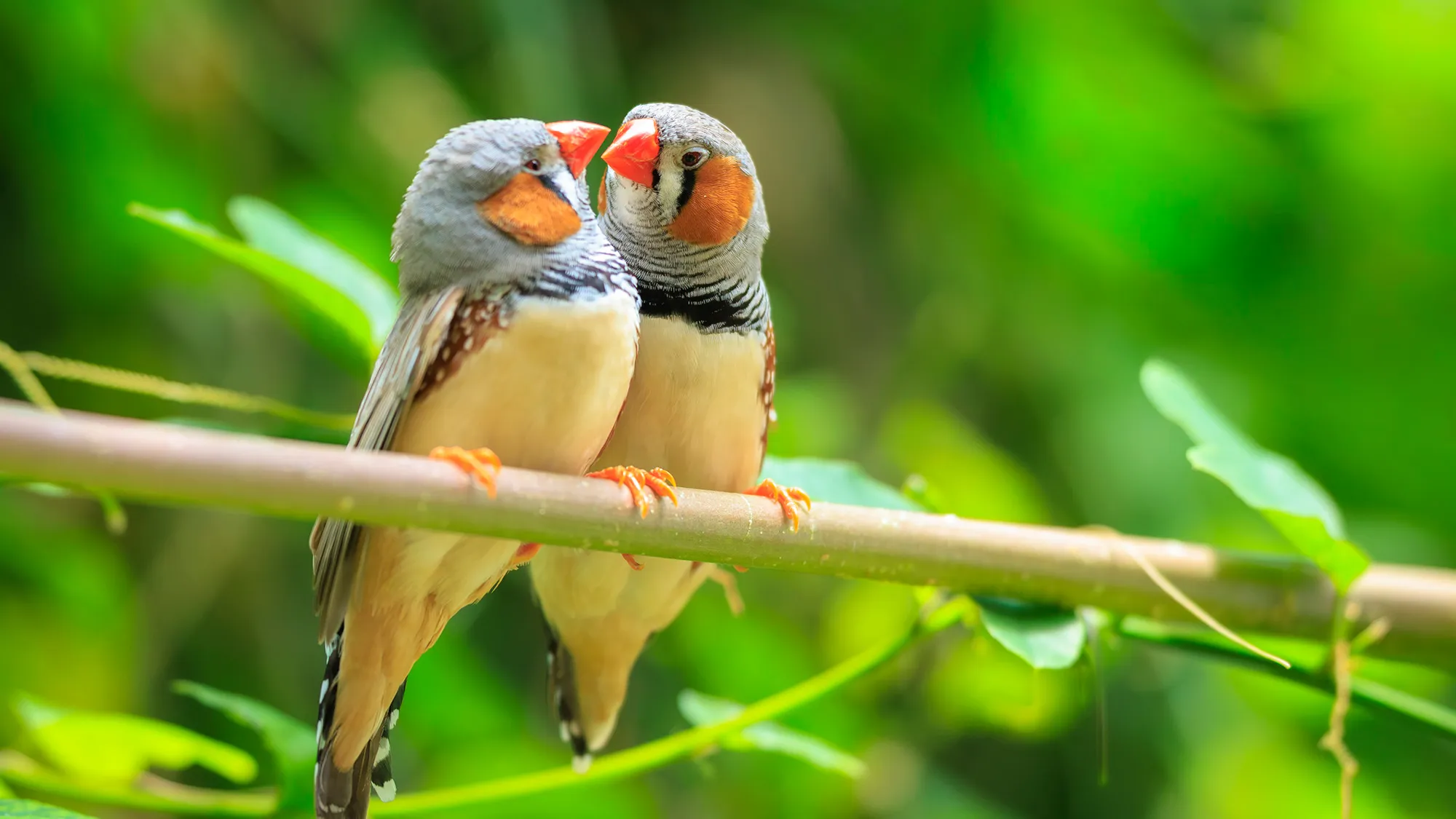
Bird calls are far more than pleasant sounds in nature. They are complex forms of communication that can reveal how birds think, learn, cooperate and respond to their surroundings. From intricate songs used to attract mates to alarm calls that warn others of danger, vocalizations offer valuable clues about avian intelligence and social organization.
Julie Elie is an animal behavior researcher and associate project scientist at the University of California, Berkeley. She recently won the 2026 Coller Dolittle Challenge for Two-Way Interspecies Communication for her work in studying and deciphering zebra finch communication.
For more than a decade, Elie observed the social behavior of birds, recording thousands of sounds and using machine learning combined with behavioral experiments to decode specific calls.
In this interview, Elie discusses how zebra finches learn and use vocalizations, what their calls reveal about intelligence and social relationships and how artificial intelligence (AI) contributed to decoding birdsong.

Dr Julie Elie is a computational neuroethologist who studies how social animals communicate. Her research combines behavioral experiments, neuroscience, and computational tools to reveal how animals produce communication sounds, what information they transmit in their vocalizations and how they perceive the meaning of vocalizations.
Kenna Hughes-Castleberry: What made you study birds and birdsong?
Julie Elie: The beginning of my work with birds dates from my Ph.D. I've always been super interested in animal behavior in general. But I think as a young person, I was more attracted by animals that we relate more easily to, which are mammals, right? Dogs, cats, horses.
I wanted to do a Ph.D. on animal behavior and, more specifically, on relationships between animals. I was interested in how animals interact with each other and what kind of social organization they establish.
[Someone suggested I] work on the zebra finch, and I said, "OK, I've never taken the time to really observe birds very well; might as well start now."
I realized that it's difficult to observe birds because they're not close to you. They can fly wherever they want. When you are out and about in town, in the countryside, and you see birds, they're here, and then they're gone. You don't get to see a lot of their vocal interactions or a lot of their social interactions.
So here I was, studying the zebra finch in cages where they were fully interacting with each other. And the question was, what kind of social organization do they have?
I realized quickly that they were not doing a dominance hierarchy [which was previously thought to be the case], but instead, the most important thing in their life was their partner. They were doing pair bonds, and that's the core of their social organization, [with] males and females pairing for life.

Studying birdsong can help researchers like Elie better understand how the birds navigate their complex environments.
KHC: Why is it important to study birdsong, and what can it teach us about intelligence and behavior?
JE: A level of complexity we were trying to understand was, what are the neural mechanisms that enable those birds to do this process of listening to something and copying it, and reproducing it, and doing a comparison between what they're producing and what they're hearing?
The zebra finch is a just-right middle ground level of cognitive ability that is interesting, where you see this pattern of copying vocalization and producing it. But you can look through the avian kingdom, and some species show more complex behaviors.
We know that there are some species that are able to not only imitate their own vocalizations from their own species, their dad, but they're able to copy other species. So, here in California, for instance, a mockingbird is a bird that is really known to be able to reproduce a bunch of different sounds and is actually incorporating this in their vocalizations.
Parrots are also well known for that because we have them as pets, and they're able to reproduce our own vocalizations as humans. This is kind of crazy, when you think about it, because they don't have the same vocal tract as we do. It's smaller, and they have a different system. I think a high cognitive level is when an animal is able to reproduce a sound that is not in their "native language," let's say, and use it for a goal. We do see this in parrots — they're able to ask you for something or even ask the dog to shut up sometimes, which is interesting. They're able to really use those vocalizations, such as "This is not mine, but I communicate with another species this way."
It shows you how smart they can be, and by studying vocal communication in animals, we are getting a window of what cognitive abilities they have and how the usage reveals their level of smartness.
KHC: Could you walk me through how you ended up decoding bird vocalizations?
JE: I spent countless hours observing zebra finches, and I realized that I could progressively do a match between the social context and the acoustic characteristics of the sound produced. I could recognize these sounds and understand what they "mean."
It's like at home with your cat or dog: Within a couple of months, you figure out every time the cat is doing this kind of sound — "meow" — it means he wants to get out or he's hungry, or he wants to cuddle. Same thing with the dog. It's the same process, but instead of doing this with cats or dogs, I did this with birds and constituted the first acoustic dictionary of zebra finch calls.
However, how do you know you are correct? That you correctly identified the sounds that correspond to the "words" in that species?

Pet owners can often differentiate between different vocalizations in their pets, such as different meowing noises for their cat.
I thought that the best confirmation of whether I was right or not could only come from the zebra finches themselves. Up to now, nobody had found a way to systematically go through the vocal repertoire of an animal and confirm if each identified call type was indeed perceived as a word in that species' language.
To achieve this somewhat impossible discussion with a bird, we designed an operant conditioning experiment where the bird is asked to classify vocalizations that were previously recorded from other zebra finches. The game is simple and relies on two rules. The first one is that every day, only the recordings corresponding to one call type are rewarded by seeds, while the recordings from the other call types in the repertoire are not rewarded. The second rule is that the bird can interrupt recordings and skip to the next one whenever they want, like how you skip through songs on your favorite music app.
The bird is placed in a cage that has a button or a little infrared sensor that it can activate with its beak. Each time it does so, the recording of a vocalization randomly drawn from the library of call types is played. Four out of five times, birds trigger the playback of a call type that will not give them access to seeds. Because they are slightly food deprived, they only really want to listen to the rewarded playback, so they interrupt the nonrewarded calls and only listen for the calls that are going to be rewarded.
Every day, the bird has to find out which call type or "word" is rewarded. They usually figure it out pretty rapidly and then start interrupting the playback of all the other call types. Using this task, we could test a different call type every dayIf they had not been able to do it, it would tell us that the call type we had identified was in fact not existing in their language. If they were able to do it — and spoiler alert, they were! — it meant that we had correctly identified that call type.
The birds told us yes, basically — the organization that you're proposing is correct.
But then we made a surprising discovery. We noticed that birds were making some rare and systematic mistakes. We wondered if these mistakes were coming from the acoustic similarity of the call types — how you might mistake, for instance, the word "glove" for "love" or "hurt" for "heart." Or if they were coming from the semantic similarity of the call types — you could maybe mistake "love" for "heart" if you are remembering about the general meaning of the rewarded word today, which is "love.".
In that last case, it would mean that birds truly have an understanding of their call types' meaning. We found out that birds' errors could be better explained by the meaning [the semantic similarity] of the call types. That is a big discovery in the field of animal communication.
I'm thinking that the first species we might be able to communicate with, interact with vocally, might be a bird.
Julie Elie
KHC: Do you think we are headed toward actually being able to communicate with birds, or do you think it's more that we're still testing the waters and we still need to learn the rest of the language before we get there?
JE: When we say "talking with birds," I think we need to understand that it's not going to be a language. Right now, I am studying the zebra finch; it doesn't mean that I would be able to communicate with a crow once I have a repertoire. So there's this component of when we talk about birds, there are many different species.
I think there's more traction in this particular part of the animal kingdom than in other parts, just because birds are really talkative. Birds use a lot of their vocalizations to communicate with each other. So because of that, I'm thinking that the first species we might be able to communicate with, interact with vocally, might be a bird, just because they are very talkative.
For now, I found all those words. But we need to understand how those words are [strung] together. So it's not necessarily the case that we need to understand the rules of the dynamic exchanges between individuals or how fast you're responding, but how you are responding and whether that makes sense or not.
They [also] have [body] postures. They have specific displays at the same time they're producing the vocalizations. And if we really want to achieve full communication with another species, we need to get to that level.
It's not tomorrow for sure, it's probably not next year, but I think in the range of 10 years we should get there. Especially with how fast the domains of AI and robotics are. I have some hope that we should be able to get to that point.
- 'They reliably chose the statistically more favorable option': A crow researcher explains how these winged geniuses process numbers, and what it could reveal about human math smarts
- 'They would come in with a chord change': Composer Jim Nollman has collaborated with turkeys, kangaroo rats and whales. Now he's dropping 'Orcas' Greatest Hits.'
- Photojournalist Steve Winter on his iconic Hollywood puma image, the illegal tiger trade and having a black panther knock on his door
KHC: Is there one takeaway you would want our readers to know about your work?
JE: Just one. The most important thing for readers that are not specifically scientists is to realize that, by studying animal behavior more generally, researchers are discovering the intelligence of animals. This is opening our eyes to other species and realizing that we're not the only species that is intelligent on this planet.
This is a lesson to us as another species on this planet, that we are not the only ones that are smart and we need to take this into account in how we are evolving.
We need to realize how we're affecting them and realize that they also have their own internal lives, and maybe we should start to respect them a little bit more.
Editor's note: Some of this interview was conducted via email as part of a follow-up conversation. The interview has been edited lightly for clarity and length.
Help us improve Live Science Pro: We're always trying to make our content better. Leave us feedback about Pro here.

Kenna Hughes-Castleberry is the Content Manager at Live Science. Formerly, she was the Content Manager at Space.com and before that the Science Communicator at JILA, a physics research institute. Kenna is also a book author, with her upcoming book 'Octopus X' scheduled for release in spring of 2027. Her beats include physics, health, environmental science, technology, AI, animal intelligence, corvids, and cephalopods.
You must confirm your public display name before commenting
Please logout and then login again, you will then be prompted to enter your display name.