













Recipe for Mass Extinction: Add Algae and Stir Controversy

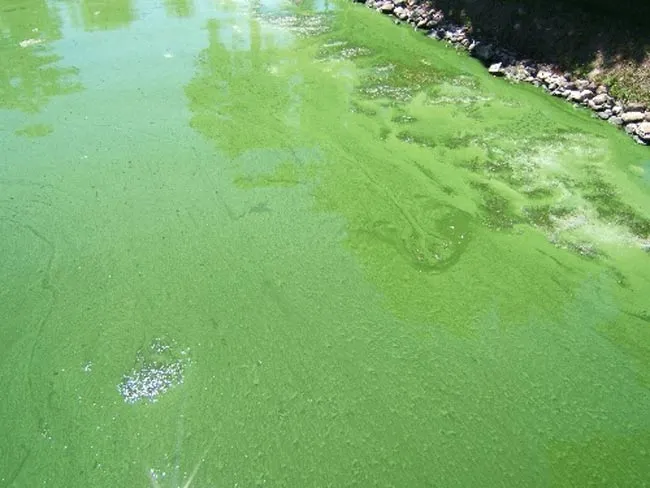
Mass extinctions that wiped entire species off the face of the Earth in a relative blink of the eye are often blamed on catastrophic occurrences, such as an asteroid crash or large volcanic eruption. But a new hypothesis points to a different culprit: lowly algae.
In the past 540 million years, five massive extinctions are thought to have killed off, in each case, some 50 percent to 90 percent of animal species. A new study suggests that toxins from algae played a major role in all five extinctions, including the most recent and most well-known – the death of the dinosaurs 65 million years ago. The idea was presented at the annual Geological Society of America meeting Oct. 19.
But could primitive algae really have taken down the dinosaurs? Well, the jury is still out, though some scientists are skeptical of the algae-killing idea, saying evidence is at best lacking and to point the finger at just one culprit for one mass extinction, let alone five, makes little sense.
And while no one can ever know for certain what caused these extinctions, some theories are more accepted than others. For instance, most scientists think an asteroid impact was the major factor in the dinosaur extinction, while a volcanic eruption was a big contributor to the Permian extinction, the largest of the five. As of now, the killer-algae hypothesis doesn't fit into the "accepted" category.
Toxic algae
Algae are simple organisms that get their energy from the sun and lack many features found in plants, such as roots and leaves. Some algae species produce toxins that are harmful to other aquatic organisms and even us. For instance, one group of algae called dinoflagellates can release neurotoxins that act on nerve cells.
When nutrients abound, the algae and other primitive microbes can grow rapidly and can aggregate to form dense populations, known as algae blooms. Such outbreaks of toxic algae can have devastating effects on ecosystems, killing fish, birds, marine mammals and even people.
Get the world’s most fascinating discoveries delivered straight to your inbox.
The most problematic group of toxin-producers are cyanobacteria, commonly known as blue-green algae. While cyanobacteria are not technically algae – they were reclassified from algae to bacteria – they can produce their own energy from the sun, and some researchers still place them in the algae group. Also, their "blooms," which cover the water with a blue-green film, are referred to as algal blooms.
Clemson University researchers James Castle, a geologist, and John Rodgers, an environmental toxicologists, wanted to find out if such algal blooms that are harmful today could have posed a threat millions of years ago and possibly contributed to extinctions.
First, they did a literature search, turning up reports of an increase in fossilized stromatolites, or dome-shaped rocks with layers of cyanobacteria known as "microbial mats," during four out of five of the mass extinctions.
Then, the team compared the structure of modern-day cyanobacteria with ancient cyanobacteria, finding the species had not changed much over millions of years.
"Since they've changed very little in their structure, and they make toxins today, we propose that they did so in the past," said Castle. While they didn't find an increase in fossilized algae at the time of the dinosaur extinction, the authors suggest that another form of algae, one that doesn't leave fossils behind, could have contributed to that extinction. They suggest so-called planktonic algae, which produces toxins in the soil, could have found its way into the animals' diets. The toxins can also become airborne, providing another way to poison species.
Kill mechanism
The new hypothesis does not single out algae as the only extinction factor, said Castle. Instead, they view the algae as what they call a "kill mechanism," a way for environmental change to contribute to increased death.
"The toxins tend to become stronger and released when there's something that stresses the algae, [such as] a change in salinity of the water, a change in temperature," said Castle. "There could have been an impact or volcanic eruption, and that may have stressed the algae, [and] by changing the conditions, they released toxins that kill the organisms."
In this way, the hypothesis fits in with other the theories already proposed for extinction. "It does not exclude any of the other hypotheses for mass extinction," said Castle.
A matter of timing
However, some scientists are unconvinced. They say that, while there was an upswing in algae stromatolites near the time of the extinctions, the surge actually occurred after the extinctions, not before or during them.
"In all cases, the microbial sediments post-date the extinction, so it seems unlikely that they were the actual cause," said Matthew E. Clapham, a a marine paleoecologist at the Univesrity of California, Santa Cruz, who studies the Permian-Triassic extinction.
And Clapham is skeptical of the attempt to tie algae to all the major extinctions.
"Although many extinctions do share common causes, I don't know that it's really as good of an idea to try and explain all things by just one cause like this," he said.
But Clapham doesn't rule out the possibility that algae could have contributed to past extinctions in some way. "I suppose it's possible that they may have played a role in prolonging the [extinction] recovery, or maybe an additional stress after the major stress that caused most of the extinctions," he said. One way for the researchers to firm up their hypothesis would be to study modern stromatolites, which exist in a few places on Earth, such as Australia, said Clampham. They could look to see if these stromatolites are capable of producing toxins in amounts large enough to cause significant die-offs, he said.
Also, scientists could look for remnants of such cyanobacteria toxins possibly preserved in the geological record. If the preserved toxins coincide with any of the major extinctions, that would be a clue that algae perhaps played a role in such catastrophes.
"You can look for this in the rock record; you can go to these mass extinctions and see, 'Do we find some of these molecules that are associated with toxins or cyanobacteria?'" said Clapham.
Predicting the past
Some scientists argue that extinction is a natural part of life, and that there is no telling what caused extinction so long ago.
"Who knows what the causes were, or might be, for a species' extinction?" said Fredrick Rich, a geologist at Georgia Southern University. "It is all, and is absolutely, and without equivocation, speculation to decide how something or someone died."
However, the majority of scientists agree that there were five periods in time when the extinction rate was much higher than average. And while there were likely a number of contributing causes, some factors may have played greater roles than others.
"I think with all of these extinctions, there's probably multiple things going on. You can't kill off that much stuff without a number of stresses," said Clapham. "So I think the real answer is probably a combination of things, but I think it's important to determine what is the most important with each of them."
As for the algae hypothesis, Clapham says it lacks evidence to show that the toxins were really the "most important" contributor.
"Because cyanobacteria have been around for most of the history of life on Earth, it's virtually certain that there were times in the past when there were local die-offs due to cyanobacterial toxins," said Clapham. "But to demonstrate that it was a global event, or something significant enough, I'm not sure that that's likely."
The hypothesis was published in the March 2009 issue of the journal Environmental Geosciences.

Rachael is a Live Science contributor, and was a former channel editor and senior writer for Live Science between 2010 and 2022. She has a master's degree in journalism from New York University's Science, Health and Environmental Reporting Program. She also holds a B.S. in molecular biology and an M.S. in biology from the University of California, San Diego. Her work has appeared in Scienceline, The Washington Post and Scientific American.