













Mice Levitated in Lab

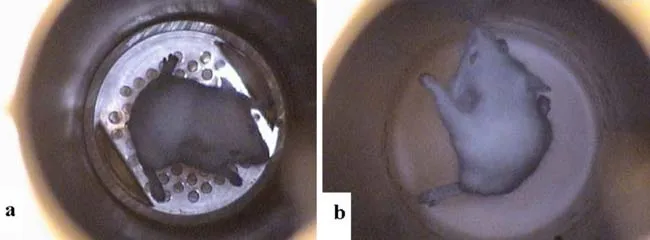
Scientists have now levitated mice using magnetic fields.
Other researchers have made live frogs and grasshoppers float in mid-air before, but such research with mice, being closer biologically to humans, could help in studies to counteract bone loss due to reduced gravity over long spans of time, as might be expected in deep space missions or on the surfaces of other planets.
Scientists working on behalf of NASA built a device to simulate variable levels of gravity. It consists of a superconducting magnet that generates a field powerful enough to levitate the water inside living animals, with a space inside warm enough at room temperature and large enough at 2.6 inches wide (6.6 cm) for tiny creatures to float comfortably in during experiments.
Disoriented
The researchers first levitated a young mouse, just three-week-old and weighing 10 grams. It appeared agitated and disoriented, seemingly trying to hold on to something.
"It actually kicked around and started to spin, and without friction, it could spin faster and faster, and we think that made it even more disoriented," said researcher Yuanming Liu, a physicist at the Jet Propulsion Laboratory in Pasadena, Calif. They decided to mildly sedate the next mouse they levitated, which seemed content with floating.
A plastic cage was also designed by physicist Da-Ming Zhu at the University of Missouri, Kansas City, to keep the mice in during levitation. Its top remained open to let in air, food, water and video surveillance, and its bottom was filled with small holes to allow waste removal.
Get the world’s most fascinating discoveries delivered straight to your inbox.
From time to time, mice would kick the walls of the cage, causing it to briefly drop off from the levitation zone before re-entering it and floating again.
Although the researchers could levitate mice with or without the cage, "it's easier to house a mouse in a cage when you bring it to the levitation zone," Liu explained. Also, if you want to run an experiment comparing mice living inside and outside the levitator, you want to set up exactly the same living conditions to match results up as best as possible.
Results
Repeated levitation tests showed the mice, even when not sedated, could quickly acclimate to levitation inside the cage. After three or four hours, the mice acted normally, including eating and drinking. The strong magnetic fields did not seem to have any negative impacts on the mice in the short term, and past studies have shown that rats did not suffer from adverse effects after 10 weeks of strong, non-levitating magnetic fields.
"We're trying to see what kind of physiological impact is due to prolonged microgravity, and also what kind of countermeasures might work against it for astronauts," Liu said. "If we can contribute to the future human exploration of space, that would be very exciting." They are now applying for funding for such research with their levitator.
The researchers also levitated water drops up to 2 inches wide (5 cm). This suggests the variable gravity simulator could be used to study how liquids behave under reduced gravity, such as how heat is transferred or how bubbles behave.
Liu, Zhu and their colleagues detailed their findings online Sept. 6 in the journal Advances in Space Research.
