











Grizzlies could thrive in California — so why aren’t we reintroducing them?
In this excerpt from "Start With a Bear," author and environmental historian Peter S. Alagona looks at the models used to develop the U.S. grizzly bear recovery program, and how California could make an ideal home for a new population.

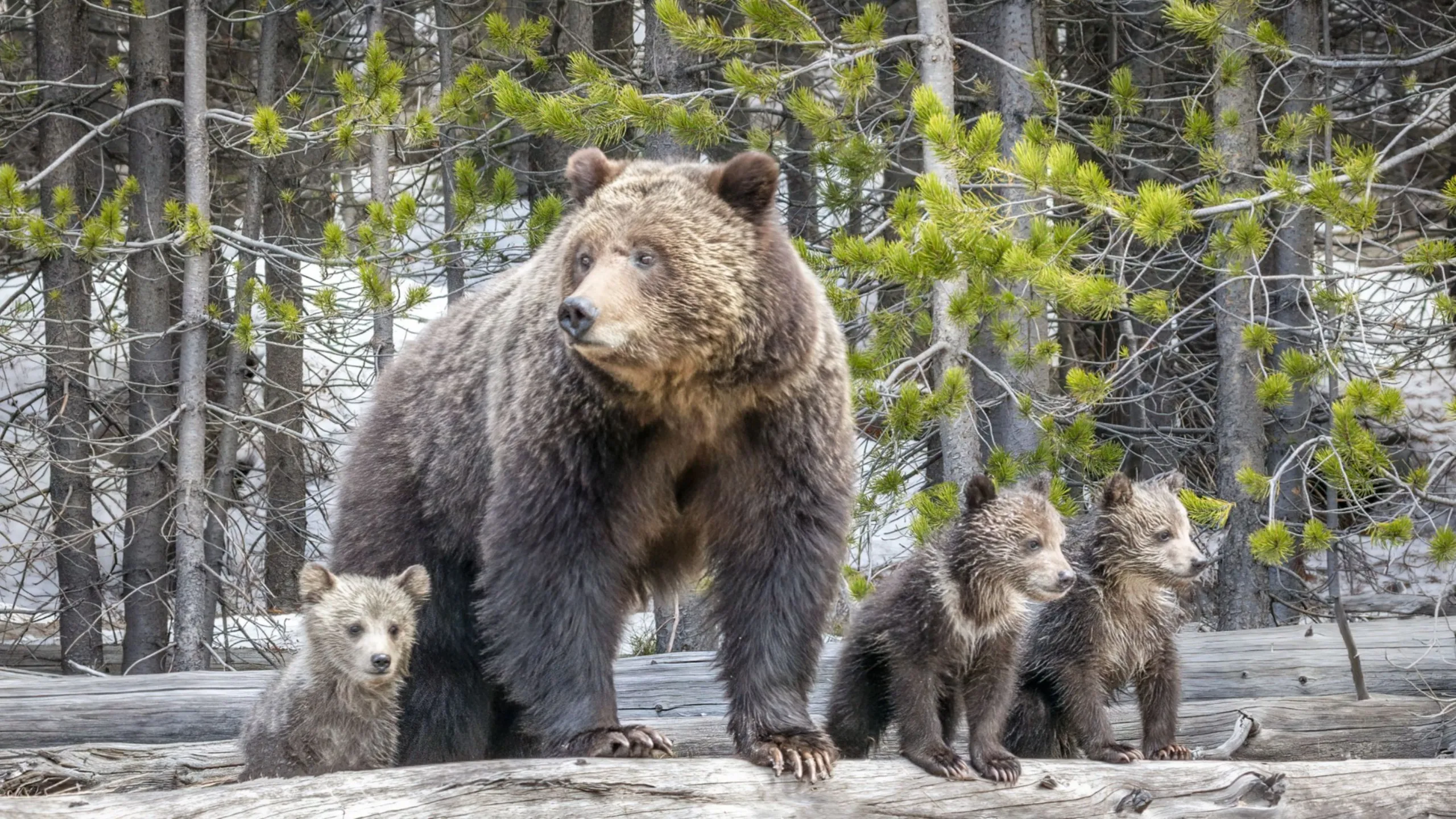
Computer models are widely used in ecological research and conservation, providing scientists with tools to predict how a given species might respond to a stressor or shift in conditions. These models can then be refined and built upon with real world data to get a better understanding of what's going on within a population and what the biggest risks are.
But models aren't perfect. In this excerpt from "Start With a Bear: Humans, Grizzlies, and the Power of Stories on a Crowded Planet" (HarperOne, 2026), author Peter S. Alagona highlights how these models are built on the presumptions of their creators. Alagona examines the model of grizzly bear (Ursus arctos horribilis) habitats used by the Fish and Wildlife Service (FWS) to inform its recovery plan for the species — and why California, despite its apparent suitability, was left out.
Most of the grizzly habitat models that were introduced in the 1990s and 2000s, and then improved in the 2010s and 2020s, make two key assumptions. They assume that conservation efforts should focus on the best remaining grizzly habitats, and that we can best understand those habitats by studying bears in the places where they still live.
The result has, indeed, been a far better understanding of grizzly habitat use. But this approach has also produced a circular logic with a structural bias toward the status quo. In most grizzly habitat models, past realities and future possibilities fade. With each new study, it seems more and more like the only possible places for grizzlies are the exact kinds of places where they currently live.
The six recovery areas identified in the 1993 Recovery Plan were all places where grizzlies still lived or had recently lived when they were listed as threatened in 1975. The plan argued that these areas "had the potential to provide adequate space and habitat to maintain the grizzly bear as a viable and self-sustaining species." But it also acknowledged the risks and uncertainties facing the bears, and it pledged to assess other areas in their historical range.
This process was expected to take five years. Twenty-eight years later, in 2019, the FWS settled a federal lawsuit in which it agreed to finally conduct this long-delayed analysis. It built a simple model based mainly on secure habitat, and then applied it to both the San Juan Mountains of Colorado and the Sierra Nevada of California. Other potential recovery areas — such as the North Rim of the Grand Canyon in Arizona, the Gila Wilderness in New Mexico, and the Northwest Forest of Northern California — were, for unexplained reasons, not included.

The current grizzly bear recovery zones with the proposed boundaries.
The model did its job. According to the FWS, neither the San Juans nor the Sierra Nevada contained enough secure habitat to support a viable grizzly population. Instead of subjecting the study to peer review, the FWS published it in an appendix on page 286 of a species status report. Having pioneered the idea of secure habitat, David Mattson now set out to explain why the FWS was abusing it. In his view, the service's models focused on artificially small areas, failed to consider several key factors described in the scientific literature, and neglected to conduct essential supporting analyses to explain its conclusions.
The FWS had dragged its heels for almost three decades, and then, after pledging in court to conduct a good-faith analysis, produced a study that seemed designed to reach a predetermined result: The only places capable of supporting grizzlies were the places where the FWS was already trying to recover them. When Mattson and his colleague Troy Merrill ran a more detailed model for the southwestern states, they found that Arizona, Colorado, New Mexico, and Utah contained seven potential recovery areas with more than 45,000 square kilometers of suitable habitat that could probably support more than 1,000 bears.
For more than a century, the prevailing narrative in California has been that the grizzly's extinction there was inevitable and its recovery is impossible. But Mattson's results for the southwest, combined with California's unique geography, cast doubt on this story.
California is home to nearly 40 million people, and it has more miles of roads than any state except Texas. But its population is extraordinarily concentrated. California is the most urban state, with 95% of its residents packed into cities and 75% living on only around 2% of its land area. Much of California has a human population density lower than that of the Northern Rockies. Unlike in the Northern Rockies, the majority of California's farms are concentrated in broad valleys dozens of miles from core wilderness habitats.

Kings Canyon National Park in California has been identified as one of the locations where grizzlies could thrive.
Outside urban and agricultural areas, California has more protected land than any state except Alaska, including the largest areas of potential grizzly habitat outside the six current recovery zones. Some of these protected areas are in desert ecosystems not suitable for grizzly bears, but others are in mountain ecosystems with potential grizzly habitat.
California's national parks and wilderness areas sometimes strain under heavy visitation, but the numbers paint a complex picture. Consider the southern High Sierra. In 2024, Sequoia Kings Canyon National Park, which is around 865,000 acres and 97% wilderness, topped 2 million visitors for the first time, whereas Yellowstone, which is around 2.2 million acres and 90% wilderness, received almost 5 million visitors, meaning that both parks had about 2.3 visitors per acre. Yellowstone has more than double the total land area in wilderness, but both parks border large U.S. Forest Service wilderness areas and other public lands, and the High Sierra has fewer roads cutting across its protected areas.
In 2024, I coauthored a study, almost eight years in the making, looking at potential grizzly habitat in California. This project, led by Alex McInturff from the University of Washington, ran four computer models, and then compared them to assess the results each produced. One of these models focused on historical sightings of grizzlies in California, two used approaches developed in other regions where brown bears currently live, and one looked at the habitat use preferences of one of California's other large carnivores, the puma.

The Grizzly Bear Recovery Program was created in the 1970s to restore populations to self-sustaining levels.
Each of these approaches has its own strengths and weaknesses. None of them fully account for the distribution or abundance of food on the landscape or for possible conflicts with people. Together, however, they provide a first assessment of the amount, quality, and locations of potential grizzly habitats. Amazingly, about a third of California appeared as suitable habitat in all four models.
The biggest areas of high-quality habitat were in the southern Sierra Nevada, around Sequoia-Kings Canyon National Park, where some of the last California grizzly sightings occurred in the 1920s. The Northwest Forest, along the Pacific Coast near the Oregon border, also scored highly owing to its low human population density and rich forest habitats. The Transverse Ranges, in the state's southwestern corner, scored highly because of their rich chaparral habitats and density of historical sightings, but ranked somewhat lower than the other two because more people live, work, and grow crops, including extensive vineyards and avocado orchards, around its borders.
- 'We're looking at how a bear sees the world': From forest trails to 'Sims for Bears,' researchers are learning how grizzlies navigate a fragmented wilderness
- Bear hair and fish weirs: Meet the Indigenous people combining modern science with ancestral principles to protect the land
- Photojournalist Steve Winter on his iconic Hollywood puma image, the illegal tiger trade and having a black panther knock on his door
These results made intuitive sense, given the state's robust historical grizzly population, large areas of protected habitat, and healthy black bear populations. But they represented a departure from the conventional wisdom that dominated the circular logic of most habitat models. For the first time, it was clear how much potential habitat could be available in California for a grizzly recovery. But our approach still clung to the conservative assumption that the grizzly is a wilderness species. We had shown, with some important caveats, that California probably had enough wilderness to support one or more viable grizzly populations.
What we hadn't shown was whether Californians were willing to coexist with grizzlies that might, someday, wander outside the state's wilderness boundaries.
From the book START WITH A BEAR: Humans, Grizzlies, and the Power of Stories on a Crowded Planet, by Peter S. Alagona. Copyright © 2026 by Peter S. Alagona. Published by HarperOne, an imprint of HarperCollins Publishers. Excerpted by permission.
Help us improve Live Science Pro: We're always trying to make our content better. Leave us feedback about Pro here.

A century ago, prevailing wisdom cast large carnivores as adversaries—pests and threats to be removed for human safety and prosperity. In North America, among the most targeted of these animals were brown bears, or grizzlies, whose population decimation has made them emblematic of this fear-driven approach to wildlife management.
In California, where they once roamed the land in the tens of thousands, grizzlys have not been seen in more than 100 years. Modern conservation has evolved, yet it often remains rooted in a separation from nature, a systemic opposition that keeps the wild at arm's length.
In Start with a Bear, historian, ecologist, and bear expert Peter Alagona suggests we must reimagine the very heart of conservation, inviting a new framework for sustainable, reciprocal relations with the wild creatures that remain.

Peter S. Alagona is an environmental historian, conservation scientist, and nature-culture geographer. His work explores what happens when people share space and resources (their habitats) with other species: how we interact with non-human creatures, how we make sense of these interactions, why we fight so much about them, what we can learn from them, and how we might use these lessons to foster a more just, peaceful, humane, and sustainable society. He is a professor of environmental studies at the University of California, Santa Barbara. He is the author of "After the Grizzly" and "The Accidental Ecosystem."
- Hannah Osborne Editor
You must confirm your public display name before commenting
Please logout and then login again, you will then be prompted to enter your display name.