Live Science Plus


Mysterious Ancient Moroccan Rock Pile Explained

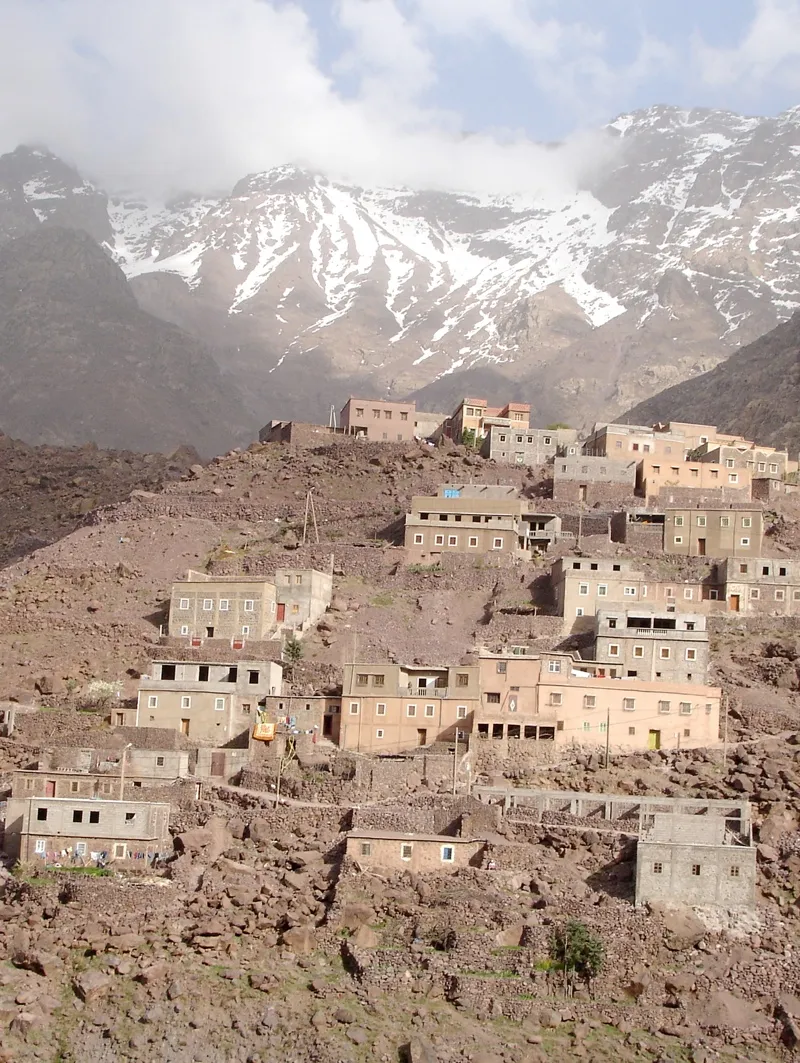
The origin of the giant pile of boulders a Moroccan village rests precariously on has long mystified scientists. But the mystery has now been solved: the boulders are the result of a catastrophic rockfall that occurred 4,500 years ago in the High Atlas Mountains, scientists find.
A glacier apparently made the Moroccan cliffs prone to collapse, suggesting rockfalls elsewhere in the world might be due to a similar process, researchers said.
Scientists analyzed the remains of one of the largest debris fields known in North Africa — the Arroumd rock avalanche at the foot of the northwest face of Mount Aksoual, which stands 12,834 feet (3,912 meters) above sea level in the High Atlas Mountains in Morocco. A village now sits on top of this rock pile, below acliff face 6,500 feet (2,000 m) high. [Photos: See the Atlas Mountains of Morocco]

The age and origin of Arroumd have puzzled for more than 135 years. In the past, researchers suggested it was a feature of moraines, or masses of rock and sediment carried and deposited by glaciers. In contrast, study lead author Philip Hughes, a geomorphologist at the University of Manchester in England, had assumed that Arroumd was the result of a rock avalanche that happened soon after a glacier that dominated the valley melted.
To help solve the mystery of Arroumd, Hughes and his colleagues dated the age of the rocks there.
They looked at levels of the isotope beryllium-10, which is often formed on Earth when cosmic rays hit quartz in surface rocks. Levels of this isotope can reveal when these rocks were exposed to open air, showing when the deposit formed. (Isotopes of an element have differing numbers of neutrons from one another.)
Arroumd was a difficult place to work, Hughes said.
"Several incidents occurred at the site, including some accidents — minor, thankfully — and mystery ailments to those who went there," Hughes said. "I always joke about the 'curse' of the Arroumd landform. This year we encountered severe whirlwinds when entering the valley, just days after the paper was published. We were unable to stand on our feet, which is rather unusual for this part of the world where climate is often hot and calm."
Unexpectedly, the rock avalanche happened long after the glacier melted.
"The glacier would have melted before 11,700 years ago, the end of the last ice age," Hughes said. "However, the cliff did not collapse until 4,500 years ago. The rock avalanche was therefore not triggered by glacier retreat."
Instead, the researchers now suggest the avalanche was triggered by seismic activity, sitting as it does close to a major tectonic fault.
"I did not anticipate the rock avalanche being so young — I thought it formed in the last ice age," Hughes said. "But I am always ready to challenge and revise, and hopefully improve on, my earlier work. That is science, after all."
Glacial erosion probably did make the cliff face that gave rise to this avalanche excessively steep and prone to collapse. "It may be that some glaciated valleys are waiting to collapse, and the trigger could be either an earthquake, heavy rainfall, or both," Hughes said. "In the European Alps, there is evidence for a similar series of landslides at roughly the same time, and a recent paper has suggested that these landslides are associated with a deluge of heavy rainfall at this time."
As to what danger the village might face, given its precarious location, "I think that now the rock avalanche has happened, the main risks are gone — better to build below a cliff that has collapsed than one waiting to fall," Hughes said. "The village is built using the rocks of the avalanche. It is an amazing place."
The scientists detailed their findings online March 20 in the journal Geological Society of America Bulletin.
Follow Live Science @livescience, Facebook & Google+. Original article on Live Science.