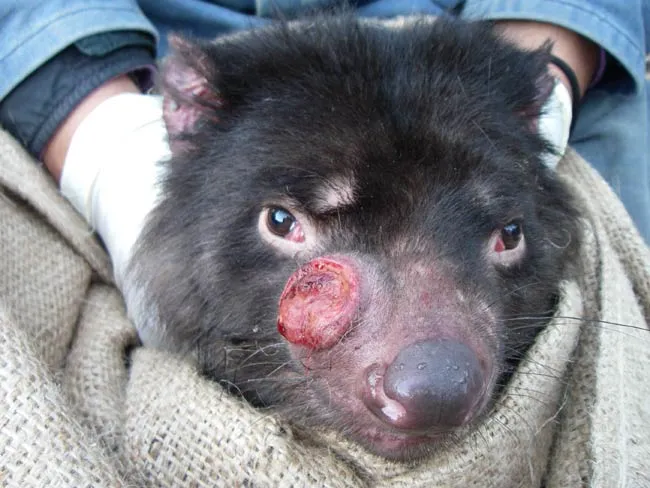
A deadly, contagious cancer that is killing off Australia's Tasmanian devils is evolving, though not how researchers typically think the process occurs.
Rather than changing their genes, a new study finds, Tasmanian devil tumors are altering on an epigenetic level — meaning the basic gene sequences stay the same, but the genes that get switched on and off are different.
Devil Facial Tumor Disease, as it is known, has killed more than 80 percent of Tasmanian devils since 1996, and could drive this unique Australian marsupial to extinction within decades.
Latest Videos From
Some of the epigenetic variants may help the cancer spread more easily or evade the immune system, said study researcher Katherine Belov, an animal geneticist at the University of Sydney.
"Now we just need to determine whether the tumors are evolving in a particular way," Belov told LiveScience. "Are they becoming more aggressive or less aggressive?"
A contagious cancer
Devil Facial Tumor Disease traces back to a single female Tasmanian devil living in northeast Tasmania. That devil is long dead, but her cancer cells live on, spread by bites and nips from Tasmanian devil to Tasmanian devil. Enormous tumors grow on the face and jaw, causing death by either preventing the devil from eating or by metastasizing to other organs. Typically, devils survive with the disease no longer than six months, during which time they can spread it to their kin through their frequent biting behaviors.
Genetic studies of the tumors have revealed them to be quite stable, with few mutations in their basic DNA sequences. But no one had studied the processes that regulate these genes, Belov and her colleagues report today (Nov. 6) in the journal Proceedings of the Royal Society B.
Using 35 tumor samples and 12 noncancerous tissue samples from 41 Tasmanian devils, the researchers examined the tumor cells' DNA methylation, or a molecular "tag" attached to portions of the DNA strand. These tags help regulate which genes will be activated and which won't. Depending on the position, methylation can suppress certain genes and even contribute to the development of cancer.
Over time, the researchers found, the tumors became less and less methylated, meaning fewer segments of DNA were "tagged."
"The key finding is that previously we thought of tumors as clonal, identical," Belov said. "Now we can say that the tumors are not static entities and are evolving and changing." [Photos: Australia's Struggling Tasmanian Devils]
What's next for Tasmanian devils
The trickier question is what this means for Tasmanian devils. It's possible the tumors are getting more aggressive, but they may also be morphing into benign forms with these changes, Belov said.
In support of the latter possibility, devils in the northwest of Tasmania seem to be contracting the disease less readily than in other areas, Belov said. A few devils have even recovered.
A similar contagious cancer, found in dogs, grows for only three to six months before the immune system beats it back (though usually not before it is transmitted to other dogs), Belov said. That cancer is an "excellent parasite," Belov said — it spreads from body to body, but doesn't wipe out its potential hosts. At this rate, she said, Devil Facial Tumor Disease will wipe out all Tasmanian devils and die with them, a less-than-ideal evolutionary strategy.
However, Belov said, tumors don't think or make plans, they just evolve. Whether or not Tasmanian devil tumors end up evolving toward a more moderate path is simply speculation at this point. Nevertheless, the new study is important for human attempts to manage the disease's spread, she said.
"Tumors from different regions of the state may behave quite differently, and this needs to be considered when making management decisions," Belov wrote in an email. "It is really important to survey the phenotype (or behavior/characteristics) of tumors across the state to better understand how the tumor is evolving."
Follow Stephanie Pappas on Twitter @sipappas or LiveScience @livescience. We're also on Facebook & Google+.