













Heartbeats physically stop cardiac cancer from growing — and that could be key to thwarting other cancers, too
Scientists have pinpointed a mechanism that may explain heart cancer's rarity and point to new cancer treatments.

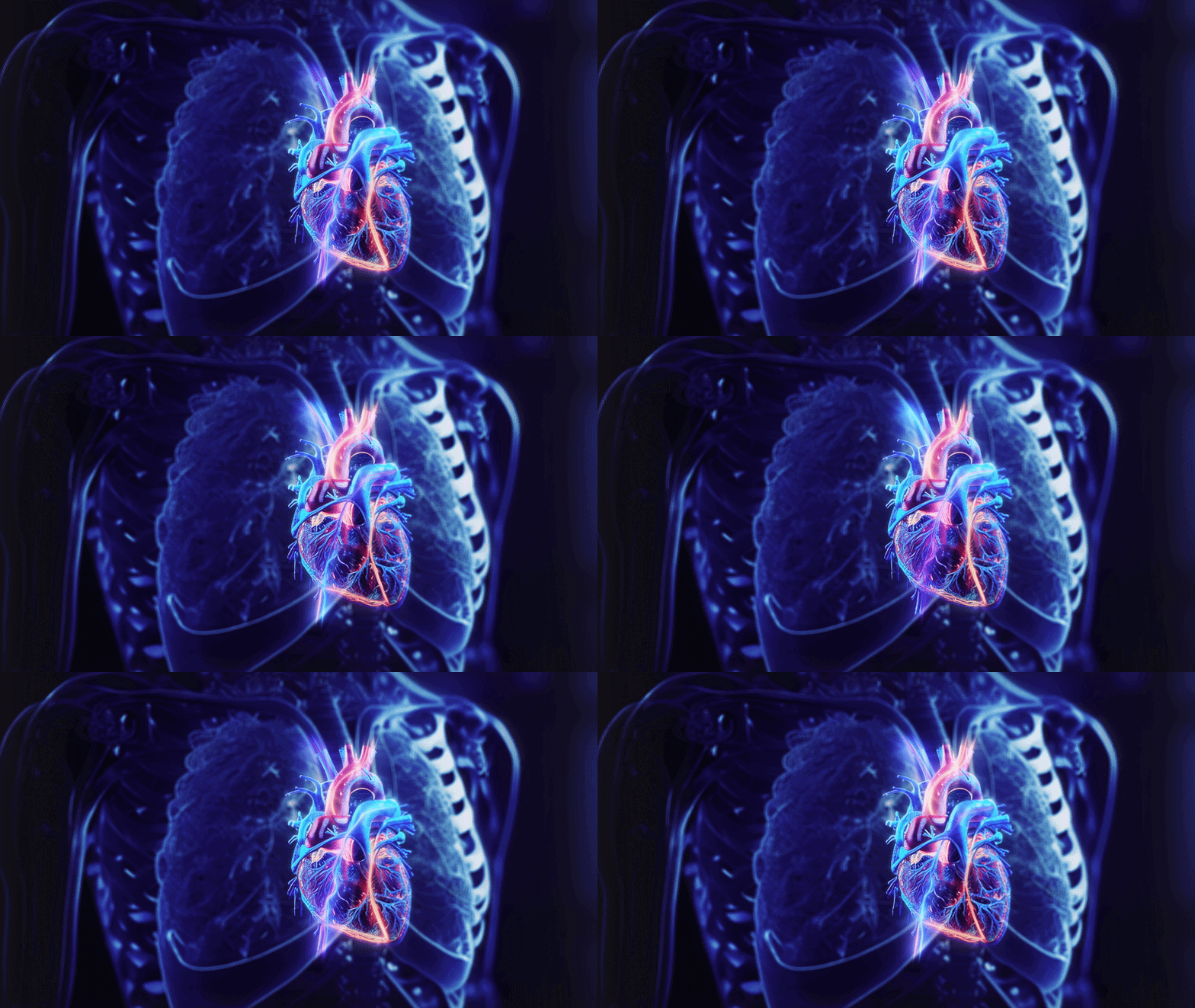
The force of a pumping heart changes how cancer cells function, halting their ability to multiply and spread, a new study shows.
The finding may help to explain why heart cancer is so rare, occurring in fewer than 2 in 100,000 people per year.
A protein called Nesprin-2 is key to this phenomenon. Found in the outer membrane of a cell's nucleus, the protein was already known to sense and respond to mechanical forces. Now, Nesprin-2 has been found to sense the force of heartbeats and stop cancerous cells from multiplying.
In addition to offering a possible explanation for why heart cancer is so rare, the findings could open the door for new therapies for other cancers, researchers concluded in the study, which was published April 23 in the journal Science.
We're going to "try to exploit this knowledge to develop a mechanical therapy for cancer," study author Serena Zacchigna, head of the Cardiovascular Biology Laboratory at the International Centre for Genetic Engineering and Biotechnology in Italy, told Live Science.
Zacchigna and colleagues are developing bands that can be strapped around tumors on the skin and then reproduce the force of a beating heart. Because metastatic skin cancer is one of the more common cancers to spread to the heart, this is a good first clinical case to look at, Zacchigna said.
Heartbeats subdue cancer
Both primary heart cancer, which starts in the heart, and secondary heart cancer, which spreads to the organ from other places, are fairly rare. The reason for this rarity is a long-standing mystery.
Get the world’s most fascinating discoveries delivered straight to your inbox.
The mechanical load of heartbeats, meaning the physical force they exert, has been found to limit the ability of heart tissue to regenerate. So Zacchigna and her colleagues wanted to see if heartbeats might also stop cancerous cells from multiplying.
First, they implanted lung cancer cells into the hearts of lab mice to observe the cells' growth and spread. The hearts were either beating normally or were "unloaded," meaning they were attached to a blood supply but not actively pumping. Beating hearts seemed to stave off cancer growth, while the unloaded hearts saw a massive proliferation of cancerous cells.
The team ran a similar test with rat heart tissue grown in lab dishes. They found that tinkering with the amount of mechanical load in the tissue affected the behavior of lung cancer cells; the cancer grew and spread more when the mechanical load was reduced.
To understand what causes this phenomenon, the team took tissue samples from human patients whose lung, colon or skin cancer had spread to the heart and other organs. They mapped the gene activity of those cancer cells and zoomed in on their epigenetics, the markings "on top of" DNA that control which genes are switched on.
They found that certain epigenetic markers were tied to tumor growth and confirmed that heartbeats reduce these tumor-related markers. From there, they identified Nesprin-2 as a key player — switching off Nesprin-2 in "beating" heart tissue increased cancer proliferation.
These findings are the first to show that mechanical forces beyond the tumor itself affect the growth and spread of cancerous cells, Zacchigna said. The ability for mechanical forces to thwart cancer proliferation also appears to be a general mechanism, as "we saw that this signature is common to many cancer types," she said.
Possible treatments?
These findings are "of consequential importance," said Julie Phillippi, a chair of cardiothoracic surgery and head of the Cardiac Research Laboratory at the University of Pittsburgh, who was not involved in the research.
In an email, she told Live Science that the findings could also shed light on how to regenerate heart tissue in a targeted manner. And because heart cancer is so rare, "this work may have stronger impact in the context of cancers in other organs," she added.
The potential of using mechanical stimulation in cancer therapies is an "exciting idea to pursue," Phillippi said. But it requires a better understanding of how the properties of the tissue surrounding cancer cells affect their ability to sense mechanical forces.
With their new cancer-shaking bands, the team hopes to start a clinical trial within four years. For that, they'll need the first prototypes of these systems ready for human use, Zacchigna said. It will be key to identify the right time to implement the therapy and the patients who would benefit most, she noted.
RELATED STORIES
A major challenge is to confirm this mechanical stimulation is a safe procedure, Zacchigna said.
"My fear is that by squeezing a tumor we may favor its dissemination," she said. "This is something we really have to rule out before moving forward."
Another approach could be to find drugs that can mimic the epigenetic effects of heartbeats, without the need for mechanical stimulation. The team is exploring that idea, too.
This article is for informational purposes only and is not meant to offer medical advice.
Ciucci, G., Lorizio, D., Bartoloni, N., Budini, M., Colliva, A., Vodret, S., Nguyen, A., Ciacci, L., Texler, B., Cardini, B., Oberhuber, R., Bindelli, S., Del Giudice, I. L. C., Vuerich, R., Riccitelli, F., Zago, E., Finsberg, H. N., Chiesa, M., Perrucci, G. L., . . . Zacchigna, S. (2026). Mechanical load inhibits cancer growth in mouse and human hearts. Science, 392(6796), eads9412. https://doi.org/10.1126/science.ads9412

Sophie is a U.K.-based staff writer at Live Science. She covers a wide range of topics, having previously reported on research spanning from bonobo communication to the first water in the universe. Her work has also appeared in outlets including New Scientist, The Observer and BBC Wildlife, and she was shortlisted for the Association of British Science Writers' 2025 "Newcomer of the Year" award for her freelance work at New Scientist. Before becoming a science journalist, she completed a doctorate in evolutionary anthropology from the University of Oxford, where she spent four years looking at why some chimps are better at using tools than others.
You must confirm your public display name before commenting
Please logout and then login again, you will then be prompted to enter your display name.