













Some fungi can influence the weather — and now we know how they do it
Some types of fungi borrowed a gene from ancient bacteria that gave the ability to make ice and trigger rain.

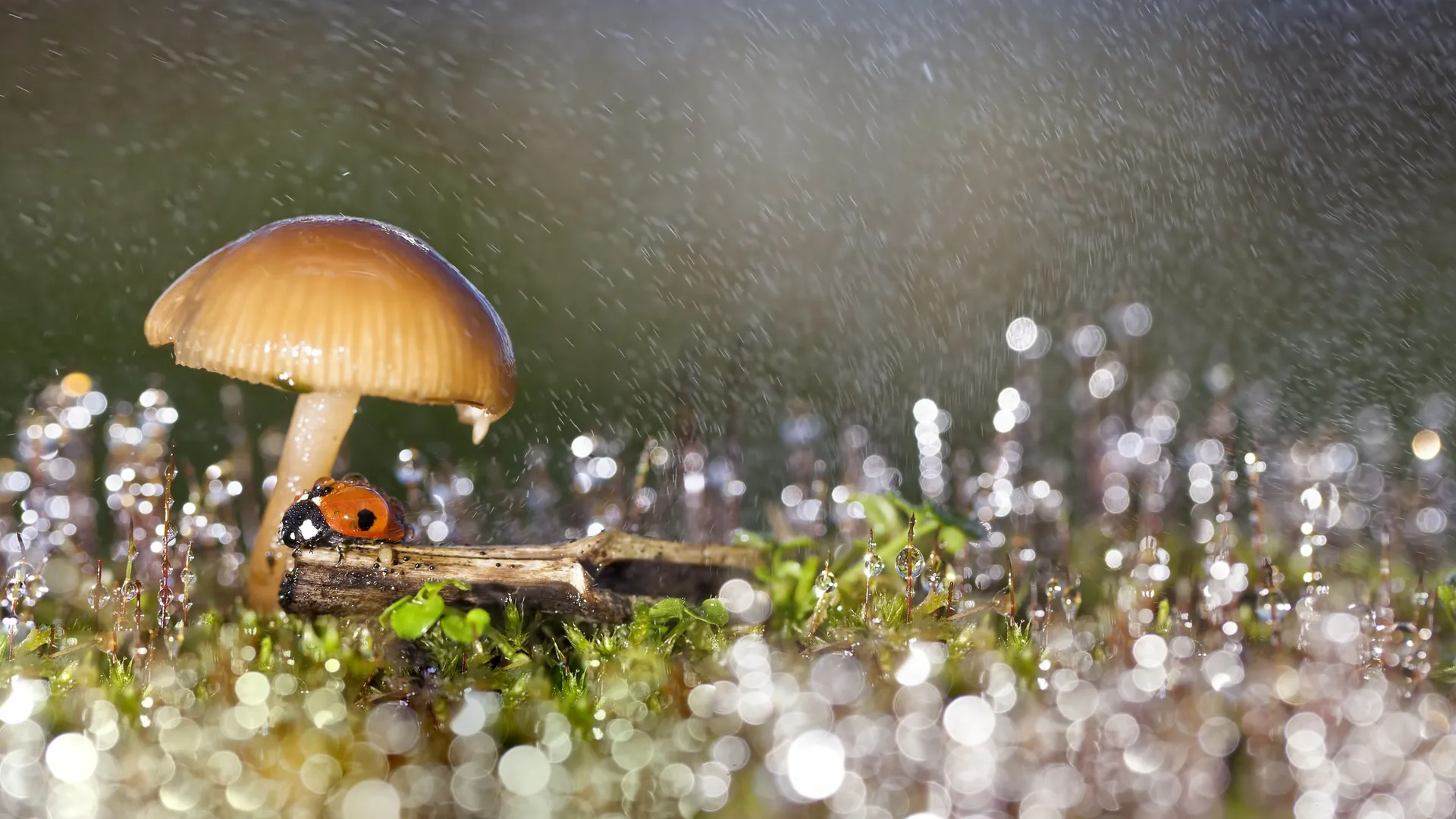
Some fungi can produce proteins that freeze water, which may allow them to reach into the atmosphere and trigger rain. Now, scientists have discovered the secret to this process: a gene from ancient bacteria.
Researchers have long known that some bacteria have proteins in their cell membranes that allow them to freeze water at relatively high temperatures, about 23 degrees Fahrenheit (minus 5 degrees Celsius) — a process known as ice nucleation. Certain species of fungi can do this as well, but much less was known about how it worked in that kingdom of life.
"We just wanted to figure out how this works," said Boris Vinatzer, a microbiologist at Virginia Tech and co-author of the new study, which was published March 11 in the journal Science Advances.
Vinatzer and his colleagues studied the genomes of two strains of fungi in the Mortierellaceae family to find their ice-nucleating protein. They had a couple of leads: They knew the protein was secreted into the environment rather than stuck to the fungal cells, and they knew roughly how big it was. So they looked for genes that had those characteristics and were similar to known bacterial ice-nucleating proteins.
They were surprised to find a candidate that was almost identical to a bacterial gene called InaZ. And when they transferred that fungal gene into a yeast cell, the yeast gained the ability to create ice as well.
"We confirmed that that particular DNA fragment actually makes ice nucleation proteins," he told Live Science.
This suggests that, at some point in the past, perhaps millions of years ago, an ancestral fungus acquired the gene from its bacterial neighbors — a process known as horizontal gene transfer — and then made it its own.
Get the world’s most fascinating discoveries delivered straight to your inbox.
Less clear, however, are how the fungi are using this ice-making ability and what evolutionary advantage it gives them. "We really have no idea so far," Vinatzer said.
Bacteria that have ice-nucleating proteins are often ones that attack plants, such as Pseudomonas syringae, which infects corn. Scientists think these bacteria use the ice-forming proteins to damage the plant, allowing nutrients to seep out or the bacteria to invade.
One of the fungi in the new study was from lichen, a hybrid colony of fungus and algae that grows on rocks and trees. Vinatzer speculated that the ice-nucleating proteins may allow the fungus to pull water from the air, thus providing a necessary-but-scarce resource for the lichen.
"On mornings when there is high humidity and low temperatures, the fungal proteins can trigger a frost on the lichen that then melts and provides water later in the day," he said.
Related stories
- Fungi seem to 'sweat' to stay cool, and scientists don't know why
- Plastic-eating fungi could help take a bite out of Earth's rampant pollution crisis, study suggests
- 'They are life, but not as we now know it': 26-foot organism that lived 420 million years ago is completely unknown branch of animal kingdom
But perhaps the most intriguing aspect of these ice-making bacteria and fungi is that they may be able to influence the weather, seeding the clouds to call down rain.
Ice-forming bacteria like P. syringae are known to be part of the water cycle and play a significant role in precipitation. They get swept up into the clouds by wind or evaporation, where their ice-nucleating ability generates tiny crystals that eventually get large enough to fall as rain or snow. It seems likely that the ice-nucleating proteins secreted by fungi undergo a similar process, Vinatzer said.
Because a single fungus can secrete many proteins, with each acting as an individual ice nucleus, there may be many more of them in the clouds than there are rain-making bacteria. "That suggests fungi may actually be more important than bacteria in influencing the weather," he said, which could benefit not only the fungi on the ground but the entire ecosystem.
These newly discovered fungal proteins could be useful for humans as well, Vinatzer suggested. Cloud-seeding operations currently use a toxic chemical called silver iodide to generate ice crystals, but maybe it could be replaced with a benign organic protein.
"These proteins could be an alternative to toxic silver iodide," Vinatzer said. "If we can figure out how to produce them, why not use them instead?"
Eufemio, R. J., Rojas, M., Shaw, K., De Almeida Ribeiro, I., Guo, H., Renzer, G., Belay, K., Liu, H., Suseendran, P., Wang, X., Fröhlich-Nowoisky, J., Pöschl, U., Bonn, M., Berry, R. J., Molinero, V., Vinatzer, B. A., & Meister, K. (2026). A previously unrecognized class of fungal ice-nucleating proteins with bacterial ancestry. Science Advances, 12(11), eaed9652. https://doi.org/10.1126/sciadv.aed9652

Brian is an award-winning freelance science journalist based in New Brunswick, Canada. His work has appeared in New Scientist, Scientific American, Nature, Science, and more.
You must confirm your public display name before commenting
Please logout and then login again, you will then be prompted to enter your display name.