













Mangroves clean up $8.7 billion of nitrogen pollution every year, study finds
New research suggests mangroves remove 960,000 tons per year of nitrogen from global water systems, a figure that could rise to more than 5.5 million tons annually if conditions were optimal for the plants.


Mangrove forests around the world provide a largely overlooked nitrogen-pollution cleanup service — one that, if humans had to pay for it, would cost $8.7 billion per year, a new study estimates.
Mangroves are salt-tolerant plants that grow between the high-tide and low-tide marks in tropical and subtropical coastal regions. Their tall, tangled roots trap sediments rich in microbes that break down nitrogen in the water into nitrogen gas (N2) and nitrous oxide (N2O), effectively removing this nutrient from the ecosystem.
Researchers were aware that mangrove forests are valuable carbon sinks and provide a host of other ecosystem services, including coastal defense against storm surges and a buffer against erosion. But these forests' ability to remove nitrogen is poorly understood, despite the havoc that nitrogen pollution is known to wreak in aquatic ecosystems, the authors of the new study told Live Science.
"We're still really in the infancy of trying to understand what is driving this nitrogen removal," Benoit Thibodeau, an assistant professor in the Department of Earth and Environmental Science at The Chinese University of Hong Kong, said in a joint interview with his co-author Ziyan Wang, a doctoral student in environmental science at the same university. "You're taking reactive nitrogen … and you're removing it to the atmosphere as N2, which is nonreactive and has a residence time of thousands of years."
Nitrogen pollution is caused by excess nutrient runoff into water systems due to human activities such as agriculture. Between 2002 and 2010, this runoff amounted to 35.9 million tons (32.6 million metric tons) of nitrogen per year in freshwater ecosystems. This pollution promotes algal growth, leading to blooms that massively reduce oxygen availability for other species and release toxins into the water that can make animals and people sick.
Mangroves forests cover less than 0.1% of Earth's land surface, but they remove about 960,000 tons (870,000 metric tons) of nitrogen from water systems each year, the new study found. That's roughly equivalent to the mass of 650 giant sequoia (Sequoiadendron giganteum) trees — but optimal conditions for mangroves could boost their removal capacity to more than 5.5 million tons (5 million metric tons) per year, which is equivalent to the weight of over 4,000 giant sequoias. The findings were published April 29 in the journal Earth's Future.
Thibodeau and Wang analyzed the results of 51 previous studies, as well as measurements they took themselves, to estimate global nitrogen-removal rates in mangrove forests. They divided the data into actual removal rates, which are those observed in nature, and potential removal rates, which capture the amount of nitrogen that mangrove forests could soak up if temperature, salinity and nitrogen levels were optimal.
Get the world’s most fascinating discoveries delivered straight to your inbox.
Then, the researchers calculated averages for the actual and potential rates — and these, together with a global mangrove area estimate of 52,459 square miles (135,869 square kilometers), yielded an actual removal rate of 960,000 tons per year and a potential removal rate of over 5.5 million tons per year.
Microbes in mangrove forests remove nitrogen via two main pathways: denitrification and anaerobic ammonium oxidation (anammox). Denitrification transforms nitrate in the water into nitrogen gas and nitrous oxide, which is a greenhouse gas. Anammox, on the other hand, converts nitrite and ammonium into nitrogen gas, which makes up 78% of the atmosphere and is not a greenhouse gas. These pathways work best with relatively high nitrogen concentrations, but there is a threshold past which removal slows, according to the study.
These pathways also occur in seagrass meadows and other coastal environments, but mangrove forests are especially good at removing nitrogen because their sediments are oxygen-poor, which promotes the right kind of microbial activity, Wang said.
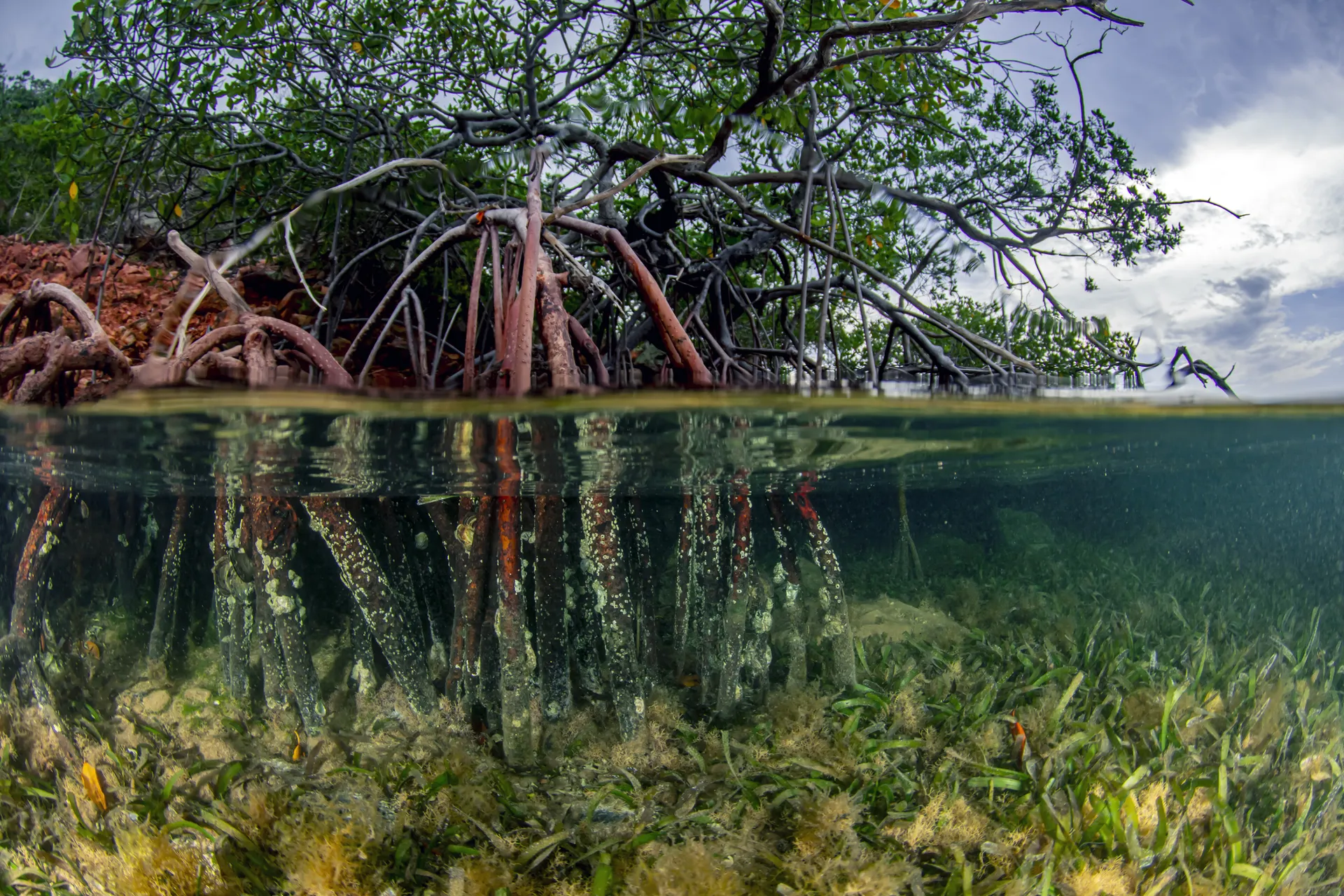
Mangrove forests host oxygen-poor sediments that encourage nitrogen-removing microbial activity.
Similar to carbon credits that people can purchase to offset their emissions from activities like flying, the researchers used a market-based credit approach to calculate the economic value of nitrogen removal in mangrove forests. Based on what municipalities in countries like Australia and the U.S. pay to get rid of nitrogen in their water systems, Thibodeau and Wang settled on a price of just over $10,000 for every metric ton of nitrogen removed anywhere in the world.
"Carbon has a very mature credit market now, but for nitrogen, it's not that mature," Wang said. "We did a very early investigation about how different markets, or different industries, deal with this kind of nitrogen pollution."
At the current rate of nitrogen removal, mangroves' cleanup service is worth $8.7 billion per year globally. If removal rose to 5.5 million tons per year, it would be worth around $57 billion annually, according to the study.
RELATED STORIES
The researchers also calculated the economic value of carbon sequestration in mangrove forests and found it was 12 times smaller than that of nitrogen removal. Notably, carbon sequestration is also less stable than nitrogen removal is, because mangroves store carbon in sediments that can be disturbed. On the flip side, mangrove forests convert nitrogen in the water mostly into nitrogen gas, which stays in the atmosphere, Thibodeau said. Nevertheless, mangrove forests "have a very high rate of storage of carbon compared to other ecosystems," he added.
Mangroves are mostly threatened by sea-level rise and land clearance for infrastructure, Thibodeau said. The results highlight that "we're not only losing space or nature, but we're also losing a very important financial value."
Mangroves have a relatively high heat tolerance, but rising global temperatures could alter how the microbes they host consume nitrogen, Wang said. Specifically, these microbes may start to rely more on denitrification, which could release more of the greenhouse gas N2O than at present.
Wang, Z., & Thibodeau, B. (2026). Blue nitrogen: global rates and economic importance. Earth S Future, 14(5). https://doi.org/10.1029/2025ef007772

Sascha is a U.K.-based staff writer at Live Science. She holds a bachelor’s degree in biology from the University of Southampton in England and a master’s degree in science communication from Imperial College London. Her work has appeared in The Guardian and the health website Zoe. Besides writing, she enjoys playing tennis, bread-making and browsing second-hand shops for hidden gems.
You must confirm your public display name before commenting
Please logout and then login again, you will then be prompted to enter your display name.