













NASA grants Voyager 2 probe another year of power with risky 'Big Bang' maneuver. Now, will it work for Voyager 1?
Voyager 1 is running low on power for science, but a successful energy-saving maneuver on Voyager 2 raises hope that the 50-year-old spacecraft can keep going.

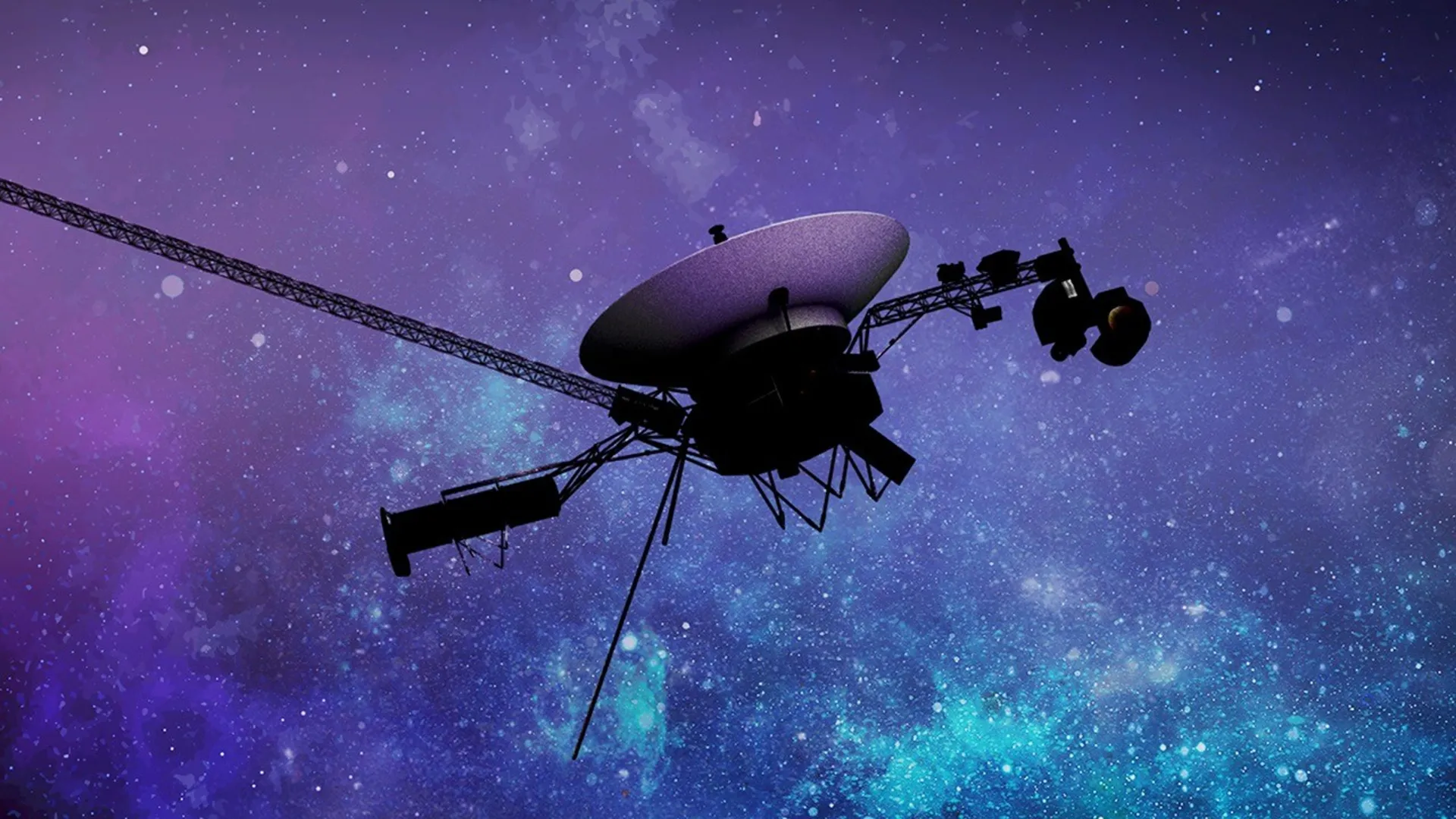
Scientists are preparing for an interstellar rescue of humanity's most distant spacecraft, Voyager 1, after fixing up its twin from billions of miles away.
According to a NASA statement released Aug. 4, a clever power-saving maneuver known as the "Big Bang" helped the agency avoid having to shut off another one of the Voyager 2 probe's three remaining science instruments later this year. The Big Bang procedure involves selectively shutting off some high-power instruments on the Voyager probes while switching on lower-power alternatives, all while keeping the spacecraft warm enough to operate in the frigid environment of interstellar space.
"The idea is to swap out a group of powered devices all at once — hence the nickname — turning some things off, and replacing them with lower-power alternatives, to keep the spacecraft warm enough to continue gathering science data," representatives from NASA's Jet Propulsion Laboratory, which manages the mission, wrote in an April blog post.
NASA carefully ran tests on Voyager 2 before implementing the procedure in May and June. Now, sharing the results of those tests in the Aug. 4 statement, NASA reports a successful power transfer that should keep Voyager 2 running a while longer.
"The savings should provide power to keep its three instruments operating for at least an extra year," NASA wrote of the Big Bang.
But power is dwindling on both nuclear-powered spacecraft, and Voyager 1 is in worse shape than its twin. Mission scientists were forced to turn off one of Voyager 1's last remaining science instruments in April.
Voyager 1's turn for a life-extending Big Bang will happen within a few months, to keep science operating there as long as possible, agency officials added.
Get the world’s most fascinating discoveries delivered straight to your inbox.
Going out with a bang
Scientists decided to do the "Big Bang" on Voyager 2 first because it is in better health, and closer to Earth, than Voyager 1. Voyager 1 is nearly 171 astronomical units (AU, where 1 AU is the average distance between Earth and the sun) from our planet, while Voyager 2 is about 143 AU away. Both spacecraft are crucial for revealing clues about the region outside the heliopause — the sphere of influence the sun exerts upon our solar system — as they are the only working spacecraft at such a distance.
That distance is no small factor. In November, Voyager 1 will reach a milestone "light day" from Earth — when it takes 24 hours for a radio signal to travel one way from our planet to the spacecraft. Both spacecraft will also turn 50 years old in 2027, assuming they keep working.
Both Voyager probes launched in 1977, with Voyager 2 getting an opportunity for a "grand tour" of our solar system. An alignment of the outer planets — Jupiter, Saturn, Uranus and Neptune — that occurs only once every 176 years allowed both Voyager probes to maneuver from one planet to the next with minimal fuel usage.
Voyager 2 flew by all four planets, finishing its Neptune encounter in 1989, while Voyager 1 was tasked with flying above the plane, or "ecliptic," of our solar system after its closest approach to Saturn in 1981. As each spacecraft finished its close-up imaging of these planets, some instruments were shut off to extend their mission for as long as possible. But as the two spacecraft aged, more instruments needed to go quiet.
Plutonium, which the spacecraft rely on for power, has a natural decay rate, with the spacecraft now losing roughly 4 watts of power a year, according to NASA. In recent years, power supplies have turned critically low on both spacecraft. Voyager 2 would have needed to shut off one of its remaining three science instruments later this year if measures were not taken, and Voyager 1 was in slightly worse shape after an unexpected power drop in February occurred following a planned maneuver in deep space. Only two of Voyager 1's 10 science instruments remain powered after the latest was shut down in April.

Elizabeth Howell was staff reporter at Space.com between 2022 and 2024 and a regular contributor to Live Science and Space.com between 2012 and 2022. Elizabeth's reporting includes multiple exclusives with the White House, speaking several times with the International Space Station, witnessing five human spaceflight launches on two continents, flying parabolic, working inside a spacesuit, and participating in a simulated Mars mission. Her latest book, "Why Am I Taller?" (ECW Press, 2022) is co-written with astronaut Dave Williams.
You must confirm your public display name before commenting
Please logout and then login again, you will then be prompted to enter your display name.