

















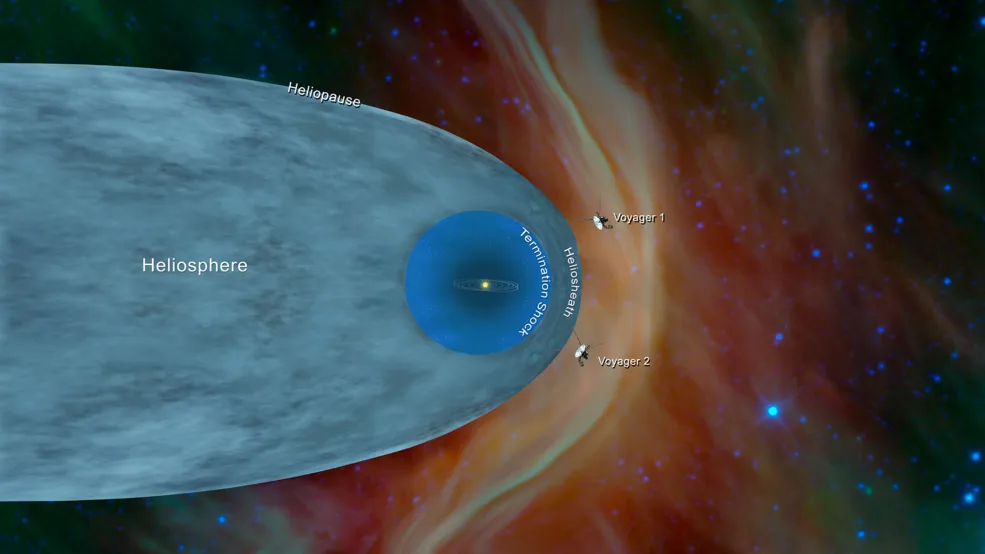
Humanity's second taste of interstellar space may have raised more questions than it answered.
NASA's Voyager 2 spacecraft popped free of the heliosphere — the huge bubble of charged particles that the sun blows around itself — on Nov. 5, 2018, more than six years after the probe's pioneering twin, Voyager 1, did the same.
The mission team has now had some time to take stock of Voyager 2's exit, which occurred in the heliosphere's southern hemisphere (as opposed to Voyager 1, which departed in the northern hemisphere). In a series of five papers published online today (Nov. 4) in the journal Nature Astronomy, the researchers reported the measurements made by the probe as it entered interstellar space.
More: NASA's Voyager Spacecraft Have Just 5 Years of Life Left
Related: Photos from NASA's Voyager 1 and 2 Probes
These data are full of surprises. For example, Voyager 2 traversed the heliopause — the boundary between the heliosphere and interstellar space — when the probe was 119 astronomical units (AU) from the sun. (One AU is the average Earth-sun distance, which is about 93 million miles, or 150 million kilometers.) Voyager 1 made the crossing at nearly the same distance, 121.6 AU.
This consistency is "very strange, in the sense that one [Voyager 2's crossing] occurred at the solar minimum, when the solar activity is the least, and the other one occurred at the solar maximum," Stamatios Krimigis, lead author of one of the new Voyager 2 papers, said during a teleconference with reporters last week, referring to the sun's 11-year activity cycle.
"If we take our models at face value, we expected that there would be, indeed, a difference," added Krimigis, who's based at the Johns Hopkins University Applied Physics Laboratory in Laurel, Maryland, and the Office of Space Research and Technology at the Academy of Athens in Greece.
Get the world’s most fascinating discoveries delivered straight to your inbox.
Voyager project scientist Ed Stone, of the California Institute of Technology in Pasadena, also emphasized the dynamism of the solar bubble. "The heliosphere itself is breathing in and out," he said during the same teleconference.
In addition to the large-scale expansion and contraction noted by Krimigis, Stone said, there are shorter-term heliospheric perturbations caused by coronal mass ejections, powerful explosions that blast huge amounts of solar plasma out into space.
"It's a very complicated interaction that's going on that we're studying," said Stone, who led one of the new studies and co-authored another one.
Voyager 2's measurements of the interstellar magnetic field are also intriguing. Before Voyager 1's 2012 crossing, the team expected to see significant differences in the direction of the magnetic field outside the heliosphere compared to the one inside, said Leonard Burlaga of NASA's Goddard Space Flight Center in Maryland.
But Voyager 1 found that the interstellar field was largely aligned with the heliospheric field — and so did Voyager 2, we learned today. So this appears to be a real phenomenon, not some fluky coincidence.
"We have to come to some understanding of why the magnetic field doesn't change," Burlaga, the lead author of one of the new Nature Astronomy papers and a co-author on another one, said in the telecon.
There must be some process causing the alignment, he added, and "that process is simply not understood."
Then there's the "leakage" observed by both spacecraft. Voyager 1 detected interstellar particles on two separate occasions as it neared the heliopause, and the mission team has attributed that finding to two intruding "interstellar flux tubes." But Voyager 2's experience was quite the opposite: The probe detected some solar particles for a while after it left the heliosphere.
The difference may have something to do with heliospheric geometry, given that Voyager 1 and Voyager 2 left the solar bubble in very different places. "But we don't really know the answer to that," Krimigis said.
There are other differences reported by the two probes as well. For example, Voyager 1 observed that the speed of the solar wind — the stream of charged particles flowing continuously from the sun, "inflating" the heliosphere — dropped nearly to zero close to the heliopause. But Voyager 2 measured relatively high solar-wind speeds almost all the way through until crossing. And Voyager 2's data suggest a smoother and thinner heliopause than that observed by Voyager 1 (though both spacecraft apparently traversed the boundary in less than a day).
Related: Solar System Facts: A Guide to Things Orbiting Our Sun
A long ride nears the end
Voyager 1 and Voyager 2 launched a few weeks apart in 1977, tasked with performing an unprecedented "grand tour" of the solar system's giant planets. Voyager 1 flew by Jupiter and Saturn; Voyager 2 did the same but then zoomed past Uranus and Neptune as well.
After Voyager 2's Neptune encounter, which occurred in August 1989, the two spacecraft entered a new phase known as the Voyager Interstellar Mission. They would journey on into the distant unknown, lighting up the darkness as they flew.
And that darkness was nearly total at the time; very little was known about the heliosphere's outer reaches.
"We didn't know how large the bubble was," Stone said. "And we certainly didn't know that the spacecraft could live long enough to reach the edge of the bubble and leave the bubble and enter interstellar space."
(A quick note here: Entering interstellar space is not the same thing as leaving the solar system, because the sun's gravitational influence extends far beyond the heliosphere. Indeed, trillions of comets orbit in the Oort Cloud, thousands of AU from the sun, and they're still considered part of the solar system.)
But the Voyagers are nearing the end of the line. Each spacecraft is powered by three radioisotope thermoelectric generators (RTGs), which convert to electricity the heat generated by the radioactive decay of plutonium-238. The RTGs' power output decreases over time as more and more of the plutonium decays.
Related: Nuclear Generators for NASA Deep Space Probes (Infographic)
The mission team has already taken steps to squeeze the most out of the remaining nuclear fuel, turning off certain heaters and scientific instruments over time to lower the power needs. (Voyager 2 retains five working instruments out of its original 10, but Voyager 1 is down to four; its plasma spectrometer failed in 1980.) But there aren't many more such levers to pull, so each Voyager can probably collect and return data for just five more years or so, Stone said.
Those five years could end up being very productive, potentially revealing key characteristics of the "true" interstellar medium — the vast region beyond the tangled and complicated swath near the heliosphere, where our solar bubble exerts considerable influence.
For example, "as we move further away, will we see the [magnetic] field outside slowly but surely sort of twist and turn to relax to an unperturbed state, which is what's farther away?" Stone said. "How far can we get from the heliosphere and measure the Milky Way galaxy without the perturbation of the heliosphere changing it?"
Other important questions may be answered only with the launch of new missions. For example, we still don't know the shape of the heliosphere, whether it's roughly spherical or has a long, comet-like tail. Both Voyagers popped free from the "head" of the heliosphere, the leading edge that's plowing through the interstellar medium on our solar system's long orbit around the center of the Milky Way.
"We would certainly like to have a spacecraft go down the tail," if it exists, said Don Gurnett of the University of Iowa, the lead author of one of the new Nature Astronomy papers. "But, of course, the tail might be really long — I mean, hundreds of AU."
Voyager 1 and Voyager 2 are currently about 148 AU and 122.4 AU from Earth, respectively, and 160 AU from each other. The next-most-distant operational spacecraft, NASA's New Horizons Pluto probe, is just over 46 AU from our planet at the moment.
And we shouldn't bank on interstellar data from New Horizons; that spacecraft will likely run out of power by the time it's about 90 AU away, Krimigis said. (But New Horizons will keep gathering interesting data about the Kuiper Belt, the ring of objects beyond Neptune, well into the future. The spacecraft has already performed two flybys in the region — one of Pluto and one of the small body 2014 MU69 — and has enough fuel for another encounter if NASA greenlights another mission extension, New Horizons team members have said.)
- What's Next for NASA's Voyager 2 in Interstellar Space?
- Voyager 2 Transformed Our Ideas of Jupiter's Moons 40 Years Ago
- At Solar System's Edge, NASA's Voyager 2 Probe Copes with Reduced Power
Mike Wall's book about the search for alien life, "Out There" (Grand Central Publishing, 2018; illustrated by Karl Tate), is out now. Follow him on Twitter @michaeldwall. Follow us on Twitter @Spacedotcom or Facebook.
