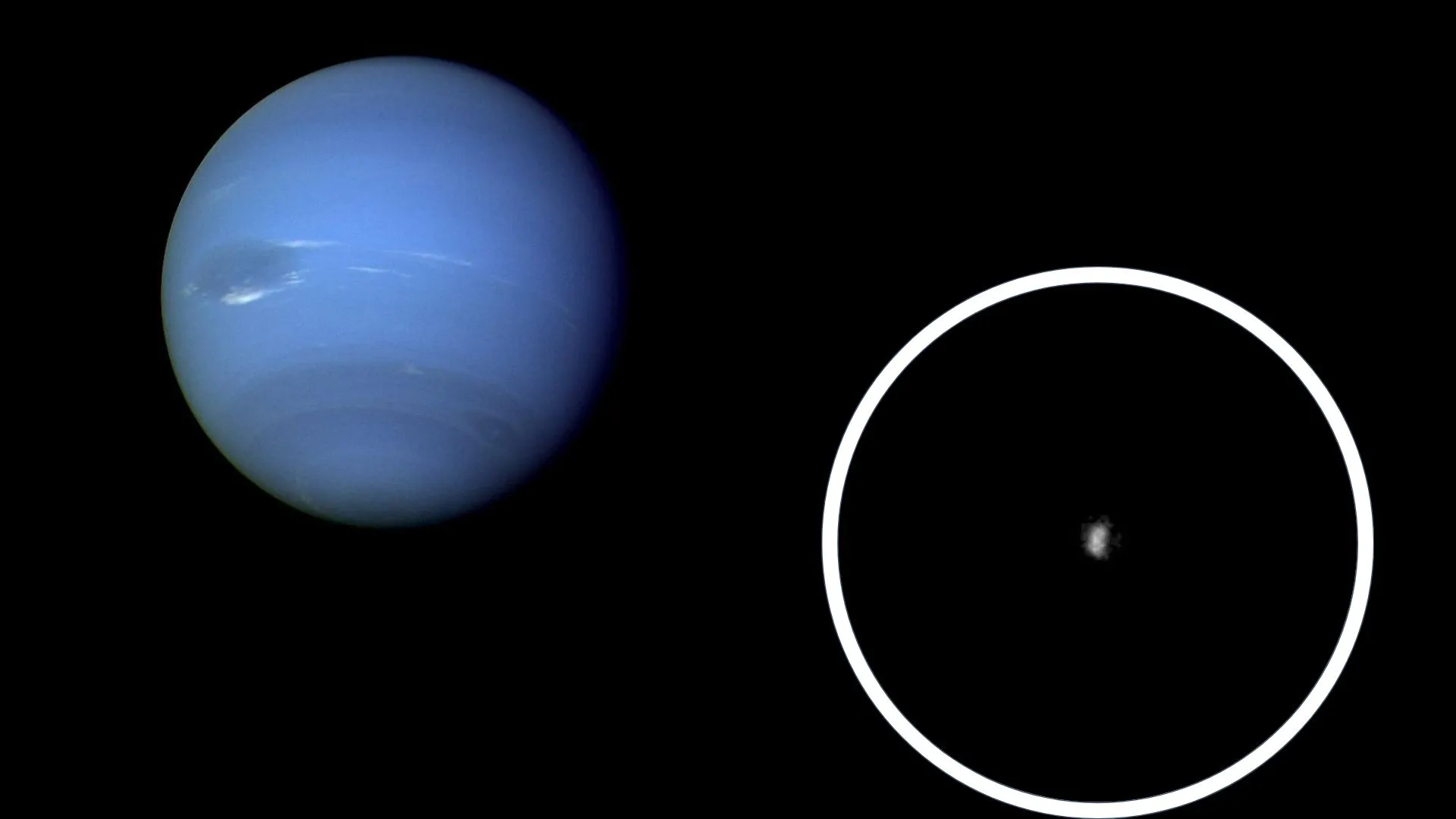
Nereid (inset) may be the only moon of Neptune (background) that was around when the planet first formed, a new JWST study hints. (This composite image is not to scale).
One of Neptune's largest moons has stuck around the neighborhood much longer than scientists previously thought — in fact, it may be the sole survivor of the planet's earliest days.
Nereid, Neptune's third-largest moon, is probably the only moon left over from when the ice giant formed early in the solar system's 4.5 billion-year history, a new analysis of James Webb Space Telescope (JWST) data suggests.
The results, published Wednesday (May 20) in the journal Science Advances, contradict the previous story about Nereid's history told in the decades since its 1949 discovery: that Neptune "captured" the 220-mile-wide (350 kilometers ) moon from an icy well of bodies in the outer solar system known as the Kuiper Belt.
JWST's observations were key to this realization, said first study author Matthew Belyakov, a graduate student in planetary science at Caltech. "What JWST did for Nereid is it confirmed that it had a lot of water ice, and gave us the overall shape of the spectrum [of light]," Belyakov told Live Science in a phone call.
The telescope's observations of the moon revealed a composition that's significantly different from that of known Kuiper Belt objects, he continued. Crucially, JWST has been in space long enough to allow direct comparisons against Kuiper Belt worlds that the telescope itself has observed. "We're able to compare apples to apples," Belyakov added.
The moon-stealing planet
Previously, astronomers assumed that Nereid was "captured" by Neptune's gravity, like the planet's other known moons are suspected to have been. This is due to Nereid's orbit, which is highly elliptical — suggesting the moon was snatched from a previous, more stable orbit in the Kuiper Belt.
But that hypothesis is challenging to prove, given that Neptune has 16 known moons. Most of those moons are small, aside from Triton, which is slightly smaller than Earth's moon. The system is made up largely of small moons in irregular orbits.
Sign up for the Live Science daily newsletter now
Get the world’s most fascinating discoveries delivered straight to your inbox.
"The trouble at Neptune is that we don't have any regular satellites really, whatsoever," Belyakov said.
Triton, Neptune's largest moon, represents 99% of the Neptunian moon system's mass and is on a "retrograde," or backward, orbit, Belyakov added. Triton is clearly a captured object — not only because of its odd orbit but also because observations have shown that its composition is more similar to Pluto's than to Neptune's, he said.
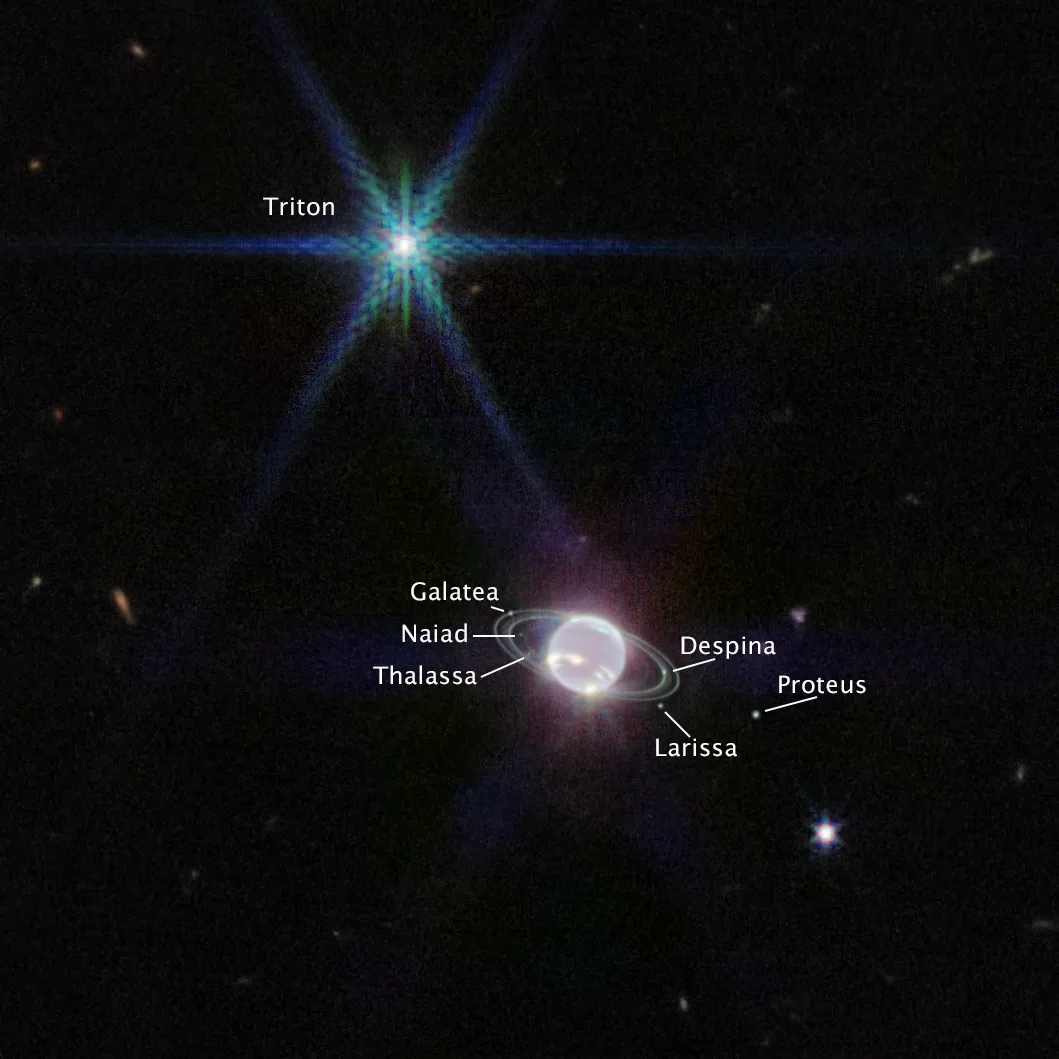
This JWST image of Neptune shows the planet’s rings and several of its 16 moons. The third-largest moon Nereid (not pictured) may be the only one leftover from the planet’s formation.
(Image credit: NASA, ESA, CSA, STScI; Image Processing: Joseph DePasquale (STScI), Naomi Rowe-Gurney (NASA-GSFC))
In the new study, the authors ran simulations of Triton's capture from the Kuiper Belt and how it may have affected the existing moons of Neptune. The simulations show that Triton's arrival gave the original Neptune moons a tremendous kick. "Triton gets captured and alters the original system, and creates a Nereid-like object," Belyakov explained.
Moon mysteries
To shore up this theory, Belyakov hopes to get a better look at Nereid in higher resolution. JWST is in high demand by astronomers, and Belyakov's team, which includes noted moon dynamicist and Caltech professor Konstantin Batygin, got a few minutes of telescope time using the lowest-resolution mode of JWST's Near-Infrared Spectrograph (NIRSpec). The team plans to submit an application for use of a higher-resolution mode of NIRSpec in a future call for telescope observations, he said.
These observations have implications not only for Neptune but also studies of exoplanets and gas giants, Belyakov emphasized.
"The big picture is that really we don't quite understand how moons around Uranus and Neptune form," Belyakov said. "What we're finding generally, in the study of exoplanets, is that planets of the size of Uranus and Neptune are pretty much the most common type of planet. And so if we don't understand how moons around these objects form, that's a really big problem."
The histories of Uranus and Neptune are making the study more challenging, he noted. Uranus is weirdly tilted on its side, perhaps due to a big collision with another object eons ago, which means its first generation of moons likely no longer exists.
"And at Neptune, we're also missing that first generation of moons," Belyakov said.The planet's innermost moons today were reforged from the original generation of moons that broke apart in the wake of Triton's arrival, the authors noted.
"So perhaps," he continued, "Nereid is the only original, sort of intact, remnant of satellites that originally formed around these planets. That would be a very exciting result, because it means that we have this one window to explore and understand satellites."
Article Sources
Matthew Belyakov et al. ,Nereid as a regular satellite of Neptune. Sci. Adv. 12, eaeb1429 (2026). DOI:10.1126/sciadv.aeb1429
Elizabeth Howell was staff reporter at Space.com between 2022 and 2024 and a regular contributor to Live Science and Space.com between 2012 and 2022. Elizabeth's reporting includes multiple exclusives with the White House, speaking several times with the International Space Station, witnessing five human spaceflight launches on two continents, flying parabolic, working inside a spacesuit, and participating in a simulated Mars mission. Her latest book, "Why Am I Taller?" (ECW Press, 2022) is co-written with astronaut Dave Williams.
You must confirm your public display name before commenting
Please logout and then login again, you will then be prompted to enter your display name.