Get the world’s most fascinating discoveries delivered straight to your inbox.
You are now subscribed
Your newsletter sign-up was successful
Want to add more newsletters?
Join the club
Get full access to premium articles, exclusive features and a growing list of member rewards.
An account already exists for this email address, please log in.
Lost photos suggest Mars' mysterious moon Phobos may be a trapped comet in disguise
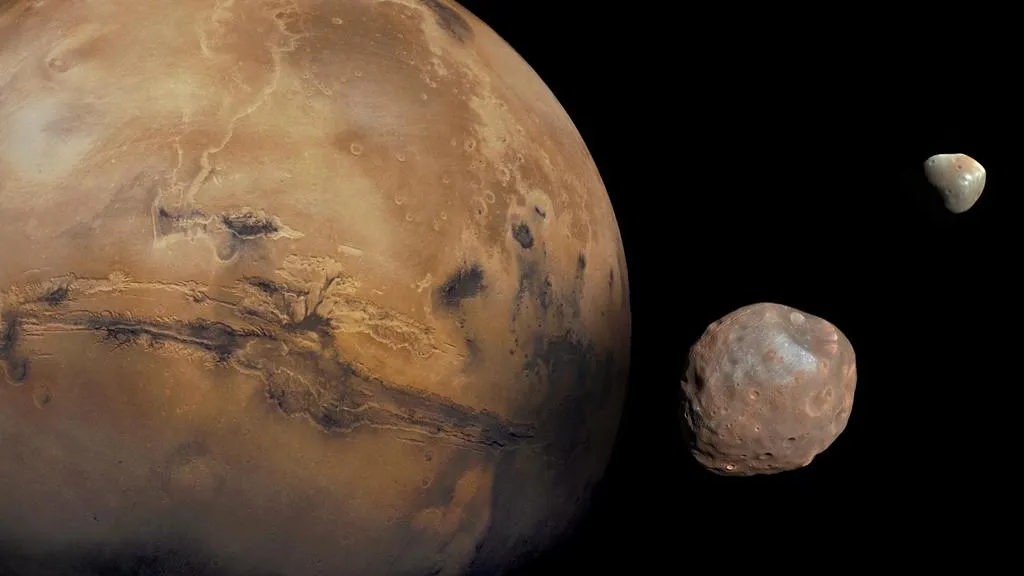
Previously unpublished photos of Mars' moon Phobos hint that the mysterious satellite may actually be a trapped comet — or perhaps just a piece of one, along with its twin moon Deimos.
A composite photo of Mars with its twin moons Phobos and Deimos. New research suggests the pair may in fact be two halves of an ancient comet captured by Mars long ago.
(Image credit: NASA/JPL-Caltech/GSFC/Univ. of Arizona)
Mars' moon Phobos may actually be a comet — or at least part of one — that was gravitationally captured by the Red Planet long ago, a new preprint study based on previously unpublished photos suggests.
For years, researchers have puzzled over the origins of Phobos and its twin, Deimos. Some have theorized that the moons are former asteroids lured in by Mars' gravity, because their chemical composition is similar to that of certain rocks in the main asteroid belt between Mars and Jupiter. However, computer models simulating this capture process have not been able to replicate the pair's near-circular paths around Mars.
Another hypothesis suggests that a giant impact, like that which created our moon, gouged the duo out of the Red Planet; but Phobos has a different chemical composition from Mars, making this scenario unlikely, too.
Taken by high-resolution cameras onboard the Mars Express spacecraft, a European Space Agency (ESA) orbiter that has studied Mars and its moons since 2003, these 300-odd images exquisitely document Phobos' features. That includes the 9-kilometer-wide (5.6-mile-wide) Stickney crater, Phobos' largest landmark.
Fornasier and her colleagues used the snapshots to analyze the intensity of sunlight Phobos reflected from different angles. This technique, called photometry, allowed them to determine how much light Phobos reflected when the sun was right in front or at an offset angle.
A close-up photo of Phobos. Stickney Crater is the large dent visible in the lower right corner.
(Image credit: NASA/JPL-Caltech/University of Arizona)
The researchers discovered that Phobos's surface didn't reflect light uniformly. Some regions, like the northeastern rim of the crater, were highly reflective. But the team's analysis also showed that overall, Phobos's surface appeared noticeably brighter when the sun was directly overhead. This phenomenon, called an opposition surge, is characteristic of many airless solar system objects. Also, the researchers found that Phobos's surface was porous, like sand. This led the team to suggest the moon's surface may be cloaked by a thick dust layer with grooved particles, whose shadows vanished when directly illuminated.
Sign up for the Live Science daily newsletter now
Get the world’s most fascinating discoveries delivered straight to your inbox.
Both these properties are also features of Jupiter-family comets, which are comets whose orbits are gravitationally tweaked by Jupiter. These include the "rubber ducky" Comet 67P, which ESA's Rosetta mission studied up close in 2016. In fact, Phobos' photometric properties matched Comet 67P's almost perfectly. So, the team concluded that Phobos was possibly a comet captured by Mars.
The study's findings have implications for Deimos, too. Fornasier noted that if Phobos was once a comet, Deimos may have been one as well. In fact, based on the study, her team suggests the two moons may have once been joined together as a single bilobed comet that was trapped and eventually torn apart by Mars' gravity. In other words, Mars’ twin moons may actually be two halves of a single whole.
"If the Martian satellites are indeed captured comets, this implies that comets may be captured also by telluric [terrestrial] planets," Fornasier added. She said that some moons of gas giants like Saturn likely originated from the Kuiper Belt, the doughnut-shaped region that swathes the solar system, and from which many comets arise. However, astronomers haven't identified a "comet moon" for terrestrial planets before now, making Phobos a potential first.
Nonetheless, the comet interpretation has problems, too. Some photometric parameters, like the fraction of light scattered, don't match those of comets. In any case, Fornasier said, dynamical simulations — which consider movements of celestial objects, including Mars and Phobos — will help the team determine the likelihood of such a comet entrapment. Ultimately, though, the MMX program, which will physically sample bits of Phobos, is probably the best hope of resolving the murky origins of this mysterious moon.
Abha Jain is a freelance science writer. She did a masters degree in biology, specializing in neuroscience, from the Indian Institute of Science, Bengaluru, India, and is almost through with a bachelor's degree in archaeology from the University of Leicester, UK. She's also a self-taught space enthusiast, and so loves writing about topics in astronomy, archaeology and neuroscience.