The amount of ice in Arctic waters waxes and wanes with the change of the seasons, though some ice persists in the Arctic Ocean even throughout the summer. But in Canada's Hudson Bay, sea ice can completely melt out during the summer months.
A NASA satellite has caught the melt of ice in the bay during this spring, showing the dramatic shifts that the changing of seasons can cause.
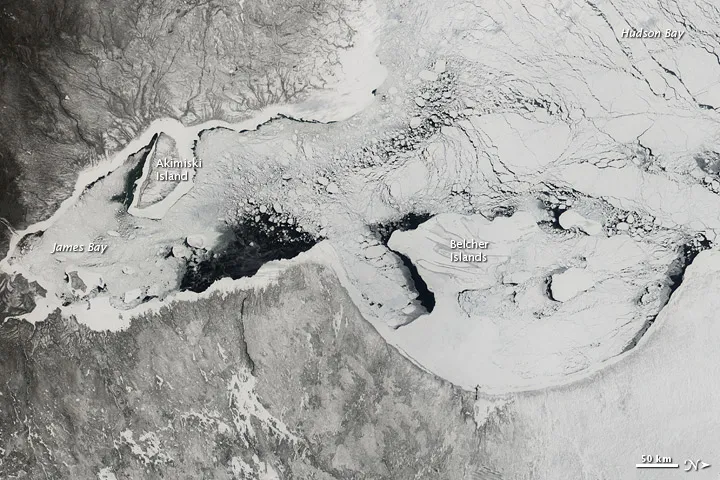
The Moderate Resolution Imaging Spectroradiometer (MODIS) on NASA's Aqua satellite snapped images of the southeastern corner of Hudson Bay on April 6 (top), and June 5 (bottom). The images have been rotated and north is at right.
In the April image, snow blankets most of the land around this corner of the bay, and sea ice covers most of the water. The ice isn't a solid sheet, instead, chunks of ice of varying sizes and shapes drift around the bay with the prevailing winds and water currents. Pieces of dark ocean water are visible near the shore where the winds have pushed the ice away.
In the June image, snow has melted and ice has retreated, leaving Akimiski Island and the Belcher Islands in the bay easier to spot. The ice has a bluish tint to it, likely because it is waterlogged and melted ice has pooled in ponds on the ice's surface. Sea ice will sometimes melt out completely in the bay during July.
In this NASA satellite taken on June 5, sea ice has retreated from large portions of Hudson Bay and islands in the bay are more clearly visible.
(Image credit: NASA)
Interestingly, ice has moved into some areas, for instance south and west of the Belcher Islands, where it had not appeared in early April. The ice isn't spreading, it's simply moving and, broken into small pieces, it can drift easily. Unlike two months earlier, areas of open water are the result of ice melt.
The ice in Hudson Bay has been melting earlier each spring since the 1970s. The trend has been strongest in the western portions of the bay.
Sign up for the Live Science daily newsletter now
Get the world’s most fascinating discoveries delivered straight to your inbox.
A 2011 modeling study published in the journal Climate Dynamics suggested that in the future, the duration of ice-covered conditions could be reduced by seven to nine weeks per year. The changes were likely to be the most pronounced in southeastern Hudson Bay and James Bay, according to the model projections.