











Rare fifth-century burials of Germanic chieftains with dazzling weapons and warhorses discovered in France
Archaeologists found a small cemetery full of high-status burials, two of which may be the graves of Germanic chieftains.

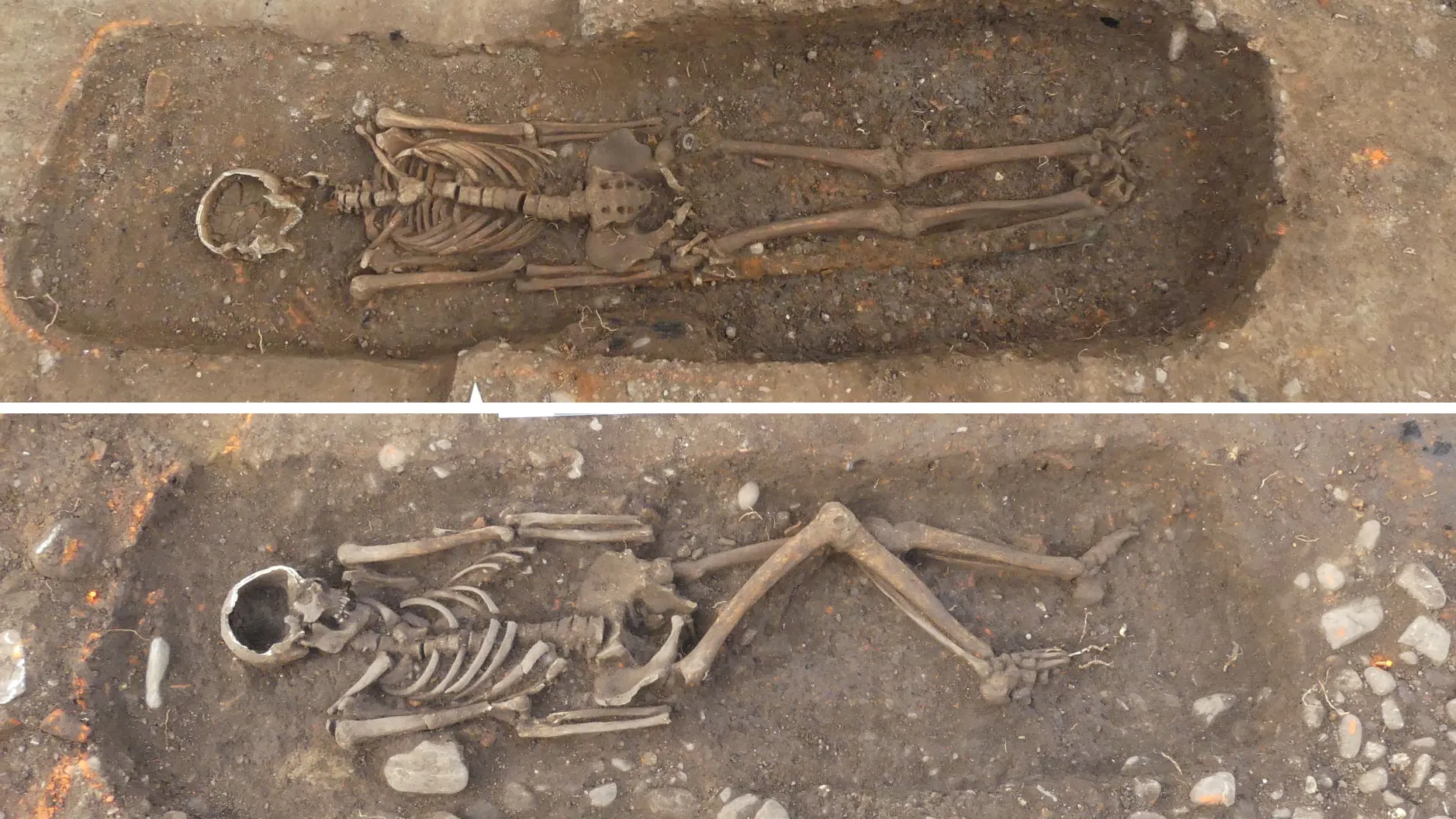
Archaeologists excavating in northeastern France have unearthed a small fifth-century cemetery containing the graves of two Germanic chieftains and two warhorses. The burial ground is providing new information about the transitional period after the fall of the Roman Empire.
The burial complex was discovered near the city of Colmar, just a few miles from the Rhine River, which forms the border between France and Germany. This area had a Gallo-Roman village from the first to the third centuries, and archaeologists found several ancient houses, hearths, wells and craft areas, according to a Nov. 6 translated statement from the French National Institute for Preventive Archaeological Research (Inrap).
Archaeologists also uncovered a rare fifth-century cemetery at the site, which was used from about A.D. 450 to 500, a critical time period in Western Europe because of the collapse of the Roman Empire. While scholars have debated for centuries about why the empire fell, one key issue was the repeated occupation of Rome in the fifth century by Germanic tribes known as the Goths and the Vandals.

Several of the burials included gold-and-garnet accessories on weapons and clothing.
Archaeologists discovered 11 adult graves, three graves of children and two horse burials at the site, according to the statement. In two of the female burials, archaeologists found silver bird-shaped brooches, glass bead necklaces and a bone comb, suggesting that these may have been high-status women.
But two of the male burials, in particular, stood out because of their high-quality grave goods, including a sword with a partially preserved wooden scabbard, a shield, a javelin and a scramasax, a type of Germanic short sword, which was decorated with a gold-and-garnet accessory. The weapons are characteristic of the burials of Germanic chieftains or mercenaries, according to the archaeologists, and two horses were buried nearby with their harnesses.

Two horse burials were discovered in the cemetery.
In addition to the weapons and warhorses, archaeologists noticed evidence on the men's bones that hinted that the individuals were likely warriors. Two people suffered stab wounds that showed no signs of healing, which suggests they died quickly and violently, according to the statement. And another man's right knee bones had completely fused together, which would have prevented him from bending it. This condition, called ankylosis, commonly results from an improperly healed injury.
The archaeologists believe the warrior's grave goods weren't just for show, but further study of the skeletons is planned to confirm whether the injuries seen during the excavation could have been sustained in a conflict.
Get the world’s most fascinating discoveries delivered straight to your inbox.
Few Germanic settlements and cemeteries from the fifth century have been found, so the newly excavated site should provide important information about the upheavals linked to the fall of the Western Roman Empire and how that political collapse affected communities on the edge of the empire.
Can you identify these historical objects of war? Test your smarts with our weapons of the world quiz!

Kristina Killgrove is a staff writer at Live Science with a focus on archaeology and paleoanthropology news. Her articles have also appeared in venues such as Forbes, Smithsonian, and Mental Floss. Kristina holds a Ph.D. in biological anthropology and an M.A. in classical archaeology from the University of North Carolina, as well as a B.A. in Latin from the University of Virginia, and she was formerly a university professor and researcher. She has received awards from the Society for American Archaeology and the American Anthropological Association for her science writing.
You must confirm your public display name before commenting
Please logout and then login again, you will then be prompted to enter your display name.