














NASA Voyager 1 Spacecraft Nears Interstellar Space

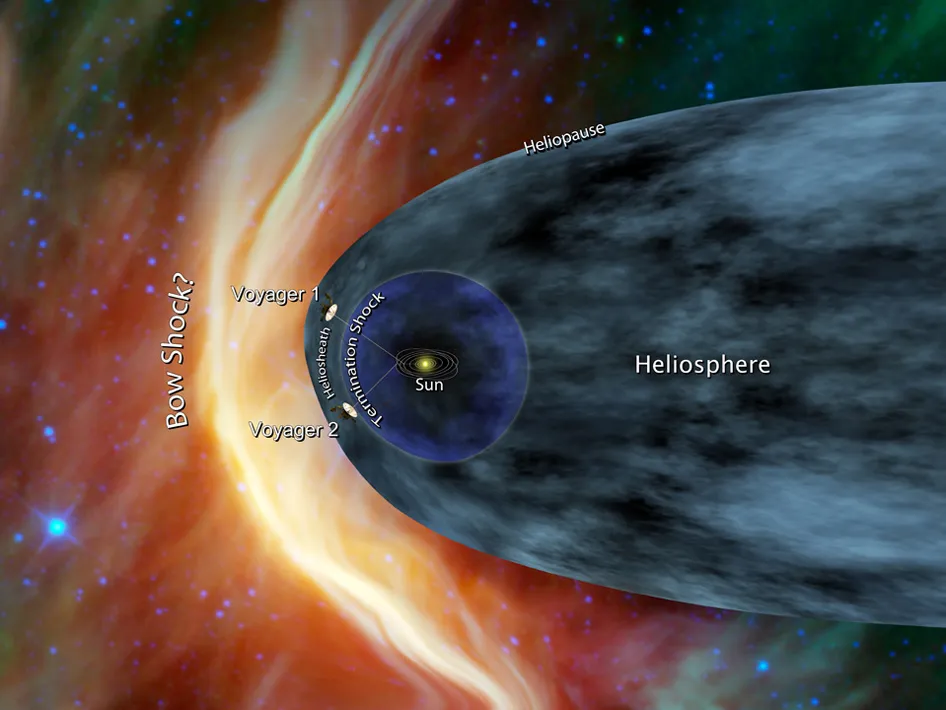
NASA's Voyager 1 spacecraft has encountered a new environment more than 11 billion miles from Earth, suggesting that the venerable probe is on the cusp of leaving the solar system.
The Voyager 1 probe has entered a region of space with a markedly higher flow of charged particles from beyond our solar system, researchers said. Mission scientists suspect this increased flow indicates that the spacecraft — currently 11.1 billion miles (17.8 billion kilometers) from its home planet — may be poised to cross the boundary into interstellar space.
"The laws of physics say that someday Voyager will become the first human-made object to enter interstellar space, but we still do not know exactly when that someday will be," said Ed Stone, Voyager project scientist at the California Institute of Technology in Pasadena, in a statement.
"The latest data indicate that we are clearly in a new region where things are changing more quickly," Stone added. "It is very exciting. We are approaching the solar system's frontier." [Photos From NASA's Voyager 1 and 2 Probes]
Far-flung spacecraft
Voyager 1 and its twin, Voyager 2, launched in 1977, tasked chiefly with studying Saturn, Jupiter and the gas giants' moons. The two spacecraft made many interesting discoveries about these far-flung bodies, and then they just kept going, checking out Uranus and Neptune on their way toward interstellar space.
They're not quite out of the solar system yet, however. Both are still within a huge bubble called the heliosphere, which is made of solar plasma and solar magnetic fields. This gigantic structure is about three times wider than the orbit of Pluto, researchers have said.
Get the world’s most fascinating discoveries delivered straight to your inbox.
Specifically, the Voyagers are plying the heliosphere's outer shell, a turbulent region called the heliosheath. But Voyager 1's new measurements — of fast-moving galactic cosmic rays hurled our way by star explosions — suggest the probe may be nearing the heliosphere's edge.
"From January 2009 to January 2012, there had been a gradual increase of about 25 percent in the amount of galactic cosmic rays Voyager was encountering," Stone said. "More recently, we have seen very rapid escalation in that part of the energy spectrum. Beginning on May 7, the cosmic ray hits have increased five percent in a week and nine percent in a month."
More measurements needed
While it may be tough to identify the moment when Voyager 1 finally pops free into interstellar space, scientists are keeping an eye on the cosmic ray measurements and a few other possible indicators.
One is the intensity of energetic particles generated inside the heliosphere. Voyager 1 has recorded a gradual decline in these particles as it flies farther and farther away from Earth, but it hasn't seen the dramatic dropoff that scientists expect would accompany an exit from the solar system.
The Voyager team also thinks the magnetic fields surrounding the spacecraft should change when it crosses the solar boundary. Those field lines run roughly east-west within the heliosphere, and researchers predict they'll shift to a more north-south orientation in interstellar space. They're currently looking at Voyager 1 data for any signs of such a transition.
In the meantime, both Voyagers just keep on flying and exploring. Voyager 2 trails its twin a little bit; it's currently 9.1 billion miles (14.7 billion km) from home.
"When the Voyagers launched in 1977, the space age was all of 20 years old," Stone said. "Many of us on the team dreamed of reaching interstellar space, but we really had no way of knowing how long a journey it would be — or if these two vehicles that we invested so much time and energy in would operate long enough to reach it."
This story was provided by SPACE.com, a sister site to LiveScience. Follow SPACE.com on Twitter @Spacedotcom. We're also on Facebook and Google+.
