Mimicking reproduction in living organisms, researchers have built a simple self-replicating robot out of automated blocks.
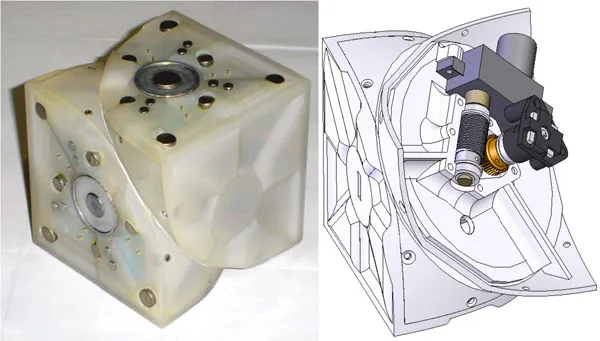
Machines that can copy themselves have been built before, but the earlier experiments were limited to two dimensions or confined to a track. Hod Lipson and his collaborators at Cornell University have designed modular cubes, called molecubes, that can assume a range of three-dimensional shapes.
"People think of robots as durable metallic machines, and the only way to make them last longer is to make them more sturdy," Lipson said.
Lipson and his colleagues are exploring a different paradigm, in which robots become more robust through self-repair.
"Animals survive longer than robots because they can repair themselves," Lipson explained in a telephone interview.
The new robots are simpler and less autonomous than biological organisms. But the scientists argue that self-replication is not a yes-or-no proposition, but rather a spectrum based on complexity and independence.
"Some viruses can reproduce, but only in very specific environments," Lipson said. "Other organisms, like mammals, are less restricted."
Sign up for the Live Science daily newsletter now
Get the world’s most fascinating discoveries delivered straight to your inbox.
The robots are composed of four-inch-wide cubes that attach and release each other with electromagnets. The cubes are cut in half along a diagonal plane, allowing the robot to swivel 90 degrees.
Each module carries a microprocessor with the step-by-step instructions for replication. Sensors tell the robot when a new cube has been attached at one end, and power is supplied through floor plates.
To help the robot make a copy of itself, the scientists placed new cubes at "feeding" stations. One of the challenges was designing modules that would not topple during motion. The initial robot relies on help from its unfinished "clone" in the construction process.
In experiments, a four-cube-high robot copied itself in two and a half minutes. More complex shapes are possible in principle, but Lipson said that there are practical difficulties in making robots with more cubes.
Currently, the robots have no practical use, but the research team said that it would be fairly easy to add other modules with grippers or a camera.
Self-replicating robots could be valuable for space exploration and in hazardous environments, where they could take care of themselves without human help. One robot could even build out of its own components a new type of robot for a specific task, Lipson said.
The robots and their capabilities are reported in the May 12 issue of the journal Nature.
Michael Schirber began writing for LiveScience in 2004 when both he and the site were just getting started. He's covered a wide range of topics for LiveScience from the origin of life to the physics of Nascar driving, and he authored a long series of articles about environmental technology. Over the years, he has also written for Science, Physics World, andNew Scientist. More details on his website.