













New AI technique helps robots complete tasks twice as fast by letting them 'think ahead'
A new AI system lets robots plan their next move while they're in motion — removing reaction delays and doubling task speeds without any extra computing overhead.


Scientists have engineered a new artificial intelligence (AI) system that cuts reaction delays in robots by over 10 times without using additional computing power.
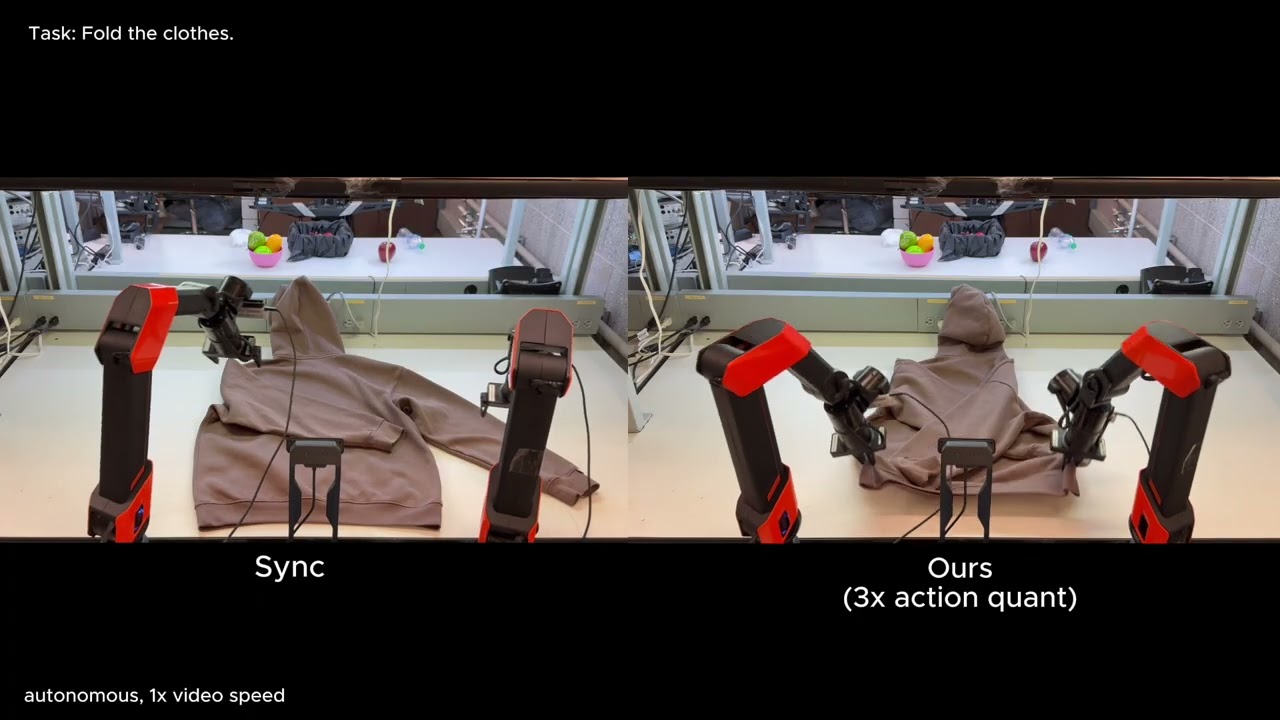
Many robots controlled by vision language action (VLA) models move in fits and starts: reach, pause, adjust, pause again. The problem largely stems from how these models are typically run: After completing one set of instructions, the robot waits for the model to calculate the next set, creating a stop-and-go rhythm. This reaction lag is a major barrier to using VLA-controlled robots for tasks that demand continuous, real-time interaction.
A new system called "VLASH" tries to eliminate that wait by planning the next actions while the robot completes its current ones. In tests, robots using VLASH completed some tasks 1.5 to 2 times faster while retaining most or all of their accuracy. Maximum reaction latency fell by up to 11.8 times, depending on the computer hardware used.
Researchers from MIT; Nvidia; Caltech; the University of California, Berkeley; the University of California, San Diego; and Tsinghua University in China described the system in a paper uploaded to the arXiv preprint server and will present at the Intelligent Robots and Systems Conference this fall.
An earlier version of the paper reported a speedup of more than 30 times, but the researchers told Live Science that those tests used longer action sequences and slower hardware. The newer experiments used shorter, more common action sequences and more powerful GPUs. "The 11.8x figure may better represent recent practical settings," the study authors told Live Science in an email.
Robots are getting a brain upgrade
VLA models act as the brains of many advanced robots. They combine images from a camera with human instructions and information about the robot's current state, and then translate that information into physical movements. As the robot completes one group of actions, VLASH uses its current position and scheduled movements to estimate where it will finish. From that projected state, the AI plans the next group of actions.
VLASH predicts the robot, not the world around it. Predicting the entire environment with a world model can take more computing time, making it less useful when a robot needs very fast reactions. The two approaches could eventually work together, the researchers said.
Get the world’s most fascinating discoveries delivered straight to your inbox.
It is like planning your next step before your foot touches the ground, rather than waiting for it to land before deciding where to go.
Researchers tested two VLA models on two robot platforms, using a laptop with an Nvidia RTX 5090 GPU. They tested pick-and-place, stacking and sorting tasks, running 20 trials per method, plus fast-reaction challenges, including table tennis and Whac-a-Mole. They separately measured reaction latency on various processing units.
Because VLASH estimates the robot's future state from movements that have already been scheduled, it does not require a separate prediction model or additional inference step at runtime.
Priming machines for the real world
The researchers also reorganized existing training data to speed up fine-tuning. In one benchmark, each training step was 3.26 times faster while reaching comparable accuracy. That does not mean total training becomes 3.26 times faster or cheaper, the researchers cautioned, because the overall cost also depends on the model, hardware, data and number of training steps.
Table tennis and Whac-a-Mole put VLASH's reactions to the test. In both, the target could move while the robot was still calculating what to do.
VLASH does not try to predict those movements. Instead, it processes new observations 15 to 30 times per second, allowing it to quickly spot changes such as an object being moved, the researchers said.
This increased speed doesn't address the robot's safety around humans, however. Roshni Lulla, co-founder and chief research officer at the Institute for Humane Robotics who wasn't involved with the research, cautioned that faster reactions do not necessarily make a robot safer. "Reacting sooner is a real benefit, but the case for improved safety is unclear to me," she explained.
The researchers said manipulation tasks that require continuous motion and rapid responses would probably benefit first. That could eventually include manufacturing and other environments where objects move and plans change. But Lulla said the more revealing test would be putting these robots around people. "The real question is how this changes robotic performance in human-centered environments," she said. "I would want to see testing done with a human present in the room, when the state of the environment could be changed by another agent."
Search and rescue is a more distant possibility. VLASH has not been tested in poor lighting, smoke, unstable terrain, or with damaged cameras or unreliable communications. How it performs under those conditions would largely depend on the underlying VLA model, the researchers said.
Related stories
- Scientists found the optimal robot body, and it has 20 legs — watch it scale walls and move through trees
- China's real-life 'transformer' mech is a giant humanoid robot that can switch from bounding on 4 legs to walking on 2
- Creepy humanoid robot face learned to move its lips more accurately by staring at itself in the mirror, then watching YouTube
VLASH could eventually be paired with more advanced world models that predict changes in the wider environment. First, however, researchers need to test it across more robots, VLA models, tasks and environments, as well as in longer experiments and with unexpected disturbances.
Lulla said the results support a relatively narrow conclusion. "We can fairly claim that this new methodology removes a bottleneck in terms of processing time and preserves capabilities," she said. But, she added, "What I would not claim is a meaningful advance in safety or in intelligence."
"Rather than any single demonstration, we would look for consistent gains across many robots, tasks, environments, and long-running trials, together with appropriate reliability and safety validation," the study authors said. For now, VLASH shows that robots can spend less time waiting to decide what to do next. Whether those faster reactions hold up outside the lab remains to be seen.
Tang, J., Sun, Y., Zhao, Y., Yang, S., Lin, Y., Zhang, Z., Hou, J., Lu, Y., Liu, Z., & Han, S. (2025, November 30). VLASH: Real-Time VLAs via Future-State-Aware asynchronous inference. arXiv.org. https://arxiv.org/abs/2512.01031v2

Niba (@NotesByNiba) is a video host and producer focused on science, culture and research-driven storytelling. Her work spans SciShow, Seeker (The Verge), Stanford University, and Lawrence Berkeley National Laboratory including her PBS series Hungry Planet and KQED series Big Ideas. Originally trained as a plant developmental geneticist, she studied genetics and toxicology at the University of California, Davis, genetics at Duke University and science communication at Northwestern University.
You must confirm your public display name before commenting
Please logout and then login again, you will then be prompted to enter your display name.