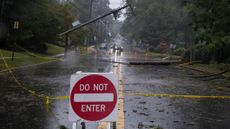
The 'easyJet ecoJet'¯ would emit 50 percent less CO2 than today's newest ...
Science Notes
Compiled by the editors of LiveScience.
Shark Attacks Off New Jersey
June 8: A teenage surfer was bitten in an apparent shark attack off the New
Jersey coast, and experts believe a small great white may be responsible. It
would be the first recorded shark attack in the state's waters in 30 years.
Ryan Horton, 17, said he never saw what bit him when he felt a stabbing pain
in his ankle Sunday afternoon.
"I was swimming up and it just felt like somebody hit me in the foot with a baseball bat," Horton said. He paddled to shore, where his brother helped him to a hospital. Horton received more than 50 stitches on his lower leg. Based on the tooth marks, the season and the location, the shark was likely either a small great white or a sandbar shark, said George Burgess, a Florida expert who is curator of the International Shark Attack File. He had examined an e-mailed photo of Horton's injury. -- Associated Press
What Happens When Monks Meditate
June 7: A new study of 76 monks found they can weed out multiple stimuli
and stay focused while meditating. In fact, they alter their perception of the
world, researchers conclude. While performing "one-point" meditation -- a focus
of attention on a single object or thought -- the monks were shown two different
images at once. "Typically this results in a switching between the two images,
but in the case of [one-point] meditation, the monks reported a perceptual dominance
of one of the images," said University of Queensland researcher Olivia Carter.
The findings are published in the latest issue of the scientific journal Current
Biology.
Archaeologists Find Hoard of Celtic Coins
June 3: AMSTERDAM, Netherlands (AP) _ Archaeologists have uncovered 17
ancient Celtic coins in a field in the south of the Netherlands, the first hoard
of such coins found in the country. Amsterdam's Free University excavated the
site in April and will display the coins, which are made of silver and mixed
with copper and gold, in the Limburgs Museum in the city of Venlo on Saturday.
They are estimated to date from 20-50 B.C., shortly after Julius Caesar began
the Roman conquest of the region. Leaders of local Germanic tribes ''probably
used these coins to reward their followers for loyalty,'' researchers said.
Similar finds have been made in neighboring Belgium and Germany. -- Associated
Press
Death Forecast for L.A. Quake
May 25: Potential earthquakes on the Puente Hills fault beneath the Los
Angeles area could result in 3,000 to 18,000 fatalities and more than $250 billion
in damages, according to the Southern California Earthquake Center (SCEC) and
the U.S. Geological Survey (USGS). The study, released today, was based on previous
work that found the fault had ruptured at least four times in the past 11,000
years, with earthquake magnitudes ranging from 7.2 to 7.5. To determine probable
losses from such earthquakes, scientists created 18 scenarios depicting possible
shaking levels throughout the region.
"Quantifying earthquake risk is difficult and fraught with many uncertainties," said Tom Jordan, director of SCEC, and a co-author of the paper reporting the study results. "One of the main goals of this study is to use our improved knowledge of seismic hazards in Southern California to evaluate--and hopefully reduce--the uncertainties in this type of risk analysis." [Daily California Quake Forecast]
Mexican Volcano Erupts
May 24: MEXICO CITY (AP) -- A volcano in western Mexico unleased its
most powerful eruption in more than a decade Monday, shooting ash two miles
into the sky and sending burning gas and rock fragments down the slopes. No
injuries or damages were reported -- the nearest settlement is about four miles
away. Winds blew the ash cloud toward the west, away from the most heavily populated
areas.
Tonatiuh Dominguez, a seismologist at the volcano observation station operated by the University of Colima, warned that the peak "'is still in an explosive stage.'' Experts said it was the biggest explosion at the volcano in the western state of Colima since 1991. The Colima volcano, which has erupted violently dozens of times since its first recorded eruption in 1560, is considered to be among the most active and potentially the most destructive of the volcanoes in Mexico. The eruption at the 12,533-foot volcano, 430 miles northwest of Mexico City, was considered larger than one in 1999 but smaller than a 1913 blast that created a crater 1,650 feet deep and rained ash on Guadalajara, 75 miles to the north. -- Associated Press [Volcano Image Gallery]
Rodent Virus Kills 3 Transplant Recipients
May 23: PROVIDENCE, R.I. (AP) _ Three transplant patients have died of
a rodent virus after receiving contaminated organs from the same donor, the
state Health Department said Monday. Health officials said it is only the second
documented case anywhere in the world that the viral infection LCMV has been
transmitted through an organ transplant. Two people from Massachusetts and one
from Rhode Island died in late April and early May of LCMV, which is associated
with exposure to rodent waste, health officials said. The patients received
lung, kidney and liver tissue, officials said. The source of the infection was
found to be an organ donor from Rhode Island, who died of unrelated causes.
Officials said that at least one pet at that person's home _ a hamster _ tested
positive for LCMV. They said the hamster was bought at a pet store in Warwick.
-- Associated Press
Ancient Beer, Wine Jars Found in Egypt
May 19: Archaeologists digging in a 5,000-year-old site in southern Egypt
have unearthed 200 rough ceramic beer and wine jars and a second mud-brick mortuary
enclosure of King Hur-Aha the founder of the First Dynasty, Egypt's Supreme
Council of Antiquities said Wednesday. A joint American excavation mission from
Yale University, Institute of Fine Arts, the Pennsylvania University Museum
and New York Universities found the treasure Wednesday at Shunet El-Zebib, north
of Abydos in the Upper Egyptian city of Sohag. -- Associated Press
Gray Wolf Pups Caught, Killed
May 16: ALBUQUERQUE (AP) _ An endangered Mexican gray wolf that was part
of a cattle-killing pack has been captured in the Gila National Forest. Six
wild-born puppies, possibly wolf-dog hybrids, were euthanized.
The healthy year-old male from the Francisco pack was captured in a trap Thursday and taken to the Sevilleta Wildlife Refuge north of Socorro, the U.S. Fish and Wildlife Service said. The Fish and Wildlife Service ordered the killing of the pack because it had been preying on livestock in the Gila National Forest. It has killed four animals in the past several weeks. The wolf's parents are still being targeted, said service spokeswoman Elizabeth Slown.
The service has said any wolves that are captured will never be rereleased into the wild. The puppies were taken from an Arizona den where a lone female wolf had been. Biologists had determined that the pups were not pure Mexican wolves. Fish and Wildlife began a release program in March 1998 to re-establish wild populations of Mexican gray wolves in Arizona and New Mexico after the species had been hunted to the brink of extinction in the early 1900s. There are now about 50 wolves in the wild. -- Associated Press
Genetic Testing Can Create Family Strife
May 11: Newfangled DNA tests can reveal a person's propensity to develop
certain diseases, based on family history and other factors. But the knowledge
gleaned can create other problems.
University of Iowa researcher Rebekah Hamilton surveyed the decision-making process of 29 study participants. Knowing the risk for children and being able to plan for the future were seen as benefits of genetic testing. The type of disease, as well as an individuals' perceived need to prepare, influenced the timing of disclosure to family members, the study found. The subjects sometimes withheld information from some family members while sharing it with others.
"Individuals who have a family history of a particular disease such as breast cancer or Huntington's disease can now have a genetic test that will tell them if they, specifically, are at risk for that disease," Hamilton said. "Some evidence from this study indicated that cliques form in families composed of those who test positive for a mutation."
The results are detailed in the Journal of Nursing Scholarship.
Consumer Reports Rates Popular Diets
May 10: Consumer Reports' review of leading popular diets examined nutrition,
weight loss and dropout levels. The magazine used five icons to illustrate its
findings. The Associated Press converted that to a 1-5 rating system with 5
being the best and 1 being the worst. The time period shown here is over one
year; the findings for the six-month period varied slightly:
- Weight Watchers: Nutrition, 5; weight loss, 3; dropout rate, 4.
- Slim-Fast: Nutrition, 5; weight loss, 4; dropout rate, 1.
- Zone: Nutrition, 5; weight loss, 3; dropout rate, 2.
- Ornish: Nutrition, 3; weight loss, 4; dropout rate, 1.
- Atkins: Nutrition, 1; weight loss, 3; dropout rate, 2.
-- Associated Press
Alaska Town Won't See Sunset for Months
May 10: When the sun rises Tuesday in the continent's northernmost community,
it will stay up for nearly three months. The last sunset of the season occurs
at 1:50 a.m. Tuesday. The sun rises again at 2:56 a.m. "Then it will stay
above the horizon until Aug. 2, when the first sunset will take place at 3:09
a.m.,'' said Gina Sturm of the National Weather Service office in Barrow.
"It is so energizing after being in the dark during winter,'' said lifetime resident Diane Martin. "It's almost like coming out of hibernation. It brings us back to getting out and about, and participating in our subsistence activities.'' Barrow is about 330 miles above the Arctic Circle. In winter, the sun sets in mid-November and the region is dark until late January. -- Associated Press
Plastic Sheets Convert Light into Energy
May 6: BOSTON (AP) _ The Army is bringing to the battlefield flexible plastic
sheeting that converts light into energy -- technology that could someday find
its way into the casing of laptops or even clothing to power portable devices.
Konarka Technologies Inc. has signed a $1.6 million contract with the Army,
which hopes to lighten the load for troops who must lug around batteries to
power everything from night vision goggles to GPS units.
Troops could recharge devices by connecting them with energy-converting plastic sheets, replacing disposable batteries and easing logistical requirements in remote settings, according to the Army's Natick-based Soldier Systems Center. The sheeting also could be woven into sunlight-soaking tents, reducing the need for diesel fuel for noisy, polluting generators. Lowell-based Konarka is among the developers of next-generation photovoltaic technology that seeks to improve on rigid, glass-panel solar cells.
Advances in semiconducting materials allow for lower-cost production of lightweight solar cells that can be woven into plastics and textiles -- including camouflage-patterned materials Konarka is developing for the Army. Konarka is working with partners on commercial applications, said Daniel Patrick McGahn, an executive vice president. He offered no predictions when such products would reach the market. -- Associated Press
Meditation Prolongs Life
May 2: A new study of 202 people found that transcendental meditation
prolonged life. Based on ancient Hindu writings, transcendental meditation involves
repeating a mantra to achieve a state of relaxation. The study evaluated men
and women who had mildly elevated blood pressure. The subjects, average age
of 71, were monitored over 18 years. The death rate for those who meditated
was 23 percent lower. The results are reported in the May 2 issue of the American
Journal of Cardiology. The research was funded in part by the National Institutes
of Health.
First Horse Clone in North America
April 28: COLLEGE STATION, Texas (AP) _ A team of French and American
researchers has successfully cloned a horse, Texas A&M University officials
announced Wednesday. The foal was named Paris Texas. The university believes
it's the first successful cloned horse in North America; horses have previously
been cloned in Italy.
"Look at him, he's gorgeous,'' Katrin Hinrichs, the lead scientist on the project said just before the six-week-old, light brown foal made his public debut. He whinnied and walked up to several photographers who snapped his picture. "He's very bold,'' said Hinrichs, a professor at Texas A&M's College of Veterinary Medicine. She also heads the school's Equine Embryo Laboratory. A&M researchers used adult horse skin cells biopsied from a valuable horse in Europe to clone the foal, born March 13. The process took 400 attempts over a four-month period. Six embryos were created but only one was successfully gestated in a host horse named Greta during a pregnancy that lasted 12 1/2 months. Horses usually have an 11-month gestation.
Cryozootech, A&M's Paris-based partner, is dedicated to preserving the genes of exceptional horses for their use in producing cloned offspring, though there are no guarantees Paris Texas will turn out exactly the same as the donor horse. The first cloned cat was born at the school Dec. 22, 2001. Since then, the university has cloned several litters of pigs, a Boer goat, a disease-resistant Angus bull, the first Brahma bull and a deer. -- Associated Press
Exploding Toads Baffle German Scientists
April 27: BERLIN (AP) _ More than 1,000 toads have puffed up and exploded
in a Hamburg pond in recent weeks, and scientists still have no explanation
for what's causing the combustion, an official said Wednesday. Both the pond's
water and body parts of the toads have been tested, but scientists have been
unable to find a bacteria or virus that would cause the toads to swell up and
pop, said Janne Kloepper, of the Hamburg-based Institute for Hygiene and the
Environment.
"It's absolutely strange,'' she said. "We have a really unique story here in Hamburg. This phenomenon really doesn't seem to have appeared anywhere before.''
The toads at a pond in the upscale neighborhood of Altona have been blowing up since the beginning of the month, filling up like balloons until their stomachs suddenly burst. "It looks like a scene from a science-fiction movie,'' Werner Schmolnik, the head of a local environment group, told the Hamburger Abendblatt daily. "The bloated animals suffer for several minutes before they finally die.''
Biologists have come up with several theories, but Kloepper said that most have been ruled out. The pond's water quality is no better or worse than other bodies of water in Hamburg, the toads did not appear to have a disease, and a laboratory in Berlin has ruled out the possibility that it is a fungus that made its way from South America, she said. She said that tests will continue. In the meantime, city residents have been warned to stay away from the pond. -- Associated Press
Expedition Reaches North Pole
April 26: A five-man team reached the North Pole on Tuesday, using sled-dogs
to arrive seven miles before American explorer Robert E. Peary's disputed 1909
expedition, according to a Web site following the race. British explorer Tom
Avery was determined to verify Peary's claim by matching the still unbeaten
37-day time for the 475-mile trek from Cape Columbia in northern Nunavut, the
Inuit territory of Canada opposite Greenland. Avery's team of four men and one
woman traveled in a similar style to Peary, using Canadian Inuit huskies and
custom-built wooden sledges. -- Associated Press
Government Issues New (and Complex) Food Pyramids
April 19: As if the old food pyramid wasn't ignored enough, the U.S.
government has now issued 12 new ones. The motivation -- Americans' expanding
waistlines -- is good. But how many people will take the time to explore
the new rainbow-colored bands and myriad food choices tailored (at MyPyramid.gov)
to individual age, gender and exercise habits?
Light Relayed around the World
April 19: PRINCETON, N.J. (AP) -- Physicists and Albert Einstein buffs
began flipping light switches and dialing phones Monday night in an attempt
at a worldwide relay of lights to commemorate the 50th anniversary of Einstein's
death. The relay got under way at 8:45 p.m. with the illumination of the football
stadium and two towers on the Princeton University campus.
From there, about 140 groups planned to illuminate everything from campus structures to private homes, one right after another, in a relay across the country. Organizers were then expected to take the relay around the world, using the telephone on some legs of the journey, said Claire Gmachl, an associate professor of electrical engineering at Princeton who was organizing the start of the relay. She said phone calls travel over fiber-optic cables, which make them lights, in a sense.
| Will there Ever be another Einstein? |
The event, organized by Dr. Max Lippitsch, a physicist at the University of Graz in Austria, has drawn some criticism from astronomers concerned about light pollution. Einstein, who lived and worked in Princeton from 1933 until his death on April 18, 1955, published three groundbreaking papers on physics in 1905. One of them laid out what is now known as the Theory of Relativity, which deals with the nature of light. The 100th anniversary of the papers is also being celebrated by the World Year of Physics. -- Associated Press
Early Relative of T. Rex Discovered in Georgia
April 15: COLUMBUS, Ga. (AP) -- Paleontologists have identified a new
dinosaur species, an early relative of Tyrannosaurus rex that probably roamed
what is now the Southeastern United States about 77 million years ago. The scientists
made the identification from hundreds of fossilized fragments collected mostly
in Montgomery County, Ala., and southwestern Georgia. They named the new dinosaur
Appalachiosaurus montgomeriensis, which means "the Appalachian lizard from
Montgomery County.''
The 25-foot-long creature roamed the earth 10 million years before T. rex and was smaller and more primitive, with a narrower snout. David R. Schwimmer of Columbus State University; Thomas Carr of Carthage College of Kenosha, Wis.; and Thomas Williamson of the New Mexico Museum of Natural History and Science were credited with the discovery when the dinosaur's name was recognized by the Journal of Vertebrate Paleontology.
"We've been finding teeth and odd bones from this animal for 20 years, and it's nice to finally have a name for it,'' Schwimmer said. The researchers said Appalachiosaurus montgomeriensis was buried in mud at the bottom of a shallow sea about 77.8 million years ago, after currents carried it away from shore. -- Associated Press
Hawaiians Unite to Kill Frogs
April 12: (AP) -- A group of neighbors in a rural Upcountry Maui community
has banded together to rid their yards of annoying coqui frogs. "It's all
about people power,'' said Adam Radford of the Maui Invasive Species Committee.
"It's a waste of resources when you work up to a border and you can't go
any farther. We'll never get on top of this without neighborhoods and personal
responsibility.''
The invasive quarter-sized frogs subsist on the same diet of insects as native birds and are seen by many in the state -- including the Department of Land and Natural Resources -- as a threat to local species. Although the sound of the frogs' "ko-KEE, ko-KEE'' song is cherished in their native Puerto Rico, the coquis' loud chirping is unwelcome in the otherwise quiet neighborhoods of the Big Island and Maui, the island most impacted by the frogs.
Marine biologist Ann Fielding said her yard is officially frog-free thanks to her friends and neighbors. "A lot of times, you'll get one or two people who are really proactive, two or three who will be supportive but not active, and one that's not necessarily supportive and takes some convincing,'' she said. Fielding said her neighborhood "frog squad'' has grown to include about a dozen regulars who meet monthly and participate in hunts that take place after dark. "Once you hear the frogs and you know you've got them, you just think you have to learn to live with them until you realize there's a whole group that cares,'' said Fielding. -- Associated Press
Michigan to Residents: Eat this Alien Plant
April 9: EAST LANSING, Mich. (AP) _ Area residents are being encouraged
to chow down on an invasive plant. Garlic mustard is commonly tossed into landfills,
killed with herbicides or burned. But now it's being donated to food banks to
use in a variety of recipes provided by the Michigan Nature Association. The
organization planned to hold a benefit dinner Saturday so people can sample
appetizers, soups, salads, entrees and even desserts -- all containing garlic
mustard, the Lansing State Journal reported.
|
Natalie Kent, development associate at the Michigan Nature Association, came up with the idea for the "Eat the Invasive'' Garlic Mustard Project after spending a day pulling the plant and throwing it away. A co-worker mentioned that garlic mustard was edible, and Kent was surprised. "I thought, ... 'why are we throwing this away if we can eat it?''' Kent said. "This whole project evolved from that.'' Garlic mustard is a threat to many of Michigan's native plant species, but can be used in salads, bread, lasagna and added in virtually any dish.
The plant is found in many grassy areas and even suburban back yards. Garlic mustard used for the dinner and donated to food banks comes from many of the 160 nature sanctuaries around the state owned by the Williamston-based association. Member Brad Slaughter is volunteering to pick the plant this month. "This is really an innovative idea,'' Slaughter said. "It will help make people aware of their surroundings.'' -- Associated Press
Mammoth Bones Found in California Housing Development
April 8: MOORPARK, Calif. (AP) _ The remarkably well-preserved remnants
of an estimated half-million-year-old mammoth -- including both tusks -- were
discovered at a new housing development in Southern California. An onsite paleontologist
found the remains, which include 50 percent to 70 percent of the Ice Age creature,
as crews cleared away hillsides to prepare for building, Mayor Pro Tem Clint
Harper said. Paleontologist Mark Roeder estimated the mammoth was about 12 feet
tall, Harper said. Roeder believed it was not a pygmy or imperial mammoth, but
he had not yet determined its exact type, Harper said.
"It's considered a very significant find, and it's a very complete fossil. It's unusual because it was found all the way down near the bedrock,'' Harper said. "We asked if carbon dating could be used and they said no way, it's too old.''
Harper said the first bones were spotted several days ago and a special crew was called in after Roeder found more remnants, including the 6- and 7-foot-long tusks. "They've been encased in plaster and burlap and removed from the site,'' Harper said. Moorpark in Ventura County is about 30 miles west-northwest of downtown Los Angeles. "The Moorpark mammoth, that's what we'll call it,'' Harper said. Other Ice Age creatures have been found in recent years around Southern California, including a mastodon in Simi Valley, a mammoth in Oceanside and a pygmy mammoth on the Channel Islands. -- Associated Press
Congress May Extend Daylight-Saving Time
April 7: (AP) _ If Congress passes an energy bill, Americans may see more daylight-saving
time. Lawmakers crafting energy legislation approved an amendment Wednesday
to extend daylight-saving time by two months, having it start on the last Sunday
in March and end on the last Sunday in November.
"Extending daylight-saving time makes sense, especially with skyrocketing energy costs,'' said Rep. Fred Upton, R-Mich., who along with Rep. Ed Markey, D-Mass., co-sponsored the measure.
The amendment was approved by the House Energy and Commerce Committee that is putting together major parts of energy legislation likely to come up for a vote in the full House in the coming weeks. "The more daylight we have, the less electricity we use,'' said Markey, who cited Transportation Department estimates that showed the two-month extension would save the equivalent of 10,000 barrels of oil a day. The country uses about 20 million barrels of oil a day. -- Associated Press
Entire 'Don Quixote' on Six Human Hairs?
April 7: (AP) -- Physicists in Spain are celebrating the 400th anniversary
of publication of "Don Quixote'' in a very small way: they wrote the first paragraph
on a silicon chip in letters so tiny the whole 1,000-page book would fit on
the tips of six human hairs. The feat -- just for fun -- shows off a data-storage
technique developed years ago by the Microelectronics Institute of Madrid, part
of the government's top scientific research agency. It uses a device called
an atomic force microscope, which runs a ceramic or semiconductor tip over a
silicon surface in much the same way as a phonograph needle scans a record.
Using water vapor in the atmosphere and an electric charge, that tip basically
etches out tiny letters on the surface, lead researcher Ricardo Garcia told
the newspaper El Pais.
The technique can be used to make computer chips and so-called electronic paper, thin flexible sheets that can store and erase information. Garcia's team added a high-tech element to a year of celebrations honoring the 400th anniversary of Miguel de Cervantes' novel "Don Quixote.'' Other commemorative events include conferences, readings, adaptations, theater works, films and concerts in Spain and across the globe. In English, the 10 lines written on the silicon chip read: "In a certain village in La Mancha, which I do not wish to name, there lived not long ago a gentleman _ one of those who have always a lance in the rack, an ancient shield, a lean hack and a greyhound for coursing.'' -- Associated Press
Dogs with Arthritis Get New Diet
April 6: Perhaps you didn't know it, but arthritis is the leading cause
of chronic pain in dogs, affecting one in five of those over age one. Big breeds
like labs, golden retrievers and German shepherds are at the greatest risk.
And now there may be some relief. A scientist at the University of Liverpool
has developed a new dog food that seems to ease the pain and slow the development
of arthritis in dog. It contains omega-3 fish oil that, in tests, reduce damage
to cartilage. The product is expected to be made commercially available.
Ancient Maya Salt Works Uncovered
April 5: (AP) -- Underwater archaeologists have discovered 41 new
seaside salt production works used by the ancient Mayans in Central America.
The discovery at Punta Ycacos Lagoon in what is now Belize provides evidence
of extensive salt production to serve the large Mayan cities on the interior
of the Yucatan Peninsula, reports researcher Heather McKillop of Louisiana State
University. Her findings are reported in Tuesday's issue of Proceedings of the
National Academy of Science. Four salt works had previously been known in that
area. The discovery of 41 new works, along with the remains of wooden buildings
from the era of A.D. 600 to 900, indicates salt was mass-produced and stored
before shipment upriver, she reported. Ceramic pottery was used for boiling
water to produce the salt, she wrote, and a canoe paddle was also found, indicating
that the salt was transported inland by canoe. The research was supported by
a grant from Louisiana State University. -- Associated Press
Whale Baby Boom
April 4: (AP) _ A baby boom has given a lift to the endangered North
Atlantic right whale, with a near-record number of births in the just-ended
calving season, according to researchers at the New England Aquarium. They warned,
however, the species still faces significant hurdles. Twenty-seven whales were
born during the season that started in mid-December and ended Thursday, second
only to the 31 births recorded in 2001, the best year since scientists started
tracking births in the early 1990s. Just five years ago, there was only one
birth. The species was hunted nearly to extinction in the late 18th century
and its total population now numbers only 325 to 350. Five have died in the
last six months, including at least two pregnant females and two other females
that were of breeding age. -- Associated Press
Better-smelling Cows
March 29: The stench of what comes out of cattle is a growing problem
as cow territory gets suburbanized. Scientists at the Agricultural Research
Service (ARS) scientists are working on ways to lessen the odor. One solution:
Put more water in. High-moisture corn, as feed, reduces the smell of manure,
the scientists found. The reason: Starch in high-moisture corn is more fully
digested than the traditional dry-rolled corn. Perhaps you know a non-cow for
whom this information could be useful.
Shark Kills Australian Snorkeler
March 19: A man snorkeling off the coast of Australia with tourists was
killed by a 20-foot shark Saturday, according to news reports from the country.
The body had not been found. The 26-year-old victim was said to be a deck hand
on a luxury charter vessel. It was the third fatal shark attack in the region
in four years, according to The Herald Sun. The paper said the animal was a
white pointer shark.
Globally, there were 61 unprovoked shark attacks in 2004, according to The International Shark Attack File at the Florida Museum of Natural History. Seven people died. There were also 15 provoked attacks (typically a diver bit after grabbing a shark or a fisherman bit while removing a shark from a net) and 12 cases of sharks biting boats. The global total was down slightly from recent years but still part of an upward trend overall.
Just a dozen shark attacks occurred in Florida in 2004, compared to 30 in 2003, 29 in 2002, 34 in 2001, and 37 in 2000. The deadly series of four hurricanes in the 2004 summer meant fewer people were in the water, but sharks are known to head for deep water when a hurricane approaches.
Related: Shark Kills Two Others in Aquarium
Half the World's Pigs are in China
March 14: No country consumes more oil that the United States, but China
uses more grain, meat, coal, and steel, according to a new report from the nonprofit
Earth Policy Institute. Overall consumption of all goods, per person, is still
much lower than in the United States, but there are a lot more people -- about
1.3 billion versus 293 million. "With its coal use far exceeding that of the
United States and with its oil and natural gas use climbing
fast, it is only a matter of time until China will also be the world's top
emitter of carbon," predicts Lester Brown, the institute's president. "China
is no longer just a developing country." Not sure what that has to do with the
report's finding that half of all pigs are raised there.
March 14: Snowfall this season in New York's Central Park reached 40 inches following the 1.5 inches of snow that fell on Friday and Saturday. It's the first time the city has had three consecutive snow seasons with 40 inches or more since records began in 1869. During the 2003/2004 season, 42.6 inches fell. In 2002/2003, 49.3 inches came down. An average season has 22.4 inches.
Strong Earthquake in New Zealand
March 14: WELLINGTON, New Zealand (AP) _ A magnitude 6.4 earthquake shook
central New Zealand early Monday, waking people and tossing items from shelves
but causing no injuries, emergency services reported. The strong quake was centered
in the Tasman Sea, 100 miles northwest of the capital, Wellington. The offshore
quake did not generate a tsunami in the sea, which lies to the west of New Zealand,
separating it from Australia. Emergency services said they had received some
reports of items falling from shelves as the quake rocked commercial buildings
and houses across a wide area. Police reported that the temblor was felt from
New Plymouth on North Island's west coast and across central New Zealand to
Christchurch on South Island's east coast. New Zealand sits above an area of
the earth's crust where two tectonic plates are colliding and records more than
14,000 earthquakes a year. Only about 150 are felt by residents, and fewer than
10 a year cause damage. -- Associated Press
Spectacular Eruption from Mexican Volcano
March 10: MEXICO CITY (AP) _ Western Mexico's Volcano of Fire spewed
hot lava and rock Thursday, the latest in a series of spectacular but non-threatening
eruptions in the past few weeks. The volcano near the city of Colima, 430 miles
northwest of Mexico City, unleashed a column of smoke and ash along with a flow
of burning orange lava on Sept. 29. Since then, scientists have reported nearly
daily eruptions from its 12,533-foot peak. The eruptions have been caused by
seismic activity, and scientists can't predict how long they will last. The
activity has sometimes left a light coating of ask on nearby communities, but
officials say there is no immediate danger.
A major eruption in 1999 sent glowing rock down the volcano's slopes and fired a plume of ash more than five miles high. In 1913, an explosion created a crater 1,650 feet deep, blasted fast-moving flows of hot ash down the volcano's slopes and rained ash on Guadalajara, 75 miles to the north. Vulcanologists consider the Colima volcano to be one of the most active and potentially the most destructive of the volcanoes in central Mexico. It has erupted violently dozens of times since its first recorded eruption in 1560. -- Associated Press [Latest from Mount St. Helens]
Air Travel Safer than Ever in 2004
March 7: GENEVA (AP) _ Airlines recorded their safest year in 2004, with 428
people killed out of the 1.8 billion passengers who flew, the International
Air Transport Association said Monday. "2004 was the safest year ever for
air transport,'' said Giovanni Bisignani, IATA director-general and CEO. He
said the number of accidents rose to 103 from 99 in 2003 while global traffic
increased 15 percent. But the number of fatalities has been declining steadily
in recent years, said IATA spokeswoman Joanna Grimble. The previous safest year
was 2003, when 663 people were killed among 1.6 billion passengers flown. That,
in turn, was an improvement on the 974 killed among 1.6 billion passengers flown
in 2002, Grimble said. Bisignani said IATA is pushing to reduce the accident
rate even more through a system of safety audits. -- Associated Press
Dolphins Stranded in Florida
March 3: MARATHON, Fla. (AP) _ Some 49 dolphins stranded themselves Wednesday
off the Florida Keys and more than 20 were in a nearby canal or boat channel,
officials said. The rough-tooth dolphins were on flats and sand bars about a
quarter of a mile off Marathon, said Laura Engleby, a biologist with the National
Marine Fisheries Service. They were in about 6 inches of water at low tide,
she said. Marine mammals may strand when they are sick, injured or disoriented,
she noted. ''Right now the stranding network is busy stabilizing all the dolphins,''
Engleby said. Denise Jackson, a member of the Marine Mammal Rescue Team assisting
the dolphins, said darkness and the extreme low tide were complicating efforts.
''We're running boats in and out of an unlit channel at night,'' she said. Marathon
is on Key Vaca, in the middle of the Florida Keys about 46 miles east of Key
West. The dolphins were stranded on the ocean side of the island. -- Associated
Press
Elephant Gets Acupuncture
February 28: SINGAPORE (AP) -- The Singapore zoo is using an old Asian
remedy to treat sick animals: acupuncture. The latest patient is Tun, a 15-year-old
Asian elephant whose right leg was crushed by a male elephant nine years ago.
Zookeepers worried that Tun, who weighs 5,291 pounds, might not be able to settle
her weight on her lame leg as she grew heavier. Veterinarian and acupuncturist
Oh Soon Hock, who has poked and prodded giraffes, cheetahs and Komodo dragons
in the name of medicine, started treating Tun a month and a half ago.
"After the first treatment, she was more mobile. Now her leg can be bent better and her muscles are more relaxed,'' Oh said. Elephant handlers are on site when Tun receives acupuncture treatment twice a week. The intricate process involves coaxing with repetitive noises, gentle tugs on her fan-like ears and bribery with bananas and carrots. "I don't think acupuncture has any pain, if you know what to do,'' said Oh, who learned acupuncture at the Zhonghua Chinese Medicine College in Taiwan. Oh said acupuncture on animals and humans uses the same premise of locating key points between the joints or veins. Tun has four months of treatment left. -- Associated Press
New Cell Phones Will Reach Out and Slap Someone
February 23: Samsung will release a mobile phone next month that tickle
the person you talk to or basically slap them across the face. The touchy-feely
technology, reported by New Scientist magazine, is rooted in games that vibrate.
In the phones, "vibrotactile" motors will literally reach out and touch that
special someone. "Physical involvement creates a real attachment and is lacking
in online interactions," said at Northwestern University mechanical engineer
Ed Colgate, who works on this technology, called haptics.
Lead Exposure Creates Violent Youth
February 18: Exposure to lead may be one of the most significant causes
of violent crime in young people, says Herbert Needleman of the University of
Pittsburgh School of Medicine. "When environmental lead finds its way into the
developing brain, it disturbs neural mechanisms responsible for regulation of
impulse," he said Friday at the annual meeting of the American Association for
the Advancement of Science. "That can lead to antisocial and criminal behavior."
The notion is based on previous studies that show children with higher-then-average
levels of lead in their blood exhibit more aggression, attention disorders and
delinquency. Another study in the Pittsburgh area found between 18 and 38 percent
of all delinquency could be due to lead.
Hurricanes Take Bite Out of Shark Attacks
February 16: Sharks don't like hurricanes either. Just a dozen shark
attacks occurred in Florida in 2004, compared to 30 in 2003, 29 in 2002, 34
in 2001, and 37 in 2000. The deadly
series of four hurricanes meant fewer people were in the water, but sharks
are known to head for deep water when a hurricane approaches. Globally, there
were 61 unprovoked shark attacks in 2004, according to The International Shark
Attack File at the Florida Museum of Natural History. Seven people died. There
were also 15 provoked attacks (typically a diver bit after grabbing a shark
or a fisherman bit while removing a shark from a net) and 12 cases of sharks
biting boats. The global total was down slightly from recent years but still
part of an upward trend overall.
Do Opposites Attract?
February 14: It's an age-old question, and a new study says the answer
is "no." People tend to marry people with similar attitudes, religion and values,
but similarity of personality appears to be the big factor in happy marriages.
The 291 couples in the survey were married less than a year when it began and
had dated for an average of three and a half years. "Once people are in a committed
relationship, it is primarily personality similarity that influences marital
happiness because being in a committed relationship entails regular interaction
and requires extensive coordination in dealing with tasks, issues and problems
of daily living. Whereas personality similarity is likely to facilitate this
process, personality differences may result in more friction and conflict in
daily life," write University of Iowa researchers in the February issue of the
Journal of Personality and Social Psychology.
Weather Service Triples Computing Power
February 10: The National Weather Service has just tripled its computing
power. "Literally, we are going from making 450 billion calculations per second
to 1.3 trillion calculations per second," NWS Director David Johnson said Thursday.
The new supercomputer setup, from IBM, is expected to improve prediction of
severe and extreme weather events such as hurricanes, floods, tornadoes and
winter storms. Computing is important, but so is data, from measurement stations,
radar and satellite. The forecast: Expect the weather to remain at least somewhat
unpredictable.
Guys Want Women Who Laugh at Them
February 9: People are always saying they want a mate with a sense of
humor. The desire appears to mean totally different things to men and women,
however. A study of 150 students at McMaster University in Canada found the
women mean they want someone who makes them laugh. To a man, a sense of humor
means someone who will laugh at his jokes. "Women choose men who produce humor
62 per cent of the time; conversely, men choose women who appreciate their humor
65 per cent of the time," said graduate student Eric Bressler, who conducted
the survey. "When it comes to friendships, men like to be around women who produce
humor," Bressler also found. "When it comes to sexual relationships, they only
dig women who laugh at their jokes."
World's Second Largest Tree in Peril
February 8: (AP) _ A giant sequoia believed to be the second-largest
tree in the world may not live much longer after suffering damage from heavy
snow and strong wind, according to officials at Sequoia National Park. The sequoia
known as the Washington Tree once stood more than 254 feet tall with a circumference
at its base of more than 101 feet, ranking it second behind a tree known as
the General Sherman sequoia in the same park. But the tree was damaged in a
forest fire in 2003, then severe weather reduced its height to 115 feet, leaving
only a few branches of sparse foliage remaining. "It's just a shame,''
park ranger Mary Anne Carlton said. "But it's still got some greenery.
It's still living and hanging on.'' Studies of the tree's layers suggest it
is between 2,500 and 3,200 years old. -- Associated Press
FBI Shuts Down Public E-Mail Due to Security Breach
February 4: WASHINGTON (AP) _ The FBI said Friday it has shut down an
e-mail system that it uses to communicate with the public because of a possible
security breach. The bureau is investigating whether someone hacked into the
www.fbi.gov e-mail system, which is run by a private company, officials said.
''We use these accounts to communicate with you folks, view internet sites,
and conduct other non-sensitive bureau business such as sending out press releases,''
Special Agent Steve Lazarus, the FBI's media coordinator in Atlanta, said in
an e-mail describing the problem. The FBI computer system that is used for case
files, classified and sensitive information, and internal communications is
unaffected, Lazarus said. The bureau is in the process of switching its e-mail
accounts, officials said. Lawmakers and the Justice Department's inspector general
have criticized the FBI for taking too much time and spending too much money
to upgrade its computer systems. A $170 million project, Virtual Case File,
may have to be scrapped because it is outdated and inadequate, FBI Director
Robert Mueller acknowledged Thursday in testimony on Capitol Hill. -- Associated
Press
Melting Ice Sheet is an 'Awakened Giant' in Antarctica
February 4: The vast West Antarctic ice sheet, once thought to be stable,
could be crumbling. "Satellite measurements tell us that a significant part
of the West Antarctic ice sheet in this area is thinning fast enough to make
a significant contribution to sea level rise, said Chris Rapley, director of
the British Antarctic Survey. "I would say that this is now an awakened giant.
There is real cause for concern." Ice shelves that act as dams to glaciers have
collapsed in recent years, allowing the glaciers to move toward the sea more
rapidly and also grow thinner. Scientists have attributed the melting to a warming
climate. See Also: Runaway
Glacier.
Cost of Spam Revealed
February 3: NEW YORK (AP) _ Time wasted deleting junk e-mail costs American
businesses nearly $22 billion a year, according to a new study from the University
of Maryland. A telephone-based survey of adults who use the Internet found that
more than three-quarters receive spam daily. The average spam messages per day
is 18.5 and the average time spent per day deleting them is 2.8 minutes. The
loss in productivity is equivalent to $21.6 billion per year at average U.S.
wages, according to the National Technology Readiness Survey produced by Rockbridge
Associates, Inc., and the Center for Excellence in Service at Maryland's business
school. The study, to be released Thursday, also found that 14 percent of spam
recipients actually read messages to see what they say, and 4 percent of the
recipients have bought something advertised through spam within the past year.
The random survey of 1,000 U.S. adults was conducted in November and has a margin
of sampling error of plus or minus 3 percentage points. -- Associated Press
Erectile Dysfunction Called 'Public Health Concern'
February 1: We chortled when Bob Dole discussed it in national TV ads.
Now scientists are getting more serious about erectile dysfunction. One group
calls it a public health concern. Hold on, now. A public health concern? Turns
out ED, as the experts like to call it, can be an early sign of cardiovascular
problems, according to a new study in the Journal of Sexual Medicine. The research
was done by the Minority Health Institute. African Americans are 20 percent
more likely than whites to suffer ED, making early recognition of the condition
among that population particularly important preventative medicine, the report
concludes.
Another Reason Why Drinking and Flying Don't Mix
January 31: General aviation pilots with a previous conviction for drunken
driving are 43 percent more likely to crash their plane than other pilots, researchers
at Johns Hopkins University reported today. That sounds obvious. But the crashes
don't necessarily involve drinking and flying. There are no cases where alcohol
has been implicated as a probable cause in a fatal crash of a major U.S. airline,
for example. "Pilots with DWI histories may simply be more prone to risk taking,
in general, or be less concerned about safety, such as flying at night, under
bad weather conditions and in violation of safety rules," said Hopkins researcher
Susan Baker, who is also a pilot. The study of 300,000 pilots' records is detailed
in the January issue of the journal Accident Analysis & Prevention.
Beached Whales May Have Been Deafened by Chemicals
January 28: NEW HAVEN, Conn. (AP) -- A toxic chemical used to prevent
barnacles from clinging to ship hulls may cause deafness in marine mammals and
could lead whales to beach
themselves, Yale researchers say. The hearing loss would be the latest environmental
hazard linked to TBT, a chemical already known to be harmful to some aquatic
life. TBT is banned in many countries but is still widely used. Yale researchers
based their theory on a study of guinea pigs, because mammals have similar ear
structure. Since many marine mammals use sonar to get around, "it's possible
this could be contributing to whales and dolphins beaching and hitting ships,''
said Joseph Santos-Sacchi, professor of surgery and neurobiology at Yale School
of Medicine. "I think it's a reasonable hypothesis that this could possibly
be happening,'' said Theo Colborn, a senior fellow at the World Wildlife Fund
who has studied TBT but was not involved in the Yale research. "It sounds
very logical.'' Many scientists also believe the beaching of whales occurs for
non-chemical reasons _ primarily the Navy's use of sonar. The Yale study will
be published in the Biophysical Journal in March. -- Associated Press
Private Company to Sell Stem Cells
January 27: A private company announced today it would sell human embryonic
stem cells to researchers, according to the Reuters news agency. Embryonic stem
cells are capable of developing into all the tissues of the body, and scientists
hope they will lead to cures for various diseases. Some religious groups oppose
their use, and the White House has cut off funding for any new lines of stem
cells. Offered by Reproductive Genetics Institute, the stem cells are diseased.
They could be used to study the brain-destroying Huntington disease as well
as a type of anemia, said CEO Yury Verlinsky. Reuters
story
Beneficial Brain Avalanches
January 26: Studies last year found rat brain cells activate others in
cascades scientists now call neuronal avalanches. A computer model that will
be published Feb. 4 in the journal Physical Review Letters suggests these
brain avalanches are useful for storing information. Researchers simulated how
activity spreads in the brain. Avalanches produced stable activity patterns
-- just the sort of thing needed for putting memories in the noggin file, experts
suspect. Perhaps, like with explosives atop a mountain, experts could induce
the phenomenon. "In the laboratory, we can apply neurochemicals to defective
networks of rat brain cells, gently easing them into a state where avalanches
occur," said John Beggs, a professor in the Biocomplexity Institute at Indiana
University Bloomington. "These chemicals suggest treatments that might someday
improve information storage in people with memory problems."
A World Without Fire
January 24: What would the world look like if there were no such thing
as wildfires? The question entered University of Cape Town researcher William
Bond's mind when he wondered why some places that have enough rainfall to support
forests are instead dominated by grass or shrubs. Humans start fires, put them
out, and sometimes prevent them from happening for decades. But Bond looked
at how fire has shaped broad ecosystems for millions of years (nature is quite
a pyromaniac). Without fire, the extent of "closed forests" would jump from
27 percent to 56 percent of the vegetated surface of the world. Tropical grasslands
and savannas would shrink to less than half their current extent. Temperate
grasslands and shrublands would shrink to 60 percent of their present coverage.
The results are published in the journal New Phytologist.
Negative Emotions Rule
January 20: We humans can be a depressing bunch. And we sure know how
to express our negative feelings. A new study of people in Chicago and Mexico
City finds both know more words to describe negative emotions than the positive
(50 percent negative, 30 percent positive, 20 percent neutral). Researchers
figure that when we're happy, we perceive it as normal and so process our good
feelings superficially. "Negative emotions require more detailed thinking, more
subtle distinctions," says Robert W. Schrauf, associate professor of applied
linguistics at Penn State. "So they require more names." The study was detailed
in a recent issue of the Journal of Multilingual and Multicultural Development.
Iceberg Doesn't Ram Glacer as Expected
January 19: An anticipated
collision between a giant Antarctic iceberg and a glacier did not occur
over the weekend as expected, new satellite images show. "The iceberg may have
run aground just before colliding," said Mark Drinkwater of the European
Space Agency's Ice/Oceans Unit. "This supports the hypothesis that the
seabed around the Drygalski ice tongue is shallow, and surrounded by deposits
of glacial material that may have helped preserve it from past collisions, despite
its apparent fragility." ESA has a monitoring page here.
And LiveScience has an updated story (Jan. 20) here.
| Update: As of Saturday afternoon five skiers were feared dead, but officials were not sure of the count. |
Avalanche Near Utah Ski
Resort
January 14:
PARK CITY, Utah (AP) _ An avalanche outside a Utah ski resort Friday trapped
at least one backcountry skier, authorities said. "We can only confirm
one, perhaps two at this point,'' Sheriff Dave Edmunds said during a short news
conference at a command center set up to look for the victim or victims. "We
are going to work this as long as it takes, whether it's a rescue or recovery
operation.'' Volunteers and rescue dogs were seen fanning out over the area.
An emergency helicopter was dispatched from Salt Lake City, about 20 miles away,
with a report of possible victims, said LDS Hospital spokesman Jess Gomez. A
series of storms lasting over two weeks dropped 6-8 feet of wet, heavy snow
on the mountains, setting up prime avalanche conditions. The Utah Avalanche
Center warned of considerable avalanche danger Friday, which means human-triggered
avalanches were probable. "We're recommending people avoid being on or
underneath any steep slopes,'' said Bruce Tremper, director of the center. Tremper
said the slide occurred just outside The Canyons resort in Park City. It is
an out-of-bounds area next to The Canyons, but the resort "can't close
it off. It would be like trying to close a city park,'' Tremper said. --
Associated Press
| Update: Jan.16: 17 pilot whales found dead in North Carolina. Story |
4 Endangered Whales Found
Dead in 6 Weeks
January 13:
BOSTON (AP) _ Four endangered whales have been found dead in the past six
weeks -- including two just this week, scientists said. A dead North Atlantic
right whale was spotted off the coast of Georgia on Wednesday, a day after one
was found off Nantucket Island in Massachusetts. Two were found in late December
off Virginia and Nantucket. Tony LaCasse, a spokesman for the New England Aquarium,
said biologists hope to perform autopsies on the whales found this week to determine
the causes of death. ''What we do know is losing that number of animals in such
a short period of time puts us generally on a slippery slope to extinction,''
he said. There are currently between 325 and 350 of the whales known to scientists.
That's an improvement from 2000, when the population was counted at about 300.
-- Associated Press
Biosphere 2 For Sale
January 9: The company that owns Biosphere 2 Center, 3.1 glass-enclosed
acres designed to simulate the Earth's environment, has put the site up for
sale. The company is also selling 70 other buildings on the center's 140-acre
campus 16 miles north of Tucson, said Christopher Bannon, general manager of
Decisions Investment Corp. of Fort Worth, Texas. "We'd love to see the
Biosphere 2 used as a research activity, but we know that may not be the end
result,'' he said last week. Texas billionaire Ed Bass, president of Decisions
Investment, spent more than $200 million to build Biosphere 2 in the 1980s as
a prototype for a space colony. The closed ecological site 16 miles north of
Tucson contained miniatures of Earth's rainforest, ocean, desert and other environmental
features. In 1991, eight ''biospherians'' were sealed inside for a two-year
stay. But the project was plagued by rising costs and other setbacks and Columbia
University assumed responsibility for the site under a management agreement,
turning it into a research and education facility. The relationship with Columbia
ended in September 2003 and Biosphere 2 has been open as a tourist destination.
-- Associated Press
Sorry, Mom, You'll Have
to Work Even Harder
January 5: In the workplace, young adults may hold mothers to a higher
standard than men or childless women. Researchers showed resumes to college
students (108 from a midwestern university, 88 from the East, aged 19-22). The
resumes were identical, but half were Kenneth Anderson's and half were said
to belong to Katherine Anderson. Further, half of each subset said the supposed
job seeker was single and kid-free, the other half said the applicant was married
with two young children. "When the applicant was male, parental status made
no difference" in whether the college students would promote them at some point.
"However, when the applicant was female, she was significantly less likely to
be promoted when a parent than if she was not a parent," said Kathleen Fuegen,
assistant professor of psychology at Ohio State University. The results are
in the December issue of the Journal of Social Issues.
Constipation Myths
January 4: Nobody really likes to talk about it, and perhaps that's why
there are some serious myths surrounding constipation. Americans spend hundreds
of millions of dollars on laxatives every year -- much of it fiber. But the
role of fiber to treat chronic constipation is exaggerated, according to an
article in the January issue of the American Journal of Gastroenterology,
with only 20 percent of "slow transit patients" benefiting from it. While many
patients may be helped by a fiber-rich diet, some actually suffer worse symptoms.
So drink more water, right? Sorry. Unless you were dehydrated, don't expect
much relief, says lead author Stefan A. Müller-Lissner of the Humboldt University
in Berlin. On the bright side, "chronic constipation is uncomfortable, but not
dangerous," Müller-Lissner said.
Two Self-fulfilling Prophecies
Stronger Than One
January 3: If you envision yourself failing, you up the odds that you
will indeed fail, studies have shown. If someone else also envisions you failing,
the odds of the prophecy being fulfilled get worse, according to a new study.
Scientists asked 115 seventh-graders and their parents about the childrens'
alcohol use, then checked in again a year later. If parents had overestimated
the drinking, it tended to increase. If parents underestimated how much the
kids imbibed, consumption didn't tend to go down. The results were published
in the December issue of the journal Psychological Science. Just a suggestion,
but maybe somebody should look into why these seventh graders were drinking.
Why Chimpanzees Don't
Get Haircuts
December 31: Long ago, humans had fur. Over time we lost it. What remains
is, for some at least, a tuft of hair atop the head and a little more in other
places. But is hair the same thing as fur? Not so, say researchers at Washington
University School of Medicine in St. Louis. They found practically no studies
on the topic. But they point out that human leg hair doesn't grow when transplanted
to the head, but head hair on the leg (somebody tried this -- we don't know
why) needs constant trimming. Further, our head hair has a different keratin
content than chimpanzees which, the scientists point out, never need haircuts.
Why did we evolve to look so naked, but with those sometimes curly locks? "If
I had to guess, I would think a lot of this somehow has to do with sexual selection,"
said anthropologist Glenn Conroy. "But how continuously growing hair plays into
sexual selection is anybody's guess." Well, chimps are cute, but ...
|
In Pacific Northwest,
a Tsunami Could Hit with 15 Minutes Warning
December 28: Tsunamis have struck the western United States before and
could do so again, experts note in the wake of Sunday's disaster
in Asia. But a warning system in the Pacific Basin could curb the loss of
life. Experts believe a magnitude 9 earthquake in the Cascadia Subduction Zone,
just offshore of northern California and southern Oregon caused a massive tsunami
around the year 1700, doing damage as far away as Japan. And the Alaska earthquake
in 1964 kicked up a tsunami that killed people in Hawaii, Oregon and northern
California. The colossal
loss of life that occurred in Asia wouldn't happen here for either a local or
distant tsunami because of warning
systems operated by NOAA, says Robert Yeats, professor emeritus of geosciences
at Oregon State University. "NOAA would record the earthquake on seismographs
and issue bulletins about the progress of a tsunami. Deep-ocean buoys off the
Aleutian Islands and Cascadia would also record the passage of tsunami waves
in the open ocean." But time could be short. For a tsunami triggered by a Cascadia
earthquake, people on the coast would have about 15 minutes to get to high ground,
Yeats said.
Step Toward Mending a
Broken Heart
December 23: Scientists have created heart tissue that contracts like
the real thing. The technique involved putting cardiac cells from a rat onto
a polymer scaffold that biodegrades as the cells develop into full tissue, with
the help of electrical signals that mimic heart activity. The goal is to engineer
tissue that could be attached over injured heart tissue in humans. "Think of
it as a patch for a broken heart," said Gordana Vunjak-Novakovic of in the Harvard-MIT
Division of Health Sciences and Technology. It will be a much bigger task, "the
greatest challenge," to reproduce the process with human cells and test it in
the body, Vunjak-Novakovic said.
Problem? Sleep On It
December 22: Researchers asked 470 psychology students to recall
dreams and select events related to them for the week prior, and then to rate
how much reality and fantasy were related. The results suggest sleeping on a
problem isn't bad advice. Events color dreams for up to a week, the study found,
and incorporations several days after an event more often reflected problem
resolution. The results, published in the December issue of the Journal of Sleep
Research, suggest "an ongoing effort to resolve a problem in dreams during the
week following the emergence of that problem," says Don Kuiken, a psychology
professor at the University of Alberta. "Something is going on there that at
least touches on and alters the resolutions that people come up with."
After the Feast: Americans
Toss Out Half Their Food
December 21: It's no secret the United States is a throwaway society,
but the quantify of food that'll be tossed out after the holiday feast -- or
any other day -- might surprise you. A recent study found 40 to 50 percent of
all U.S. food ready for harvest never gets eaten. Anthropologist Timothy Jones
of the University of Arizona spent 10 years studying the flow of food from farms
and orchards to grocery stores, kitchens and landfills. Jones says vegetable
growers are like riverboat gamblers, playing the commodity market odds and,
upon losing a bet, simply plowing a field under. The average household tosses
out 14 percent of the food it buys. A quarter of that is never even opened.
The cost per household: $590 a year just in meat, fruits, vegetables and grain
products.
Early Learning Alters
the Brain
December 20: Scientists knew that young owls could learn tricks and recall
them as adults. In a new study, special glasses offset owl vision so that a
squeaking mouse was not where it appeared. After a little "where, where?"
the owls learned a new auditory map to match the shifted visual map, and they
continued preying. Remove the glasses, and the predators reverted to their original
maps without hardly missing a mouse. The research might guide the sort of last-minute
holiday gifts you could consider for young children. "This work shows the importance
of investing in childhood experiences," said Stanford neurobiologist Eric Knudsen.
"Early learning can have long-lasting effects on the architecture of the brain."
The Timing of Freudian
Slips
December 10: Is a slip of the tongue the mouth speaking before the brain
is ready? Maybe not, says Zenzi Griffin from the Georgia Institute of Technology.
In a new study, participants were asked to name objects or describe the actions
in drawings. By recording eye movements, Griffin discovered that, before speaking,
folks looked at the drawings the same amount of time, regardless of whether
what they said was right or wrong. The implication is that the speakers were
not rushed or distracted when they made a mistake, but that they goofed while
plotting what to say. But after making a mistake, volunteers tended to stare
at an object longer, presumably to identify and right the wrong. The study will
be published in the December issue of Psychological Science.
Excavators Discover 20
Mummies in Egypt
December 8: Excavators discovered 20 gilded mummies in the Bahariya oasis
in western Egypt, the government's council of antiquities said Tuesday. The
find brings the total number of gilded mummies recovered in the 2,000-year-old
cemetery to 234. The site, known as the Valley of the Golden Mummies, was discovered
in 1996. Zahi Hawass, head of antiquities council, said excavators also discovered
the tomb of Badiherkhib, the grandson of former Bahariya Gov. Jed-Khunsu. Jed-Khunsu's
tomb already has been found. Fifty bronze coins were found with the mummies,
the statement said. Survivors were believed to leave the money for the deceased
to pay for the trip to the afterlife. -- Associated Press
Imaginary Friends 'Normal'
for Children
December 7: Imaginary companions are alive and well among American children.
By age seven, 65 percent of children in a new study had at least one friend
that no one else could see. The study involved 152 children aged three and four,
and 100 of them were questioned again a few years later. Parents were queried,
too. "Having an imaginary companion is normal for school-age children," Stephanie
Carlson, a psychologist at the University of Washington, said this week. The
companions included invisible boys and girls, a squirrel, a panther, a dog,
and a 7-inch-tall elephant. In more than a quarter of the cases, the parents
didn't know about the secret friend.
Breeding Like Rabbits in Britain
December 6: Some animals in the United Kingdom are breeding like
rabbits. But not the rabbits, whose population now stands at 40 million, up
a modest 6.7 percent from 1995. Meanwhile the non-native Chinese water deer
population more than tripled from 650 to 2,100 during the same period, according
to new estimates from the British Mammal Society, a conservation group. The
number of sika deer doubled and there are now four times as many polecats, which
are real weasels. Several species didn't do so well. Mink declined from 110,000
to 36,950, water voles saw a "dramatic decline," and wildcats have been reduced
to near extinction levels. The full report is downloadable here.
Canadian Fires Smoked Baltimore Homes
December 3: The
mid-afternoon sun dimmed to an eerie red across the eastern United States on
a Saturday afternoon in July 2002, when winds suddenly carried smoke from forest
fires in Quebec, Canada more than 700 miles south. They saw it in Manhattan.
They saw it in Washington D.C. A new study finds that homes in Baltimore, Maryland
that day suffered elevated levels of particulate matter -- tiny particles that
penetrate the lungs and exacerbate respiratory diseases. Scientists say industrial
pollution can have similar long-range consequences. "This study provides a dramatic
example of the significance that global air pollution has, not only on the outdoor
air quality in our communities, but on air quality indoors," study leader Timothy
Buckley of the Bloomberg School of Public Health said yesterday. [Satellite
image of the fires and smoke]
Rudolph the Endangered
Reindeer?
December 2: As the climate warms, the range of real-life reindeer could
be imperiled, according to a study of eons of dinner leftovers in a once-frigid
French cave inhabited by Neanderthals and Cro-Magnons. At the peak of a global
warming event about 10,000 years ago, reindeer bones become absent from the
record. "There will be a direct impact of increases in summer temperature on
reindeer well-being if global warming is allowed to proceed," says University
of Washington archaeologist Donald Grayson. "The number of southern reindeer
will diminish dramatically as their range will move far to the north, and the
number of reindeer in the north also will fall greatly." He contends reindeer
can't tolerate high summer temperatures.
Picking Out Perfect Pistachios
December 1: If you like pistachios, then you know that when the shells
are partway open, they're easy to crack. Aficionados call these "laughing pistachios,"
because they seem to smile (pastachios are not known to actually make laughing
sounds, however). Anyway, the tight-lipped variety drive you, well, nuts, because
you can't get enough leverage to pry them open. Now taxpayer dollars have generated
a solution. The USDA's Agricultural Research Service developed a high-tech sorter
that weeds out all but 10 percent of the frustrating pistachios. The Pistachio
Blaster (their name, not ours) sorts 25 nuts per second. It works by analyzing
the sound a nut makes when striking stainless steel. In a nutshell, the machine's
computer knows the difference between a "plink" and a "plunk," said inventor
Thomas Pearson.
Graphic
details of the Pistachio Blaster:Nuts go single file from the hopper (1) to a metal block (2). A microphone (3) attached to a computer (4) picks up the sound of each nut as it strikes the block. The computer analyzes the sound and uses it to distinguish ripe, open-shell nuts from those that would make you curse. The computer then directs the sorter (5) to send closed-shell nuts (6) to the reject bin while accepting those with open shells (7). It's not clear whether this graphic actually illuminates anything, but the USDA provided it with their press release explaining this marvelous new device.
Turning Old Cell Phones
into Flowers
November
30: The pace of technology dictates that cell phones be tossed out like
yesterday's newspapers, but there's no concerted recycling effort. Kerry Kirwan
(right) at the University of Warwick in the UK wants to turn discarded phone
shells into flowers. Kirwan's team has created a polymer that is hard and shiny
but biodegrades easily. The researchers are developing a small window in the
case to carry a seed, so you can show off your environmentalism every time you
annoy people with half a conversation they don't want to hear. So far, the most
suitable seed is a dwarf sunflower.
How Homing Pigeons Get
Back
November 29: Scientists have long studied whether homing pigeons find
their way by smell or by sensing Earth's magnetic field, as sea turtles do.
A new study in the Nov. 25 issue of Nature suggests the latter. In a
lab, scientists trained homing pigeons to respond to induced magnetic fields.
But then a magnet attached to the pigeons' beaks tended to disorient them. Why
it took decades to pin this down: Previous studies cut pigeons' nasal nerves,
then assumed their inability to navigate proved they did so by smell. Perhaps,
says biologists Cordula Mora of the University of North Carolina, those same
nerves carry magnetic signals to the brain. "We can now say that the pigeon's
magnetic sense is located in the nasal region," Mora concludes.
Cat Fights Create Feline Stress and Health Problems
November 26: Moving to a new house or facing a new baby can stress out
a cat. But nothing gets under feline skin like a cat fight, new research found.
Feline lower urinary tract disease "is most commonly seen in pedigree, middle-aged,
overweight male cats which take little exercise, use an indoor litter box, don't
go out much and eat a dry food diet," said Danielle Gunn-Moore of the Edinburgh
Royal School of Veterinary Studies. But a survey found that conflicts with other
cats contributed. "If a cat is living with another cat where there is a conflict,
this is a chronic situation causing long-term stress," Gunn-Moore said.
No Kidding: People Who Know When You Lie
November 24: A small number of people are exceptionally good at figuring
out when others lie. No, really. Maureen O'Sullivan of the University of San
Francisco has studied 13,000 people in the past 20 years. "We found 31, who
we call wizards, who are usually able to tell whether the person is lying,"
O'Sullivan says. "Our wizards are extraordinarily attuned to detecting the nuances
of facial expressions, body language and ways of talking and thinking."
Time Squeezed for Working Couples
November 23: If you're married with children, you probably already knew
this, but now scientists have put some numbers to the fact that couples work
more these days. While individual U.S. workers put in about the same number
of hours as they did three decades ago, more households have two breadwinners.
So the combined workweek for the typical married couple rose from 53 hours in
1970 to 63 hours in 2000, according to an analysis of census figures released
yesterday. Women are now the heads of a fifth of all households, double the
1970 figure. The study is reported in the American Sociological Association's
Contexts magazine.
Counting Elephants from Space
November 22: You'd think it would be easy
enough to find an elephant in New York City. But the Wildlife Conservation Society
is using satellite imagery to count pachyderms at the Bronx Zoo. They're testing
the technique for use in the wild. Seems to work. "We're counting individual
gazelles in the zoo's African Plains exhibit from a satellite 280 miles up,"
said Scott Bergen. "That's like standing on top of the Empire State Building
and spotting a deer in Maine."
Citrus Crops Freeze Themselves
November
19: The conversion of Florida swamps to citrus crops over the decades appears
to exacerbate freezes that threaten your OJ supply. The logic is simple: Water
retains heat better at night than land, so where once there were wetlands, now
there's morning frost. NASA and the USGS funded a study of satellite data, released
yesterday, that showed the link. "The conversion of the wetlands to agriculture
itself could have resulted in or enhanced the severity of recent freezes in
some of the agricultural lands of south Florida," said Curtis Marshall of Colorado
State University. Image: USDA
Of Two Minds: Why Decisions are So Hard
November 18: Torn between going to the mall and saving for your child's
education? Blame the indecision on your brain. A new study asked participants
to choose between getting $27.10 today versus $31.25 in a month. When subjects
were deciding, limbic systems in their brains -- where emotional decisions are
made -- were particularly active. Yet in people who chose delayed rewards, activity
was high in deliberative and analytic regions of the brain, such as the prefrontal
and parietal cortex. "Our research suggests that consumers have competing economic
value systems," says Harvard University's David Laibson. "Our emotional brain
has a hard time imaging the future, even though our logical brain clearly sees
the future consequences of our current actions. The study was funded by the
National Institute on Aging.
Pollution Monitoring from Space
November 16: A month-long fire at an Iraqi sulfur plant in 2003 released
600,000 tons of sulfur dioxide into the atmosphere, according to the Earth Probe
Total Ozone Mapping Spectrometer satellite instrument. Similar monitoring measures
emissions from volcanoes. Study authors, including Simon A. Carn at the University
of Maryland, suggest a new generation of satellite imagers will provide better
observations for measuring smaller and more frequent pollution events. The study
will be detailed in the next issue of the journal Geophysical Research Letters.
November
12: Bees definitely should not fly drunk. When tanked, they spend more time
upside-down. "Alcohol affects bees and humans in similar ways - it impairs motor
functioning along with learning and memory processing," said Julie Mustard, a
study co-author and a postdoctoral researcher in entomology at Ohio State University.
Because the honey bee nervous system is similar to that of vertebrates, Mustard
and colleagues hope future research will show how chronic alcohol use affects
humans. Image: Ohio State
Information Overload: Cockpit Displays Should be Less Colorful
November 8: You might think cockpit displays should be colorful and engaging,
to keep pilots on their toes. Lots of engineers thought so, too. But new research
suggests one-color, bland displays that contain more object and, get this --
flicker -- would be better. The human eye can register thousands of pieces of
information at once, but the brain can't keep up. "We are only aware of a tiny
fraction of this information," says Greg Davis of Cambridge University. "Our
'visual' brain has evolved to prioritize relevant features in a scene and ignore
irrelevant ones." Davis' team argues that the same information overload can
cause a driver to hit a parked police car. The research was reported in Philosophical
Transactions A, a journal of the Royal Society.
Pig Bladder Saves Dolphin's Fin
November 5: "Liko's progress has been fantastic and he's well on his
way to healing completely," Stephen Badylak of the University of Pittsburgh
said recently. Liko is a dolphin. His dorsal fin was torn, probably while playing
a game of chase with other dolphins, scientists figure. This summer, Liko got
a repair job: doctors installed a matrix of cellular material derived from pig
urinary bladder. Apparently, it worked. Researchers said today regeneration
of tissue from this first-ever marine mammal application of extracellular matrix
tissue was going as hoped.
Operation 'Urban Resolve' Wraps Up
November
1: Operation "Urban Resolve" ended late last month. According to officials,
it involved a U.S.-led coalition force "that must confront and overcome a skilled
adversary who is equipped with modern capabilities and is operating in an urban
environment." You'll never know who won, however. The operation was virtual.
It and others like it are run on computers at the University of Southern California
for the military. The adversary is endowed with artificial intelligence and
can respond and react to changing circumstances. Image: USC
Most Popular
- Recommended
- Commented
Community
- From Our Blogs
-
From Our Blogs
-
07.02.08 | by Robert Roy Britt
Frontlashes: Hypermiling and Stripping
-
07.02.08 | by Leonard David
The Road to Spaceport America
-
07.01.08 | by Tariq Malik
Japanese, U.S. Firms Offer Space Weddings
-
07.02.08 | by Robert Roy Britt
Animals
Marketplace Links
- Meet the HP ProLiant DL385 G5
- The best-selling server of its kind boasts a suite of management tools that will help you reconnect with your business
- Science. Technology. Sustainability.
- Visit the new Innovation Channel on LiveScience.com.
- LiveScience Store
- Find everything from weird science to cool gadgets!
- Don't toss it, Recycle it!
- Find local recycling centers now
- FREE Starry Night Widgets
- Get awesome cosmic power in friendly applet form!
- Like Sci Fi? You’ll Love Newsarama
- Reviews & previews of your favorite movies and TV shows
- Feel Strongly About Energy Options?
- Speak your mind about technologies and innovations in our forums.
- BP
- Beyond Petroleum