















Increasing Acid Could Kill Most Coral by 2050

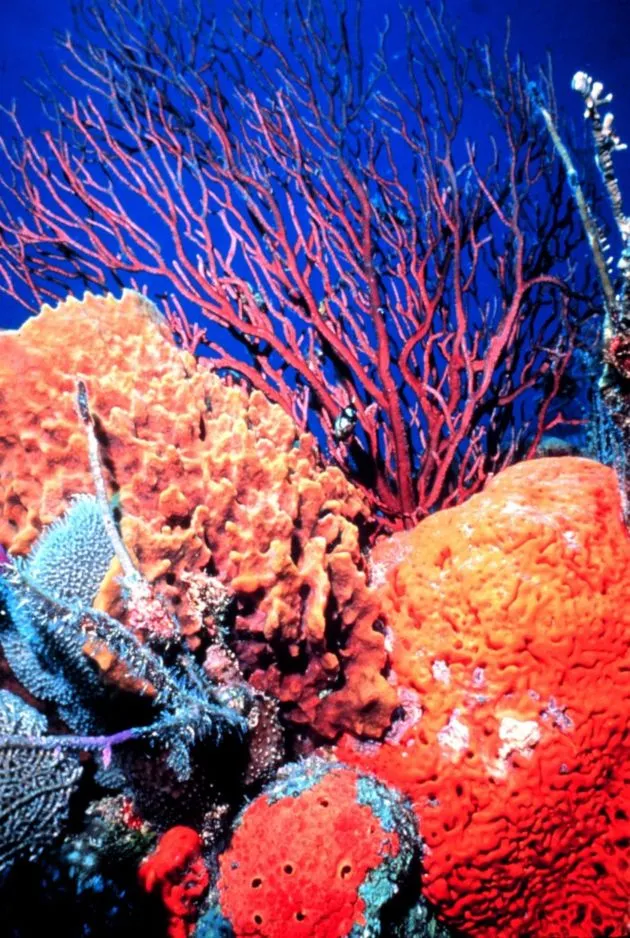
SAN FRANCISCO — The world’s coral reefs face almost certain death as increasing amounts of carbon dioxide in the atmosphere are absorbed by the oceans, acidifying the water in which corals live, a new study warns. In the past few decades, corals have come under increasing pressure from warming ocean waters, overfishing and disease. A recent study found corals in Pacific ocean were disappearing faster than previously thought. The new study, to be presented tomorrow at a meeting here of the American Geophysical Union, points to yet another factor plaguing these underwater bastions of biodiversity: carbon dioxide. As carbon dioxide is emitted through the burning of fossil fuels, some of it is absorbed by the world’s oceans. “About a third of the carbon dioxide put into the atmosphere is absorbed by the oceans,” said study team member Ken Caldeira of the Carnegie Institution of Washington, “which helps slow greenhouse warming, but is a major pollutant of the oceans.” When the carbon dioxide is absorbed in the water, it produces carbonic acid, the same acid that gives soft drinks their fizz. This acid also makes certain minerals dissolve more readily in seawater, particularly aragonite, the mineral used by corals and many other marine organisms to grow their skeletons. Caldeira and his colleagues ran computer simulations of ocean chemistry based on a range of atmospheric carbon dioxide levels, from 280 parts per million (ppm) (pre-industrial levels) to 5,000 parts per million. (Present levels are 380 ppm and rising.) Their findings, detailed in the Dec. 14 issue of the journal Science, show that if current emission trends continue, 98 percent of present-day reef habitats will be too acidic by mid-century for reef growth. “Before the industrial revolution, over 98 percent of warm water coral reefs were bathed with open ocean waters 3.5 times supersaturated with aragonite, meaning that corals could easily extract it to build reefs,” said study co-author Long Cao, also of the Carnegie Institution. “But if atmospheric CO2 stabilizes at 550 ppm—and even that would take concerted international efforts to achieve—no existing coral reef will remain in such an environment.” At greatest risk of these changes are Australia’s iconic Great Barrier Reef, the world's largest living structure, and the reefs of the Caribbean Sea. To slow ocean acidification, Caldeira and Cao warn, will likely take more stringent and immediate reductions in carbon dioxide than would be needed to reduce the other effects of global warming. “The science speaks for itself. We have created conditions on Earth unlike anything most species alive today have experienced in their evolutionary history,” said co-author Bob Steneck of the University of Maine. “Corals are feeling the effects of our actions, and it is now or never if we want to safeguard these marine creatures and the livelihoods that depend on them.”
- Gallery: Coral — Colorful Creations
- Top 10 Surprising Results of Global Warming
- Gallery: Life Under the Sea
Get the world’s most fascinating discoveries delivered straight to your inbox.

Andrea Thompson is an associate editor at Scientific American, where she covers sustainability, energy and the environment. Prior to that, she was a senior writer covering climate science at Climate Central and a reporter and editor at Live Science, where she primarily covered Earth science and the environment. She holds a graduate degree in science health and environmental reporting from New York University, as well as a bachelor of science and and masters of science in atmospheric chemistry from the Georgia Institute of Technology.