Mysterious Cheetah Disease Explained

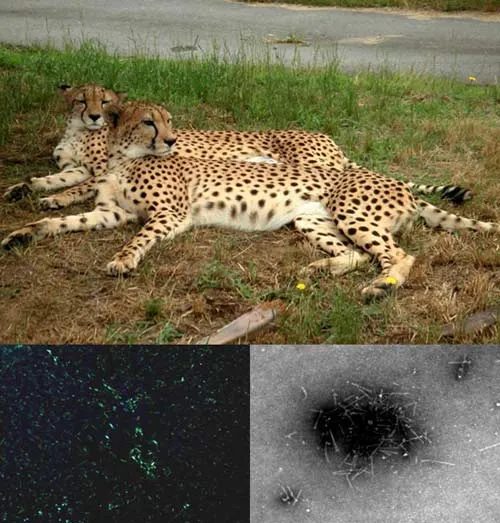
Cheetahs may get a lethal disease by eating the poop of their brethren.
This deadly ailment is similar to mad cow disease and Alzheimer's — its cause is malformed proteins.
Keeping these felines from consuming their own droppings might help keep these rare cats alive in captivity.
Cheetahs are in danger of extinction. One of the principal causes of death of these felines in zoos and sanctuaries is a disease known as AA amyloidosis — it has been found in as much as 70 percent of autopsied cheetahs in captivity.
Misfolded
Like Alzheimer's and mad cow disease, AA amyloidosis results in clumps of proteins that are normally harmless, but have somehow become misfolded into something dangerous. In Alzheimer's and mad cow disease, the fibers of malformed protein — known as amyloid — are concentrated in the brain, but in AA amyloidosis, the amyloid clumps are primarily deposited in the spleen, liver and other organs.
"Severe deposition in the heart causes heart failure," said researcher Keiichi Higuchi, a pathobiologist at Shinshu University in Asahi, Japan.
Get the world’s most fascinating discoveries delivered straight to your inbox.
Little is known about how this disease is spread, but it seems as though its misshapen clumps might actually convert normal proteins into amyloid. In this sense, it resembles mad cow disease in cattle, where abnormal versions of proteins known as prions can mutate their normal brethren.
Now Higuchi and his colleagues find that cheetahs might contract the disease from excrement. It turns out their feces contain small, fragile amyloid fibers that proved highly effective at triggering AA amyloidosis in mice.
The researchers do not believe the cheetahs are intentionally consuming excrement. Rather, "we speculate this may occur during mutual grooming — licking of fur contaminated by fecal matter," Higuchi said. Or soil contaminated with their poop could be capable of tainting both food and fur.
"We hope that we could suggest possible measures for rescuing cheetahs from extinction by preventing AA amyloidosis, such as removing feces as soon as possible," Higuchi said. The scientists detailed their findings online May 12 in the Proceedings of the National Academy of Sciences.
Other possibilities
This disease might also conceivably spread through saliva or urine. However, the cheetah "is a fierce and protected animal and it is dangerous and difficult for us to collect urine and saliva samples," Higuchi said.
Last year, amyloidologist Alan Solomon at the University of Tennessee at Knoxville and his colleagues found that foie gras — goose or duck liver — contaminated with amyloid could trigger AA amyloidosis in susceptible mice.
"So a number of amyloid diseases may be very similar to prion diseases, with the abnormal form of protein can serve as a seed," said Solomon, who did not participate in this study. "One thing we're working on is a way to eliminate or prevent this disease process, an antibody that can recognize this amyloid and help destroy it."
- Video: Dancing Wild Bears
- The World's Deadliest Animals
- Top 10 Mysterious Diseases