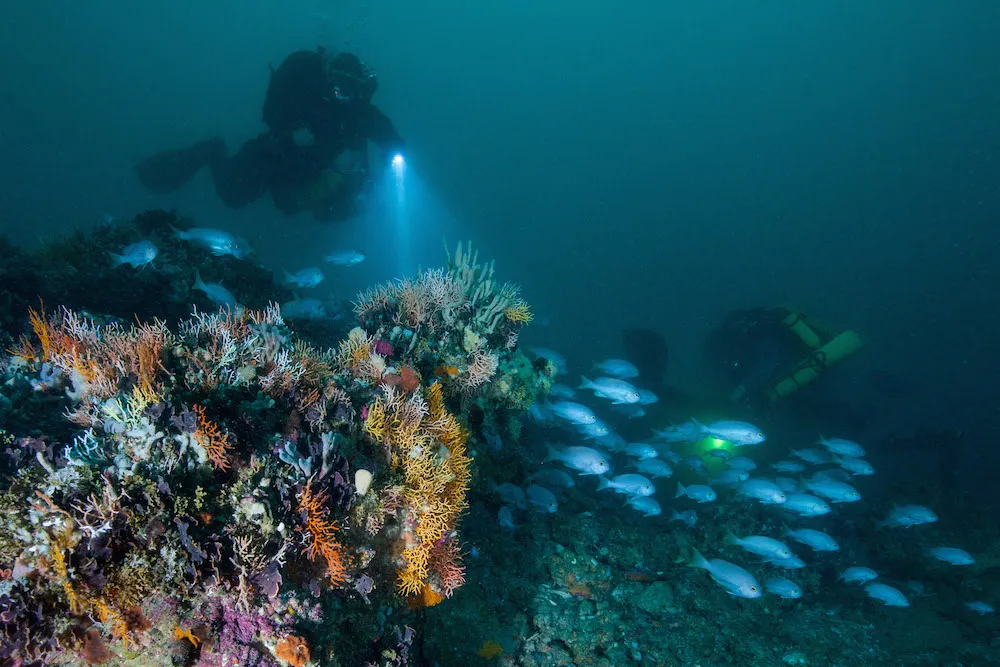
A bevy of limestone towers, dubbed the "Drowned Apostles," have been discovered beneath the waves off the coast of Australia.
Even more surprising, the delicate limestone spires were uncovered nearly 165 feet (50 meters) below the water's surface. The discovery may mark the first time scientists have uncovered limestone pillars, called sea stacks, below the water's surface. (Most of these sea stacks form on the coastline, above the water line.)
"Sea stacks are always eroding, as we saw with the one that collapsed in 2005, so it is hugely surprising that any could be preserved at that depth of water," David Kennedy, a geographer at the University of Melbourne in Australia, said in a statement. [See Images of the Drowned Apostles]
Latest Videos From
Kennedy was referring to one of the shoreline spires, which toppled spectacularly in 2005.
The limestone spires were formed through a process similar to the one that carved the famous tourist attraction of the Twelve Apostles, a handful of limestone stacks that jut out from the coastline of Victoria, Australia. These impressive sea stacks occur only when conditions are just right so that water and wind can erode a slab of rock into a steep, vertical column or columns: Rocks such as granite are too hard to erode quickly enough, while softer clay cliffs cannot support the weight of the overlying piles of rock. Limestone provides the perfect medium because it is soft but maintains a high compressive strength, the researchers wrote in the paper, which was published in the Journal of Coastal Research and will be presented today (March 10) at the International Coastal Symposium in Sydney.
Kennedy and his colleagues were surveying the seafloor to map the reefs around Victoria, which are home to abalone and rock lobster hunted by commercial fishermen. While mapping the ocean floor with sonar beams, Rhiannon Bezore, a doctoral candidate in geography at the University of Melbourne, found a series of short sea stacks next to some drowned cliffs.
The five apostles were much shorter and stubbier than the Twelve Apostles — the tallest spire was about 21 feet (6.4 m), compared with the 221 foot (67.5 m) height of the tallest Twelve Apostles pillar on the nearby shoreline. Like their shoreline-dwelling brethren, the drowned pillars are also made of limestone, and the absence of any volcanic rock nearby rules out the notion that they were formed through volcanic activity. Based on these factors, researchers concluded that the Drowned Apostles formed through the same process that carved the Twelve Apostles.
Taking into account historical data on sea-level rise in the region, the team hypothesizes that these ancient spires formed about 60,000 years ago, when the sea level was at least 200 feet (60 m) lower than it is today.
The mysterious underwater pillars are an anomaly, the researchers said.
"We had to check what we were seeing because no one has seen stacks submerged at this sea level before," Bezore said in the statement.
Follow Tia Ghose on Twitterand Google+. Follow Live Science @livescience, Facebook & Google+. Original article on Live Science.