Get the world’s most fascinating discoveries delivered straight to your inbox.
You are now subscribed
Your newsletter sign-up was successful
Want to add more newsletters?
Join the club
Get full access to premium articles, exclusive features and a growing list of member rewards.
An account already exists for this email address, please log in.
Surprising new pattern of groundwater loss may signal a turning point for the Colorado River Basin
During an intense drought from 2020 to 2022, the Upper Colorado River Basin lost far more groundwater than the Lower Basin did, despite having much higher natural recharge.
Western states that were thought to be resistant to prolonged drought may be more vulnerable than scientists previously believed, a new analysis of groundwater reserves in the Colorado River Basin finds.
Researchers revealed the four states that together make up the Upper Basin — Colorado, New Mexico, Utah and Wyoming — lost almost twice as much groundwater as the Lower Basin did during an intense drought in the southwestern U.S. between 2020 and 2022. The finding was unexpected and might signal a turning point for the region, because the Upper Basin has long been seen as more resilient to dry spells than the Lower Basin, said Esther Oyedele, a doctoral student in geosciences at Virginia Tech and the study's first author.
"The Upper Colorado River Basin has historically been considered more resilient because it receives more precipitation, particularly snowfall in the Rocky Mountains," Oyedele told Live Science in an email. "I think the important takeaway is that we should not assume that the Upper Basin will remain relatively resilient simply because it has historically received more precipitation and snowmelt."
The Lower Basin comprises parts of Nevada, California and Arizona. Less rain and snowfall means the Lower Basin naturally has less groundwater recharge, or less replenishment from other water sources, than the Upper Basin. On top of that, the Lower Basin generally has higher evaporation rates and substantial water demands, given that roughly 30 million of the 40 million people that depend on the Colorado River for water live in the Lower Basin, Oyedele said.
In the new study, published Oct. 13 in the journal Water Resources Research, researchers used satellite and hydrological data to estimate groundwater depletion across the Colorado River Basin between 2004 and 2023. The data included measurements of surface water, soil moisture and snow-water storage, as well as observations from the Gravity Recovery and Climate Experiment mission and its successor, called the Follow-On.
The results showed that groundwater depletion has been a persistent problem in the Colorado River Basin over the past two decades, but losses accelerated in 2019. The three-year drought that began in 2020 is the principal cause of this, because it shrank the snowpack in the Rocky Mountains, increased evaporation and boosted water demand across the basin, Oyedele said.
During the drought between 2020 and 2022, the Upper Basin lost around 4.2 cubic miles (17.5 cubic kilometers) of groundwater, while the Lower Basin lost about 2.3 cubic miles (9.4 cubic km). In total, the Colorado River Basin lost 14 cubic miles (58.3 cubic km) of groundwater — equivalent to 25 million Olympic-size swimming pools' worth of water — during the study period, between 2004 and 2023.
Sign up for the Live Science daily newsletter now
Get the world’s most fascinating discoveries delivered straight to your inbox.
It's unclear why the deficit is so much higher in the Upper Basin than in the Lower Basin, but the Upper Basin's proximity to and dependence on the mountains for aquifer recharge probably didn't help, Oyedele said. As snow melts, some of it replenishes groundwater, so a reduction in snowfall between 2020 and 2022 would have affected the Upper Basin particularly badly, she noted.
The Upper Basin also recorded more aquifer recharge during wet periods before the drought than the Lower Basin did, so it's possible that the pronounced decline during the drought was linked to a higher initial amount of groundwater in the Upper Basin, Oyedele said.
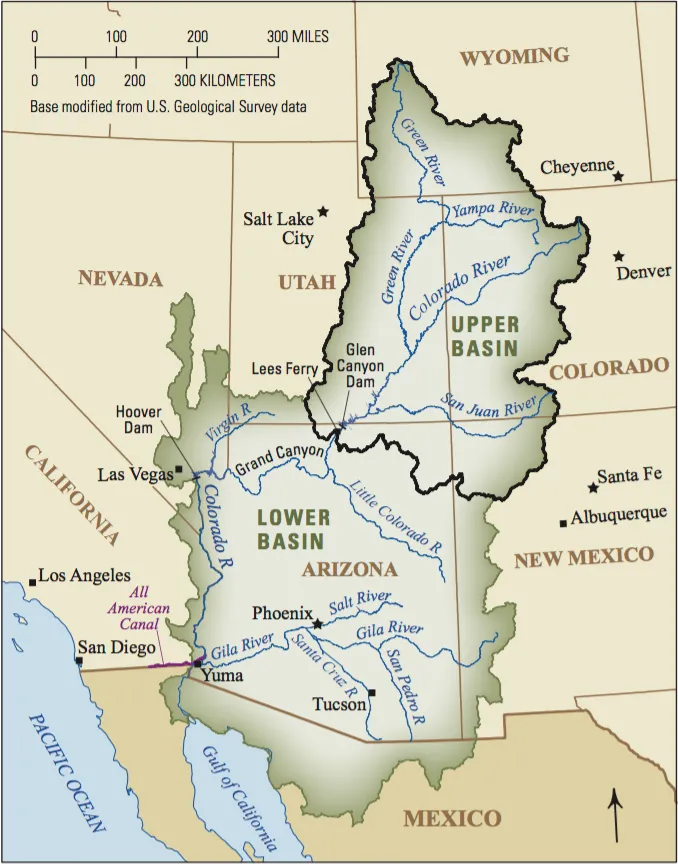
The Upper Basin includes parts of Colorado, Wyoming, Utah and New Mexico, while the Lower Basin comprises parts of Nevada, California and Arizona.
(Image credit: U.S. Geological Survey)
Next, the researchers used advanced statistical methods to explore the relationship between groundwater and surface water in the Colorado River Basin. Due to global warming and the overallocation of the Colorado River's water in a 1922 document, the river's flow is now 35% less than it was on average in the 20th century. Water scarcity in the basin has reached alarming levels, according to the study, and Lake Mead and Lake Powell, the two largest reservoirs in the U.S., dropped to record lows in August.
The team found that in the Upper Basin, groundwater levels evolve in the same direction as surface water, but with a slight delay. This suggests groundwater losses occur due to a lack of recharge and more aquifer pumping during periods of drought, when surface water levels drop. In the Lower Basin, however, this link is weaker and more complex. The results showed that groundwater losses sometimes preceded surface water declines during the study period, suggesting that groundwater depletion is not simply tied to less surface water trickling into the ground or to humans extracting groundwater when there's less surface water available. Instead, groundwater is consistently being overused, Oyedele said.
"This distinction is important because it suggests that groundwater depletion is not simply a direct response to surface-water shortages," she said. "Human water use, particularly sustained groundwater extraction, may also play a significant role."
Looking ahead, it's hard to tell if the Upper Basin will continue to lose more groundwater than the Lower Basin and what that would mean for the region, Oyedele said. What seems clear, however, is that the Upper Basin is more vulnerable to drought than experts had thought.
"Continued warming, changes in snowpack, prolonged drought, and increasing water demand could place additional pressure on groundwater resources across both basins," Oyedele said. However, future groundwater responses will depend on several factors, including precipitation, snowmelt, water use and management decisions, she added.
On the management side, Oyedele suggested tackling groundwater and surface water together rather than as two separate resources. Groundwater helps to sustain river flows, and rivers can recharge aquifers — so the two are interconnected. Groundwater often serves as a backup during drought, but it shouldn't be treated as an unlimited reserve, she said.
Article Sources
Oyedele, E. O., Werth, S., & Carlson, G. (2026). Contrasting groundwater response to surface water shortages in the Upper and Lower Colorado River Basins. Water Resources Research, 62(10). https://doi.org/10.1029/2025wr041695
Sascha is a U.K.-based staff writer at Live Science. She holds a bachelor’s degree in biology from the University of Southampton in England and a master’s degree in science communication from Imperial College London. Her work has appeared in The Guardian and the health website Zoe. Besides writing, she enjoys playing tennis, bread-making and browsing second-hand shops for hidden gems.
You must confirm your public display name before commenting
Please logout and then login again, you will then be prompted to enter your display name.