
 Live Science Plus


How Earth's Hidden Magma Ocean Formed

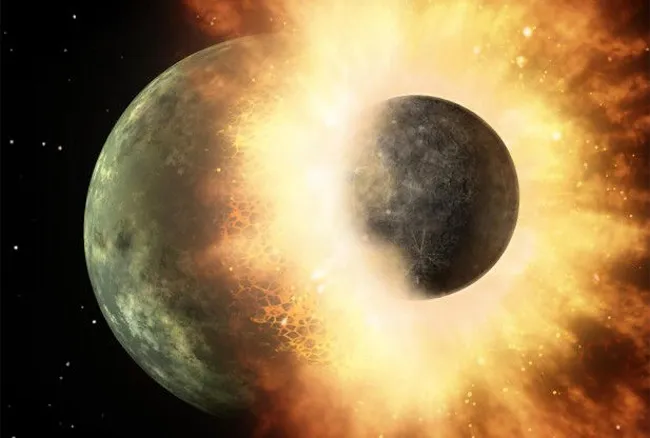
The rotation of the newborn Earth may have helped to control the evolution of a giant magma ocean sitting on top of its core, researchers say.
Knowing how Earth's magma oceans evolved over time could shed light on when the plate tectonics— the shifting of the rocky slabs that make up the planet and underlie earthquakes and volcanoes — began, scientists added.
Previous calculations suggested that Earth possessed one or more giant oceans of magma, or molten rock. For instance, after a Mars-size rock slammed into Earth about 4.5 billion years ago to create the moon, prior research suggested a magma ocean about 620 miles (1,000 kilometers) deep covered most of Earth's surface, according to prior research. [In Photos: Watery Ocean Hidden Beneath Earth's Surface]

Understanding more about how Earth's molten rock crystallized over time could yield insights on when the planet first developed a magnetic field, which could have shielded the planet from deadly solar radiation, setting the stage for the origin of life on Earth. In addition, "the crystallization of the magma ocean set the initial conditions for plate tectonics," said study lead author Christian Maas, a geophysicist at the University of Münster in Germany.
Previous research failed to take into account the effects of Earth's rotation when it came to how this ancient magma ocean evolved. Now, scientists find that Earth's spinning might have influenced how this molten rock crystallized.
"Rotational effects could have had a crucial influence on the processes in a magma ocean and, therefore, on the Earth's history,"Maas said.

The newborn Earth spun much faster than it does today, with days lasting only 2 to 5 hours instead of 24. Moreover, the planet was hotter, making its magma less viscous and easier to whirl, much like how milk spins more quickly in a blender than honey does.
Get the world’s most fascinating discoveries delivered straight to your inbox.
The scientists developed a computer model of the early Earth, to see how the planet's rotation might have affected its magma ocean over time. They found that rotation influenced the way in which silicon-rich rocks known as silicates crystallized. Silicates are main components of magma.
When the model did not rotate, heavier silicate crystals sank deeper into the magma ocean, while lighter crystals settled on top of the heavier crystals, as one might expect. However, when the model did spin, the rotational force on the crystals made them behave differently at the equator than at the poles. At the poles, the heavier crystals sank to the bottom, while the lighter crystals settled on top of them. But at the equator, the heavier crystals accumulated at mid-depths, while the lighter crystals sank to the bottom.
"The most surprising result for me is that the behavior of crystals differs significantly between poles and the equator," Maas told Live Science.
The crystals behaved as they did at the equator because of a phenomenon known as the Coriolis effect. When a planet spins, matter in and on it will move on curved paths — this effect, among other things, influences the degree to which wind patterns such as hurricanes will whirl.
At the equator, the Coriolis effect works against gravity, altering the paths of the crystals as they fall. Maas said. The heavier the particles are, the stronger the Coriolis force is on them, and at the equator, this keeps the heavier crystals at mid-depths, while the lighter crystals can sink down, he explained.
Maas noted that this research modeled the poles and equator separately from each other. "The next step is therefore to simulate the whole magma ocean, including the poles, the equator and the region between the poles and the equator," Maas said. "Even with the newest computer equipment, simulations will take months." Eventually, such research could help shed light on how the magma ocean crystallized and help trigger plate tectonics.
Maasand his colleague Ulrich Hansen, also of the University of Münster in Germany, detailed their findings online Nov. 6 in the Journal of Geophysical Research: Solid Earth.
Follow Charles Q. Choi on Twitter @cqchoi. Follow us @livescience, Facebook&Google+. Original article on Live Science.
