Get the world’s most fascinating discoveries delivered straight to your inbox.
You are now subscribed
Your newsletter sign-up was successful
Want to add more newsletters?
Join the club
Get full access to premium articles, exclusive features and a growing list of member rewards.
An account already exists for this email address, please log in.
Full moon helps paint vibrant, muddy 'brushstrokes' in Indonesian river — Earth from space
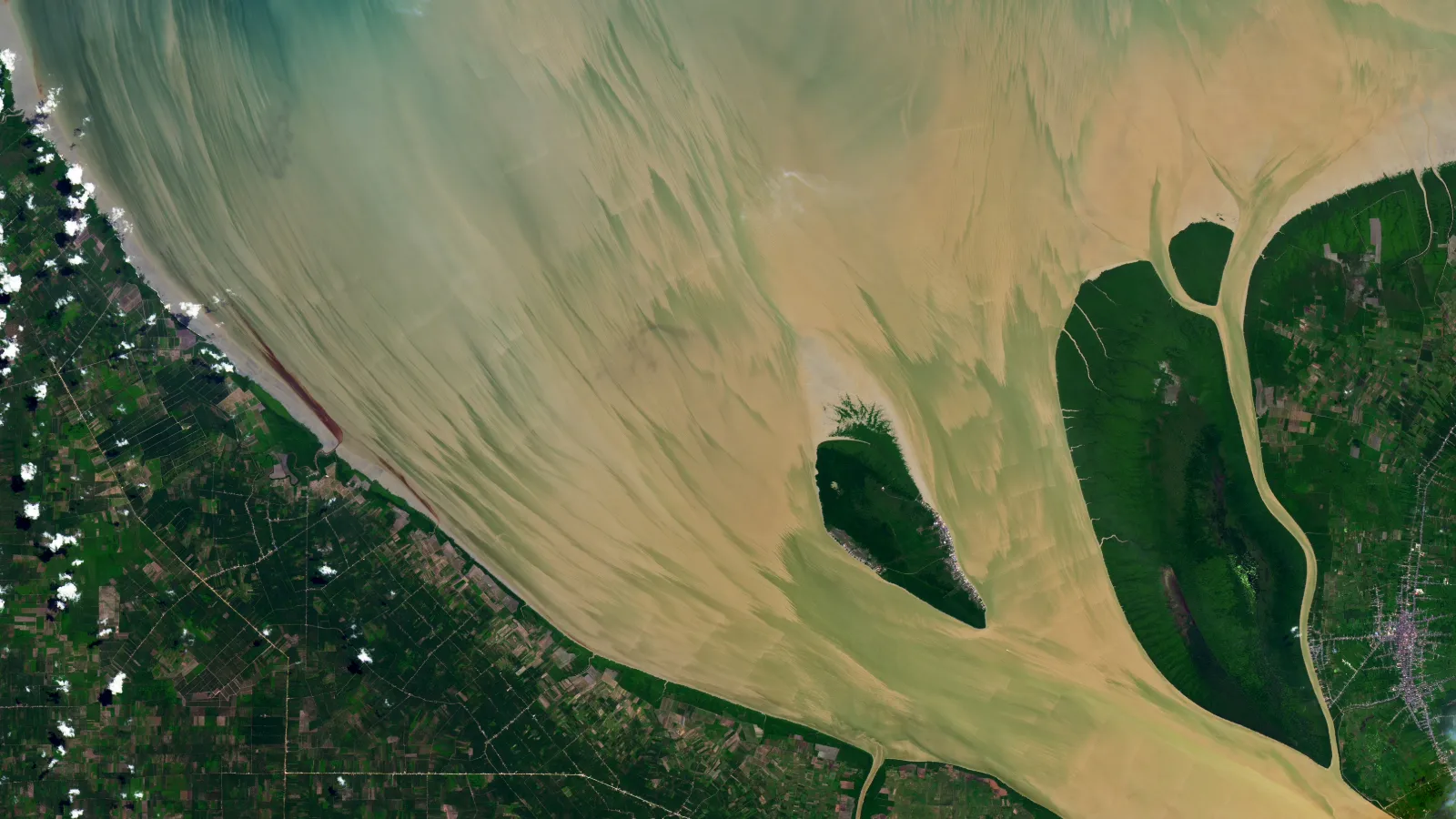
A 2024 satellite snap shows suspended sediments streaking across the mouth of the Rokan River, thanks in part to a particularly high tide caused by a full "Strawberry Moon."
What's in the photo? Brushstroke-like patterns of sediment painted by a high tide
Which satellite took the photo? Landsat 8
When was it taken? June 23, 2024
This beautiful satellite snap captured a series of "brushstroke-like patterns" that emerged in the mouth of an Indonesian river. The striking striations were triggered by a particularly high tide following a full "Strawberry Moon."
The Rokan River is a roughly 220-mile-long (350 kilometers) waterway on Indonesia's Sumatra island. The landmass covers around 170,000 square miles (440,000 square kilometers) in the Indian Ocean, making it the sixth-largest island on Earth.
The river runs from the Barisan Mountains in Sumatra's west to the island's north coast, where it drains into the Strait of Malacca. Here, the river morphs into a brackish estuary that flows on each side of Halang Island (photographed).
The Rokan River often has a yellow hue due to high levels of sand and silt in its waters. The sediment gets dragged up from the river's floor, partially due to the constant rising and falling of the tide, according to NASA's Earth Observatory.
In this image, the tide is on its way out, which causes the sediment to be slowly dragged out to sea. When viewed from above, these "brushstroke-like patterns" transform the river into what looks like an abstract painting, Earth Observatory representatives wrote.
The Rokan River stretches for around 220 miles (350 km) through Sumatra's rainforest and experiences a regular "tidal bore."
(Image credit: JOKER/Jörg Löffke/ullstein bild via Getty Images)
When the photo was taken, the high tide was at its peak — up to 16 feet (5 meters) higher than low tide. The water was especially high because it was the day after the full "Strawberry Moon" rose in the sky, according to the Earth Observatory. (June's full moon is nicknamed the Strawberry Moon because it coincides with the strawberry harvesting season in the Northern Hemisphere, not because of its color.)
The tidal range is greatest when there is a full moon because the sun and the moon are aligned in a straight line, so they gravitationally push and pull Earth's oceans in sync. This is known as a "spring tide," but it happens throughout the year.
Sign up for the Live Science daily newsletter now
Get the world’s most fascinating discoveries delivered straight to your inbox.
In addition to having a significant tidal range, the Rokan River is home to a regular tidal bore — a powerful surge of water that rushes upstream like a giant wave during high tides. This rare phenomenon occurs only in estuaries with a narrow mouth and a high tidal range.
A 2022 study revealed that the surge is responsible for transporting large amounts of sediment back up the river. If a bore occurred before the satellite photo was taken (which may or may not have happened), it could have stirred up some of the sediment streaks visible in the image.
All of this tidal action can have a significant impact on the estuary itself. A 2016 study compared satellite images of the estuary between 2000 and 2014, and found that the shoreline along the north of Halang Island (which clearly extends beyond the small landmass in the image) is growing at an average rate of 220 feet (67 m) per year.
A 2011 astronaut photo shows off a series of colorful mini-lakes that appeared around the edge of a giant Namibian salt flat, known as the Etosha Pan, following a major flooding event.
A 2022 satellite photo shows a thick mat of blooming algae and invasive aquatic plants spreading across the surface of the reservoir at South Africa's Hartebeespoort Dam.
A 2025 first false-color image from ESA's newly operational Biomass satellite shows off a unique perspective of the rainforests, grasslands and wetlands surrounding a winding river in Bolivia.
Harry is a U.K.-based senior staff writer at Live Science. He studied marine biology at the University of Exeter before training to become a journalist. He covers a wide range of topics including space exploration, planetary science, space weather, climate change, animal behavior and paleontology. His recent work on the solar maximum won "best space submission" at the 2024 Aerospace Media Awards and was shortlisted in the "top scoop" category at the NCTJ Awards for Excellence in 2023. He also writes Live Science's weekly Earth from space series.
You must confirm your public display name before commenting
Please logout and then login again, you will then be prompted to enter your display name.