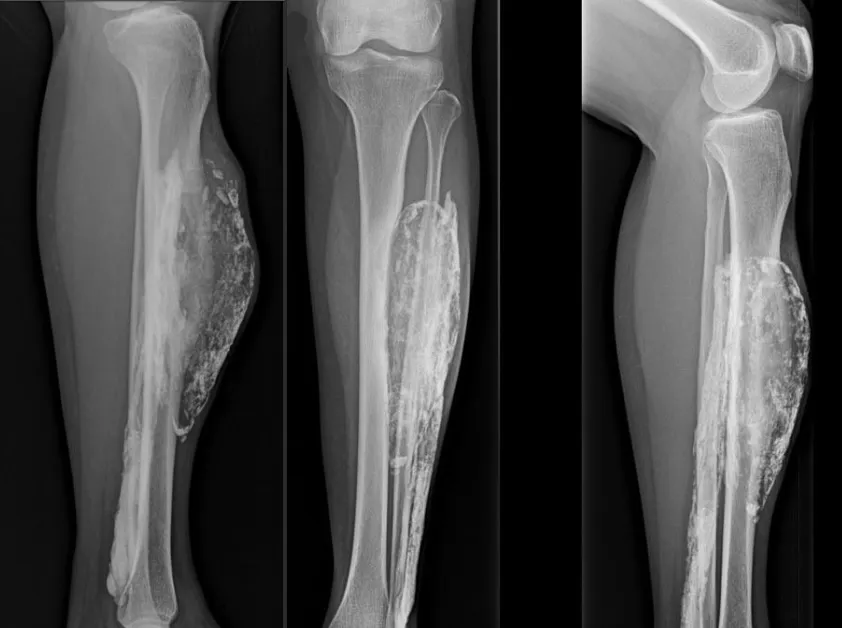
More than 50 years after being bitten by a venomous snake, a woman developed a large mass in her lower leg, according to a new report of her case.
The 66-year-old woman in Thailand had been bitten by a Malayan pit viper, a venomous snake native to Southeast Asia, when she was 14.
The painless mass had become noticeable 10 years earlier, and on an X-ray it looked like an enlarged cavity wrapped in a tough, calcified membrane, resembling an eggshell. It ultimately grew so large that it broke through the woman's skin. Doctors surgically removed the mass, and the wound completely healed by one month after the surgery, they wrote in their report, published June 16 in the Journal of Medical Case Reports.
Latest Videos From
Such masses have rarely been reported following a snakebite, but they have been seen following other types of traumatic injury to muscles, according to the report's authors, who are researchers at the Prince of Songkla University in Thailand. [16 Oddest Medical Cases]
A calcified mass can form as muscle tissue starts to die after a crushing injury or disruption of the blood supply, usually in the lower leg, said Dr. Darren Fitzpatrick, an assistant professor of Radiology at Mount Sinai Medical Center in New York, who wasn't involved in the woman's case.
The result is usually a firm, hard, palpable mass that can be examined using X-ray or MRI scans. [Image of the mass]
"It's very common for it to be mistaken for a tumor, but usually, the imaging helps with the diagnosis," Fitzpatrick told Live Science.
In the case of this patient, doctors suspected that, because of the snakebite, the woman had developed a condition called compartment syndrome; the name refers to sections of muscle that are held together, along with nerves and blood vessels, by a tough tissue called the fascia, which does not stretch easily.
The woman's compartment syndrome had been left untreated, according to the report.
"Compartment syndrome usually happens below the knee," Fitzpatrick said. "You have a big group of muscles there, and they are in kind of a tight compartment.
"If the muscles start to swell from trauma or injury, they can run out of space, and that could result in compromised blood flow," he added. "That's certainly a very plausible reason as to why this could have happened in this case." Editor's Note: This article was updated at 5:00 p.m. ET. It incorrectly referred to the snake as poisonous rather than venomous.
Email Bahar Gholipour. Follow LiveScience @livescience, Facebook & Google+. Originally published on Live Science.

 Live Science Plus