













'More than 100 million years of evolution': How snakes evolved and lost their legs
Huge snakes, tiny snakes, venomous snakes and constrictor snakes, snakes that slither, burrow or swim: New fossils and modern technology are tracing serpent origins

Back when dinosaurs stomped the Earth, dinky mammals scurried about in their shadows. The little furballs, hiding out in underground burrows, provided a fresh niche for a novel reptile: the snake. Skinny snakes could squeeze into the homes of mammals and gobble them up.
At least, that's how the dawn of snakes is imagined by Marc Tollis, an evolutionary biologist at Northern Arizona University in Flagstaff. No one knows for sure. Like the creatures themselves, the snake fossil record is long and thin, leaving gaps in snaky history. Major questions, such as where they got their start and who their closest relatives are, remain unanswered.
Today, new fossils and modern techniques are updating the story of snakes. Starting about 125 million years ago, snakes used their flexible body plans to diversify like crazy, conquering regions that now make up six continents, plus the Indian and Pacific Oceans — and Tollis would not be surprised to find snake fossils in once-balmy Antarctica, either.
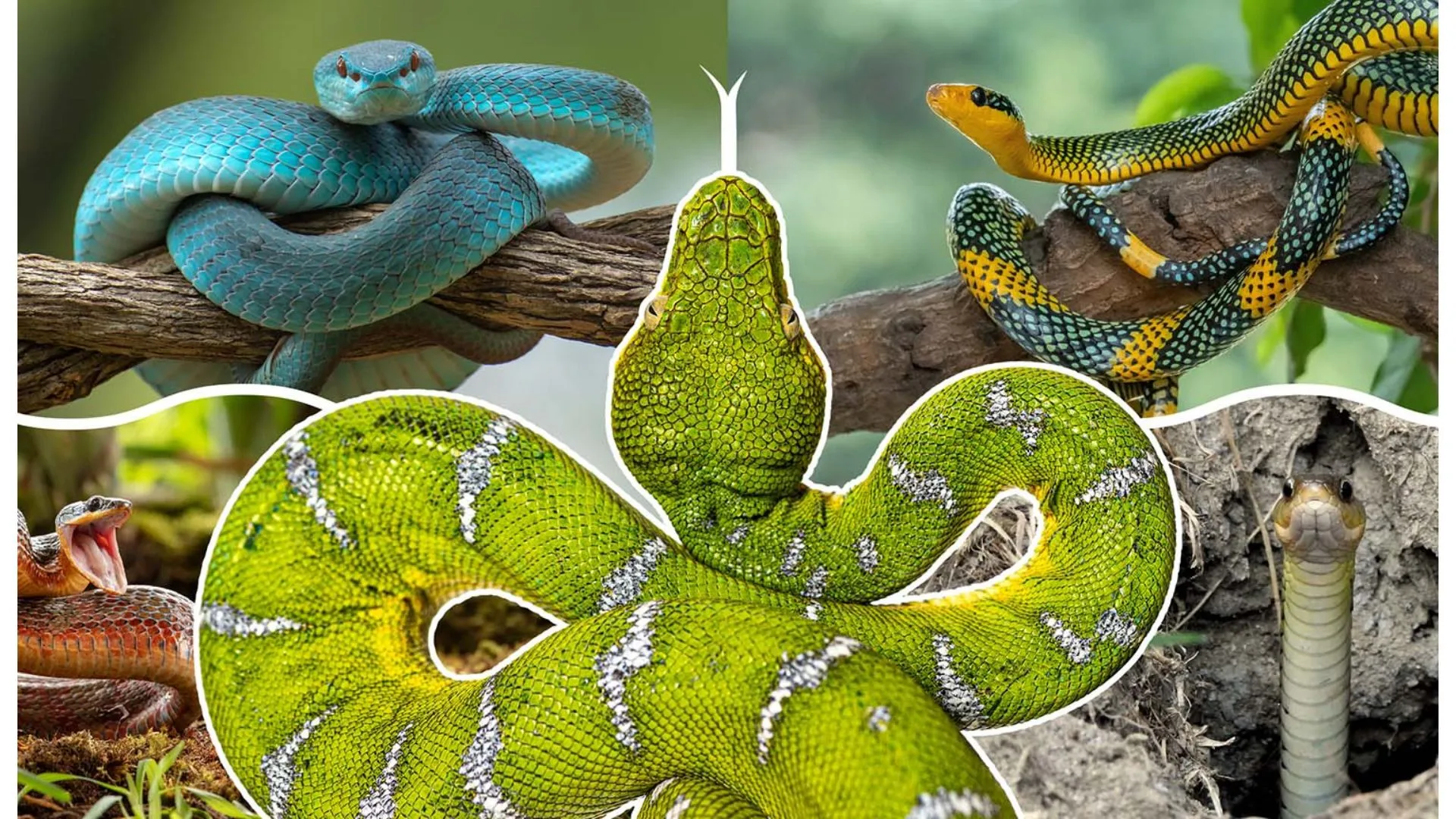
There are serpents slithering across the land, burrowing into the soil, swimming in the sea and gliding between trees, even catching rides on trains and, yes, planes. There are itty-bitty threadsnakes just a few inches long and thin as spaghetti, and there are pythons that exceed 20 feet. There are snakes that chase their prey and snakes that lie in wait to ambush it, snakes that strangle their meals and others that immobilize their dinner with venom. Snakes that lay eggs, snakes that bear live young, snakes that can reproduce without males.
It's an impressive smorgasbord of abilities for what is, essentially, a freaky offshoot on the lizard family tree. Serpents are basically predatory tubes, Tollis notes. They can't walk or chew their food. These seem like seriously limiting factors.
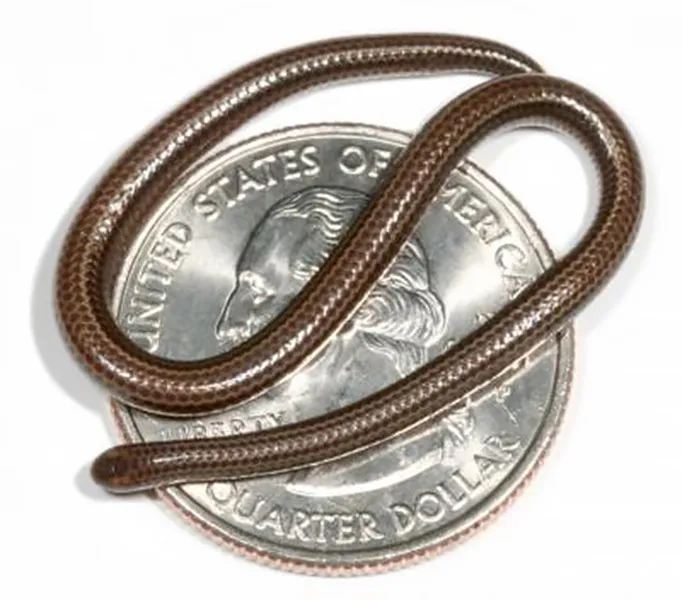
The Barbados threadsnake, Tetracheilostoma carlae, is one of the smallest snakes in the world.
"Despite that, snakes are some of the most successful animals," marvels Tollis, who coauthored an overview of early snake and lizard evolution in the 2025 Annual Review of Ecology, Evolution, and Systematics. "They definitely have superpowers that we would normally associate with the fantastic."
By sea, by land, or below?
There are more than 4,000 described living species of snakes, accounting for about one-third of the larger lizard group, and probably hundreds more awaiting official discovery, says Alex Pyron, an evolutionary biologist at George Washington University in Washington, DC. Scientists estimate that the ancestors of this wildly diverse group emerged around 160 million years ago, but they haven't figured out what the first snakes were like — land snakes, sea snakes, perhaps underground snakes?
Get the world’s most fascinating discoveries delivered straight to your inbox.
These mysterious, ancestral snakes should sit at the very base of the snake family tree, but their fossils haven't been found. The oldest snake fossils known come from a variety of environments, making it hard to determine which kind of habitat snakes wriggled out of, says Tiago Simões, a coauthor on the Annual Review paper and an evolutionary biologist at Princeton University in New Jersey.
One longstanding hypothesis is that snakes got their start underground. The original idea was based, in part, on the barely-there eyes of the blind snakes that are the lowest branch on the family tree of living snakes. But blind snakes are quite specialized for the anthills and termite mounds they inhabit, says Catie Strong, a vertebrate paleontologist and graduate student at the Harvard Museum of Comparative Zoology in Cambridge, Massachusetts.
They have weird, alien-looking skulls fit for their subterranean environment and insectivore diet. For example, Strong says, a "pronounced underbite" helps keep dirt out of their mouths. While training with vertebrate paleontologist and evolutionary biologist Michael Caldwell at the University of Alberta in Edmonton, Canada, Strong concluded, as have other researchers, that these hyperspecialized critters can't correspond to the root of the snake family tree.
In the late 20th century, evidence supporting a possible marine origin floated up. Scientists described early snakes that lived nearly 100 million years ago in the Middle East, when that land was underwater. Caldwell and colleagues also linked the snake clan to mosasaurs, extinct aquatic reptiles, raising the possibility that snakes emerged in the water. But favor for that hypothesis has sunk: There are other snakes that predate those aquatic snakes and were clearly terrestrial, says Simões. So the current consensus is that the Middle Eastern swimmers didn’t spring from the water but dived into it from land.
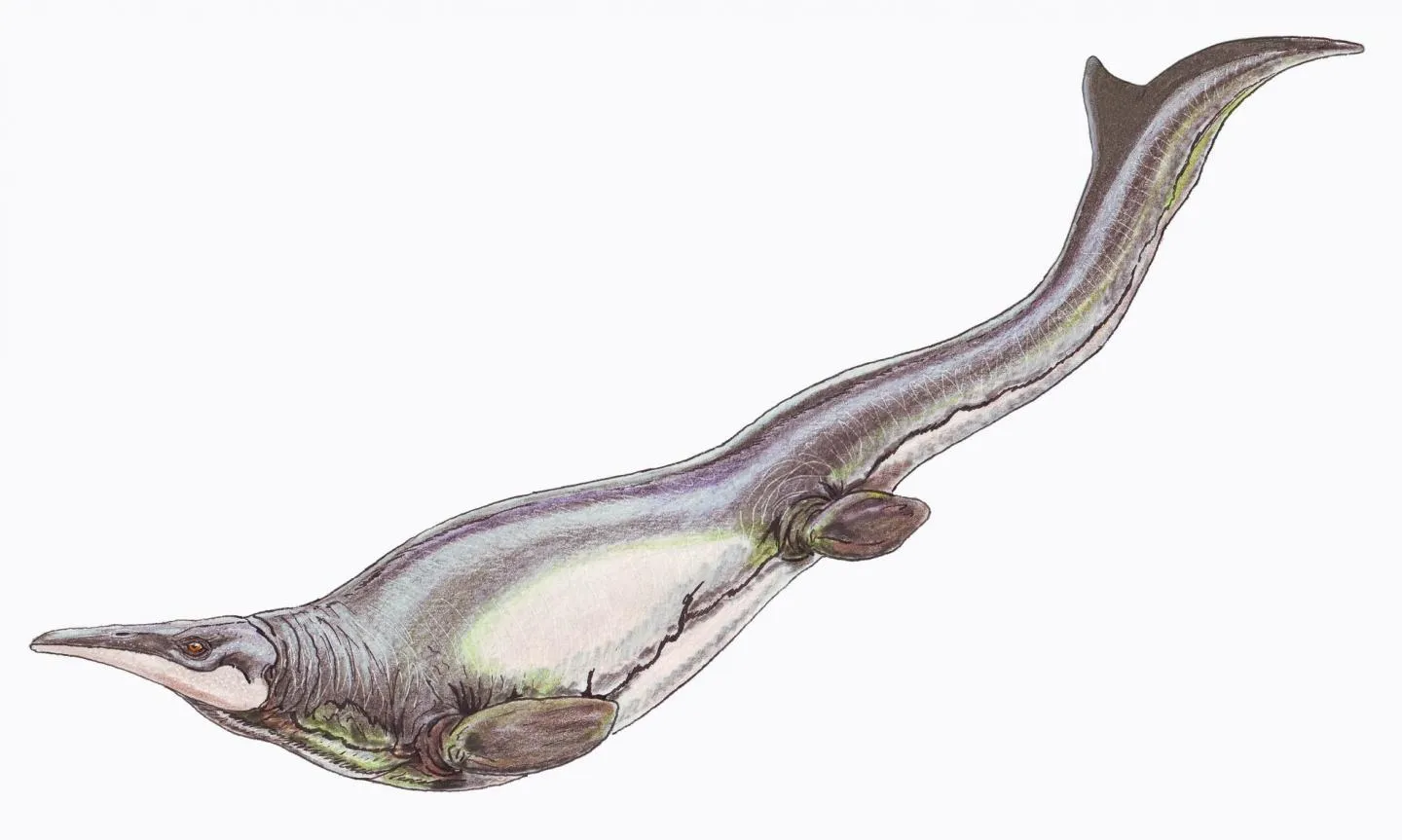
Scientists suspect that snakes share an ancestor with extinct, aquatic reptiles called mosasaurs.
Modern-day Patagonia has yielded a trove of additional snake fossils, such as Najash rionegrina, dated to about 95 million years ago, and Dinilysia patagonica, from about 80 million years ago, when that environment was desertlike. But were these South American serpents on the ground, or under it? Dinilysia probably lived aboveground, but the situation with Najash is trickier, says Simões.
Najash has skull and spinal features that, to its discoverers, suggested it spent at least some time underground. But both of these Patagonia species were "big-bodied snakes," adds Caldwell, similar to modern-day pythons. Like pythons, they might have hid out underground, but hunted on the surface, he speculates.
Additional evidence for a mixed dry land/underground origin comes from predictions about early snakes' brains. Scientists used 3D X-ray imaging to analyze the braincase — the part of the skull protecting the brain — of nearly 60 snakes and lizards, plus a few snake fossils. From those inner contours, they could infer the shape of the brain. The researchers identified burrower brain anatomy: Diggers usually possess, for example, a small, flattened, triangular cerebellum, a brain section involved in movement. When the researchers used their data to predict the ancestral snake brain shape, they wound up with some burrower-like features, including that little cerebellum, but other features inconsistent with underground living.
Bringing all the evidence together, Strong subscribes to a theory that snakes evolved on land, maybe in a sandy environment like the one Dinilysia and Najash inhabited. This, she suspects, also happened to set them up to navigate underground on occasion.
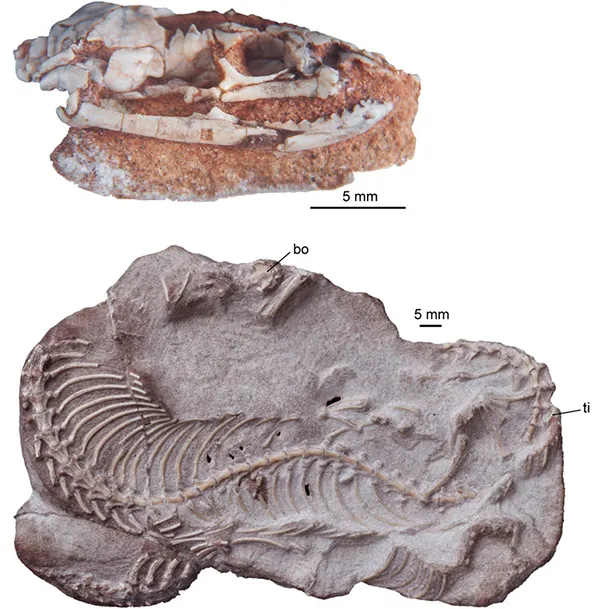
New fossils of the early snake Najash, found in Patagonia, were reported in the journal Science Advances in 2019.
A better way to slither
Another major event in snake evolution was, of course, the shedding of their legs. This is not as innovative as it might seem; among lizard-kind, several long, skinny groups have kicked their legs to the curb. When one is crawling underground or moving through grass, limbs are literally "a drag," says Daniela Garcia Cobos, an evolutionary biologist and graduate student at the American Museum of Natural History in New York City. Snakes do, however, seem to have been among the first lizards to master this streamlined shape in a variety of different types of habitats, which might underlie their success with it.
Pyron estimates this change happened between 150 million and 125 million years ago, but scientists haven’t been able to pin down exactly when or where. The known fossil snakes had hind limbs but not forelimbs, though Dinilysia’s status is uncertain because there hasn't been good evidence of pelvic region preservation in those fossils. At some earlier point, there must have been a four-legged snake ancestor, but this missing link has been elusive. One candidate was reported in 2015, but Caldwell and collaborators showed it was just a lizard.
Then came Breugnathair elgolensis, a four-legged Jurassic fossil found in Scotland and described in Nature in 2025. "If you saw it in the street, walking across the road, you’d think it was just an iguana or ordinary lizard," says Susan E. Evans, a paleontologist at University College London, who described the specimen with colleagues.
But B. elgolensis's jaw does have some snaky features, like the shape of its teeth. Caldwell, who wasn't part of the team that described it, thinks it's a snake. "It's got all the right skull features," he says.
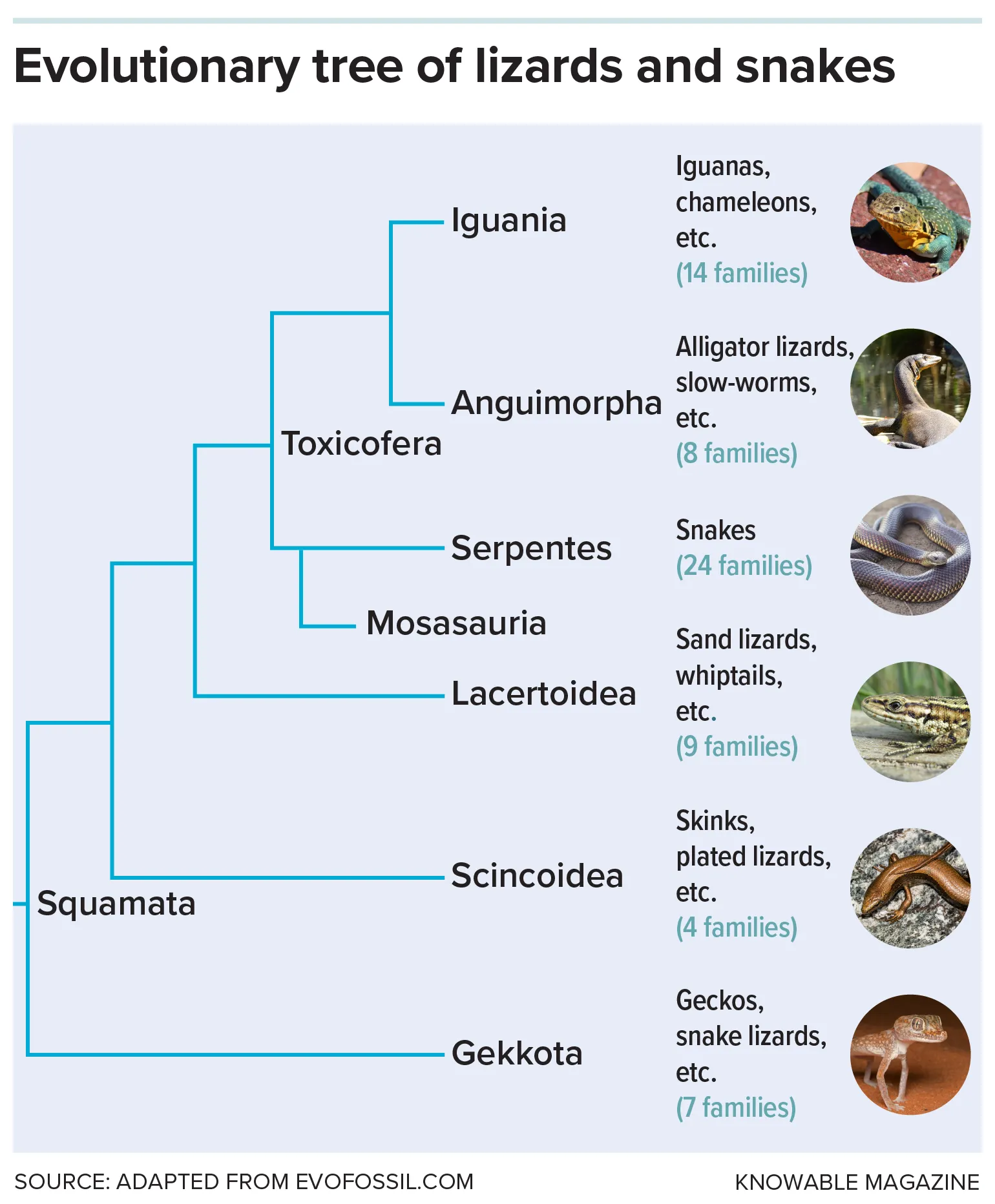
Snakes make up the suborder Serpentes, within the order Squamata, that includes all lizards and snakes. Snakes are related to other reptiles in a clade called Toxicofera, which includes all venomous lizards as well as nonvenomous species.
Evans isn't so certain, an opinion evident in the name she chose: Breugnathair derives from Gaelic for "false snake." When Evans and colleagues tried to place it in the reptile family tree, the results were wishy-washy. It might be a snake ancestor, she concedes, or it could be a lizard that independently evolved snakelike features but left no living descendants.
Heady changes
What distinguished snakes from all other legless lizards were the other changes they made, says Pyron. To investigate further innovations, Pyron and collaborators embarked on a massive reptile census, which they published in Science in 2024. They measured the skulls of thousands of snakes and lizards. They examined the stomach contents of museum specimens and pored over written dietary records. They amassed genetic data — not the whole genome, but 5,400 specific genes — from more than 1,000 snake and lizard species.
When they lined up those features, snakes stood out. About 125 million years ago, the group underwent sudden and significant changes to their skulls, diets and spines that would position them to diversify and spread.
Snakes' biggest claim to evolutionary fame is their weirdly flexible craniums, made of bony pieces connected by soft tissue; Caldwell thinks this key alteration might have happened even before they gave up their legs. En route to those piecework noggins, snakes first changed up their braincase. In most lizards, this looks like a sandwich: bone on top, bone on the bottom, brain within and open on the sides. But in snakes, it's more like a wrap, a bony tube that's only open toward the face and spine. Protecting the brain that way meant snakes were free to let the rest of the skull's bones move about. And boy, did they.
Those skull changes enabled new diets with the evolution of the serpentine jaw. While jaw anatomy varies within the group, in many snakes, the lower and upper parts are connected by stretchy ligaments, enabling a wide gape. The two sides of the lower jaw can splay apart, further expanding the snake's maw. The palate at the top of the mouth has right and left parts that move independently to convey food throatward. That's how a python can swallow a pig. Indeed, the Science team found that snakes, as a clan, can eat pretty much anything that moves. There are snakes that nosh on gooey slugs and armored snails, slippery eels and even other serpents.
And around the same time, snakes grew longer, adding hundreds of vertebrae between their necks and nether regions. "Being elongate allows you to locomote more quickly and efficiently," says Caldwell. Extra belly flesh supplies more surface area to push along the ground or climb tree trunks. For aquatic snakes, increased body length enables more efficient weaving back and forth.
In sum, these changes to body, head and diet meant the evolving serpents were flexible not just in form, but also in lifestyle. Snakes adapt rapidly to new environments, says Frank Burbrink, curator of herpetology at the American Museum of Natural History and a coauthor of the Annual Review article. In other words, these evolutionary superstars were primed to make the most of any habitat they slithered into.
Making up for absent fossils
The fragmented skulls and the body length that were so beneficial for snakes' spread create a headache for paleontologists: Dead snakes go to pieces, making complete fossils scarce and leaving many questions unanswered. For example, researchers know serpents are related to groups containing iguanas and Komodo dragons, as well as possibly those mosasaurs, but it's not certain which are their closest cousins. Knowing that would help to predict what snake ancestors should look like, says Evans.
When fossils falter, genetics can come to the rescue. The more dissimilar the genes from different animals, the longer it's been since they went their separate ways as species. Already, genetic analyses have forced a reshuffling of the lizard family tree; trees based on body shape alone turned out to be "totally wrong," says Pyron.
Genes have also illuminated how snake bodies build some of their special features. The lack of legs is linked to lost function in a limb-promoting sequence called ZRS. And scientists recently reported that snakes lack the gene encoding the "hunger hormone" ghrelin. This might make it easier for them to endure long fasts; some snakes can go for a year or more between repasts.
Burbrink, Pyron and Simões are now sequencing whole genomes of more than 100 snakes and lizards, which will double the number of high-quality genomes available. With that plus additional data on living and fossil reptiles, they expect to build better family trees and further investigate the genes behind a snake's sinuous shape.
Related stories
Still, Evans says, scientists really need more fossils to fill in the twists and turns in the serpents’ tale.
As paleontologists keep digging, Burbrink counsels us to take a moment to marvel the next time we come across a garter snake or other modern wriggler: "You're looking at the culmination of more than 100 million years of evolution."
This article originally appeared in Knowable Magazine, a nonprofit publication dedicated to making scientific knowledge accessible to all. Sign up for Knowable Magazine’ snewsletter.
Editor's note: This story was updated at 7:35 p.m. ET on July 27 to change a word in the strapline from poisonous to venomous.
How much do you know about snakes? Test your knowledge with our snake quiz!

Amber Dance is an award-winning freelance science writer based in Southern California. She is a contributor at Knowable Magazine, program director for the New Horizons in Science Briefings at the Sciencewriters annual conference for the Council for the Advancement of Science Writing and an instructor teaching Science Writing I for UCLA Extension.
You must confirm your public display name before commenting
Please logout and then login again, you will then be prompted to enter your display name.