













'A measurable, enormous global impact': Astronaut Chris Hadfield on why the true power of Artemis II could take decades to hit
Astronaut Chris Hadfield shares his emotional response to the Artemis II mission, and why it could change the course of people's futures.


With Artemis II complete, NASA is pushing ahead with plans to build a permanent human habitat on the moon, and retired Canadian Space Agency astronaut Chris Hadfield wants to make sure one crucial piece of technology is awaiting the future crop of lunar settlers: a guitar.
"We keep a guitar on the International Space Station ... and as we start to settle the moon over the next five or 10 years, we're going to need a musical instrument there," Hadfield told Live Science in an interview. "Music is really important. Even NASA, a very strict science and engineering organization, recognizes how important it is for mental health."
On his three trips to space between 1995 and 2013, Hadfield broke many records: He was the first Canadian to perform a spacewalk, the first Canadian to command the International Space Station and the first astronaut to record music in orbit. Using a small acoustic guitar that NASA supplied to the space station in 2001, Hadfield performed a microgravity cover of David Bowie's "Space Oddity," which has since been viewed by tens of millions of people.
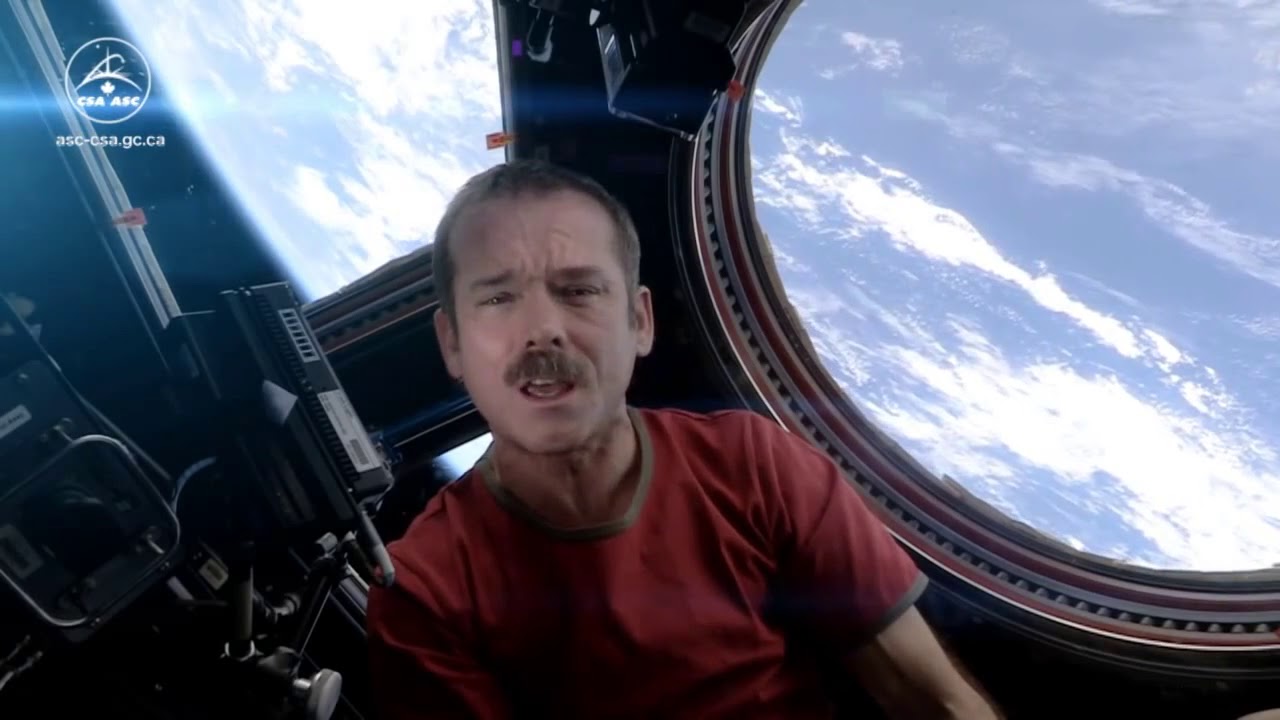
For Hadfield, connecting with the Earthbound public isn't just a perk of an astronaut's job; it's the main point. On Thursday (April 23) Hadfield brought that mentality to his home province of Ontario, Canada, where he sang and played guitar alongside a stacked lineup of musicians as part of a fundraising concert for the SickKids children's hospital in Toronto.
Live Science caught up with Hadfield before the concert to chat about his reactions to the Artemis II mission, why astronauts need to be sources of inspiration in unsettling times, and the orbiting guitar that has "done more world tours than Keith Richards."
Brandon Specktor: Hi, Chris. It's been an exciting few weeks for spaceflight. What was the most memorable moment of the Artemis II mission for you, as a former astronaut?
Chris Hadfield: [Canadian astronaut] Jeremy Hansen announcing to the commander [NASA astronaut Reid Wiseman] and the world that they were naming a newly formed crater on the moon after Reid Wiseman's late wife. That moment was so honest, and beautiful, and thoughtful, and personal — and yet he shared it live, in real time amongst all the technical stuff.
Get the world’s most fascinating discoveries delivered straight to your inbox.
And there's a lot of other things on the mission that are huge for me and fascinating and resonating. But I think, if you really want to know what it's like to be an astronaut, watch how the Artemis II crew shared their spaceflight.
People could truly see what it's like to commit your life to take enormous risk.
Chris Hadfield
This is the first time we've ever gone to the moon with such a high bandwidth of connectivity. And [footage] didn't just come down to NASA, who then would share a piece of it with a TV station, who would then maybe share a piece of it briefly over the news — this was live to anybody who wanted to watch it all around the world, all the time.
And so that combination of helping people to see what's going on, and then the magnificent work that the crew did in sharing it with everybody so that people could truly see what it's like to commit your life to take enormous risk — to fly a rocket ship no one ever flew before, to fly a spaceship no one ever flew before, to trust a heat shield with your lives that no one ever trusted before — and yet at the same time be joyful, and respectful, and competent, and sharing … that, to me, was the big benchmark impact of Artemis II.

Chris Hadfield (center) on a space walk in 2001. He was the first Canadian to ever walk in space.
BS: You were once described as the "most social media savvy astronaut to ever leave Earth." How should astronauts keep up that level of connection as we plan to send humans farther and farther from our planet?
CH: Well, part of it is why I'm playing music tonight — I don't have to do that. And there's lots of musicians on stage.
Some people don't care [about space exploration], and that's fine. But, in a time of a lot of unrest, and uncertainty, and direct conflict — right to the worst human failure of all, which is war — it is really good to have strong, undeniable public examples of something that is positive, and beneficial, and inspiring, and right on the edge of what people can do when they cooperate together and do things right. And we need that. Everybody needs something to look up to, literally.

Chris Hadfield watches a water droplet float in zero gravity.
I think people forget, or at least have a false memory, of what the Apollo program was like. Apollo 8 was sort of startlingly similar to right now: the Vietnam War, huge civil unrest, race riots going on in the United States, tremendous dissatisfaction, a corrupt U.S. president, and just nothing good — everyone just feeling so helpless.
Apollo 8 was sort of startlingly similar to right now ... everyone just feeling so helpless.
Chris Hadfield
And yet, NASA decided, "OK, even though it's early and risky, we're going to send Apollo 8 around the moon and back." Now it wasn't nearly as well shared, because they didn't have the technology and you couldn't see any imagery until they got back. But it was just before Christmas, and all three of the crewmembers read from the Bible on Christmas Eve. And it had a beautiful impact. It was slower and more carefully shared, but it had a big impact.
But then Apollo 9, nobody knows anything about. Everyone thinks the Apollo era was like, everyone was holding their breath with every flight — not at all. No one cared at all.
Apollo 11, for a few days, got the world's attention because they were actually landing. It was unprecedented. It was the most watched event in human history, and it inspired an entire generation of young people. The number of people that did Ph.D.s in the years following Apollo 11, per capita, has never been matched. People saw themselves differently, and all because of the sharing that the Apollo 11 crew did and NASA's efforts to use the best tech they could to get those grainy, slow-updated video images of Neil [Armstrong] coming down the ladder and get his audio — and it inspired me.

Hadfield plays guitar on the ISS.
And people may go, "Well, I never wanted to be an astronaut — that's silly." But it inspired the people that built your car. It inspired all kinds of people that chose to go into tech, and go into science, and go into medicine, because they thought, "Wow, if we could do that, then what am I being so fearful about?" And it had a measurable, enormous global impact that still resonates today. We now use the word "moonshot" as a common vernacular. And so that is now just as important now, and so that's why the crews take it so seriously.
So, as we look to the next moon landing with Artemis IV, the number-one thing is getting the technology right — but number two is human impact. And it's really important to share it so that other people can be inspired by it, such that they can make different choices with their lives — braver choices, more challenging choices, things where they will accomplish more. And so that's what motivated me.
Imagine a rocket ship coming down and blowing shattered glass in all directions.
Chris Hadfield, on moon dust
BS: Settling the moon is one of NASA's big ambitions. What do you think are the biggest challenges we still need to figure out before having a more permanent human presence there?
CH: Well, apart from the straight engineering challenge of landing — which has been done, but not recently and not by the machines we're using now — there are a couple of specific things.
One is moon dust. If you're landing in the vicinity of anything else, with only one-sixth the gravity of Earth and no air to slow the particles down, the blasted particulate becomes a real problem. And the dust isn't eroded dirt like on Earth; it's like shattered glass. And so if you could imagine a rocket ship coming down and blowing shattered glass in all directions, where it goes much farther than intuitively you'd think because of the much-weakened gravity and no air to slow it down, that is a problem. We have solutions with berms and hardened landing pads; we just have to build them.
The second concern is water. Is there water available in the shadowed craters of the moon or not? We think there is, but until we actually go — you know, lick them — we won't know. These craters are supercold because they're permanently shadowed; it's as cold a place as we know in the universe. And so, how do you even harvest or break up whatever the water is frozen into? It's probably at least hard, frozen dust, if not actually frozen into the rock itself.
Is it readily accessible? That's a big, big question. If it is, that's a boon. Because we know that at the lunar south pole, the sun shines almost all the time — so you've got solar power. And any place where you have power and water, you can live, so long as you have a good habitat.
So we have to go there. And we have probes doing that, we have landers doing that, and eventually, we'll have people doing that. So those are the challenges on the engineering side.
There are challenges on the human side, as well. One is, how does the human body do for an extended period at one-sixth gravity? We think because of what we've learned on [the] space station, we're going to be fine. Because we've lived on [the] space station for decades now, and some people for almost 1,000 days — multiple years, they've lived on [the] station — and they're fine. You obviously have some effects, but so long as you have exercise equipment and you get a chance to rehab when you come back to Earth, you're fine.

Chris Hadfield plays guitar along with the band Bucket List at a previous SickKids fundraiser.
BS: You're performing Thursday night (April 23) in the "A Night at the Opera" fundraiser for the SickKids children's hospital in Toronto. How did you get involved, and will you be playing guitar?
CH: We have three kids, and I've done multiple things over the years with SickKids in Toronto, which is just world-class care for young people. So when friends of mine were organizing a chance to raise funds for SickKids, and combine it with a really fun evening of music, I signed right up. And I've been doing it for, gosh, six or seven years. It's an annual event, and it's a lot of fun, with some world-class musicians on stage having a good time.
The band that I sing with is just so talented. We'll be covering some fun songs this year — and yeah, I'm playing and singing.
If you do the math, that guitar has gone around the world about 145,000 times by now. We joke that it's done more world tours than Keith Richards.
Chris Hadfield
BS: Before we go, tell me about the guitar on the space station.
CH: People think that I brought it up there, but that's a misnomer. That was put there as psychological support by the NASA psych support team, and it's been up there since the summer of 2001, that little Canadian Larrivée guitar.
But that guitar is just up there because we need music. And there's always at least one astronaut who can play some guitar, and the music is really important.
I think, if you do the math, that guitar has gone around the world about 145,000 times by now. We joke that it's done more world tours than Keith Richards.
BS: You probably couldn't fit an acoustic guitar in the Orion capsule used for the Artemis missions. What instruments would you recommend for a smaller spacecraft?
CH: Well, there have been flutes on board the ISS. [NASA astronaut] Cady Coleman — we've played in bands together for decades — she brought a flute up. In fact, she brought one of Jethro Tull's flutes, and also an old flute from the Irish band The Chieftains. It was [flautist] Matt Molloy's wooden flute from the mid-1800s.
But having a small-body guitar is kind of perfect because you can still get a big sound out of it. Lots of people can play a six string, and it just tucks out of the way. So the reasons that guitars are so ubiquitous on Earth, the same applies to a spaceship. On an Orion vehicle, you'd want something even smaller; maybe a ukulele would make sense.
As we start to settle the moon over the next five or 10 years, we're going to need a musical instrument there. Maybe one of the cargo ships up there will throw another Larrivée in, or it'd be really fun if we could transfer the one from the space station to the moon. That would be the coolest thing!
Editor's note: This interview has been condensed and edited for clarity. It was updated on April 24 to indicate the concert already happened.

Brandon is the space / physics editor at Live Science. With more than 20 years of editorial experience, his writing has appeared in The Washington Post, Reader's Digest, CBS.com, the Richard Dawkins Foundation website and other outlets. He holds a bachelor's degree in creative writing from the University of Arizona, with minors in journalism and media arts. His interests include black holes, asteroids and comets, and the search for extraterrestrial life.
You must confirm your public display name before commenting
Please logout and then login again, you will then be prompted to enter your display name.