













Artemis II: NASA is preparing for a return to the moon, but why is it going back?
NASA's Artemis II mission is sending humans back to the moon for the first time since the Apollo era. Here are the reasons why the U.S. wants to return.


NASA's Artemis II mission will soon send astronauts on a trip around the moon, if the current plans hold. But why is the U.S. so eager to revisit the moon for the first time in more than 50 years?
NASA has promised that returning to the moon will lead to new scientific discoveries, bring economic benefits, and inspire a new generation of explorers. It's also no secret that China threatens to overtake the U.S. as the leader in space exploration, and the U.S. doesn't want to fall behind.
From a scientific perspective, humanity still has much to learn about the moon. Earth's natural satellite has a long history preserved in its rocks, and it could help researchers better understand our own planet, the solar system and the universe at large.
The moon and Earth are like twins that have been dancing around each other since the beginning of the solar system around 4.5 billion years ago, said Sara Russell, a planetary scientist at the Natural History Museum in London. This means they have a shared history of impacts from asteroids, comets and other objects,
"It just has this 4-and-a-half-billion-year record of what has happened on its surface," Russell told Live Science. "We can see how affected it has been by impacts, which have also happened to the Earth, but we don't see evidence for that on the Earth so easily."
Biological processes and weather-fueled erosion obscure Earth's impact history. The moon, on the other hand, has a thin atmosphere, no weather and no life, so its impact craters can be preserved almost indefinitely. These conditions also provide other research opportunities.
"It's kind of a great laboratory about what happens to geology if there isn't any water or air," Russell said. "We can understand these very fundamental [geological] processes much more easily in many cases by looking at them on the moon."
Get the world’s most fascinating discoveries delivered straight to your inbox.

The Orion spacecraft points at the moon from its perch atop the Artemis II Space Launch System (SLS) rocket as it was rolled back to the Vehicle Assembly Building on February 25, 2026.
Artemis
Artemis II is the second of five initial missions in the Artemis program, which aims to establish a long-term U.S. presence on the moon for the first time. The inaugural Artemis mission, Artemis I, was an uncrewed 26-day flight around the moon in 2022. Artemis II is the first crewed spaceflight in the program and is scheduled to send four astronauts on a 10-day flight around the moon and back to Earth as soon as April 1.
Each Artemis mission is meant to build on its predecessor. Artemis I laid the groundwork for Artemis II, and Artemis II is about testing systems ahead of Artemis III, Artemis IV and Artemis V. The latter two missions aim to put astronauts on the lunar surface in 2028, with Artemis V laying the foundation for what NASA claims will be a permanent lunar base.
NASA famously took 12 astronauts to the lunar surface as part of the Apollo missions between 1969 and 1972. Russell noted that lunar samples collected during the Apollo missions have kept scientists busy for more than 50 years, but the Apollo astronauts explored only some of the lunar surface on the near side of the moon, and only its equatorial region.
"It's sort of like having several expeditions to the Sahara Desert and saying, OK, now we understand the Earth," Russell said. "That's why it's important to go back to the moon and, particularly, go to different areas. This is where Artemis is really exciting. The future Artemis mission will go to the lunar south pole, which is an area that really hasn't been explored before."

Astronaut David R. Scott filming on the lunar surface as part of the Apollo 15 mission in 1971.
The moon's south pole is a prime location for water ice, which is thought to be concentrated in the polar regions of the lunar surface. Studying this water ice provides scientists with an opportunity to learn more about Earth's history with water.
"We want to know how the moon got that water, and the reason we want to know that is because how the moon got its water is probably how the Earth got its water," Russell said.
Traveling to the moon with a crew will also enable mission scientists to pursue another, perhaps more disturbing, goal of the Artemis program — investigating the effects of space travel on human physiology. The Artemis II flight is an opportunity for new studies of astronaut health, including how space travel influences the body, mind and behavior, and how those impacts could affect future missions, according to NASA. This is one of many ways the lunar missions are potential stepping stones to deeper space exploration.
That's because the Artemis program is meant to advance technologies and develop infrastructure that will be necessary for sending astronauts to Mars. Space exploration is difficult, dangerous and expensive, so NASA needs to test its systems and its astronauts on the moon before sending them to farther destinations. Establishing a lunar base could be key to traveling to Mars.
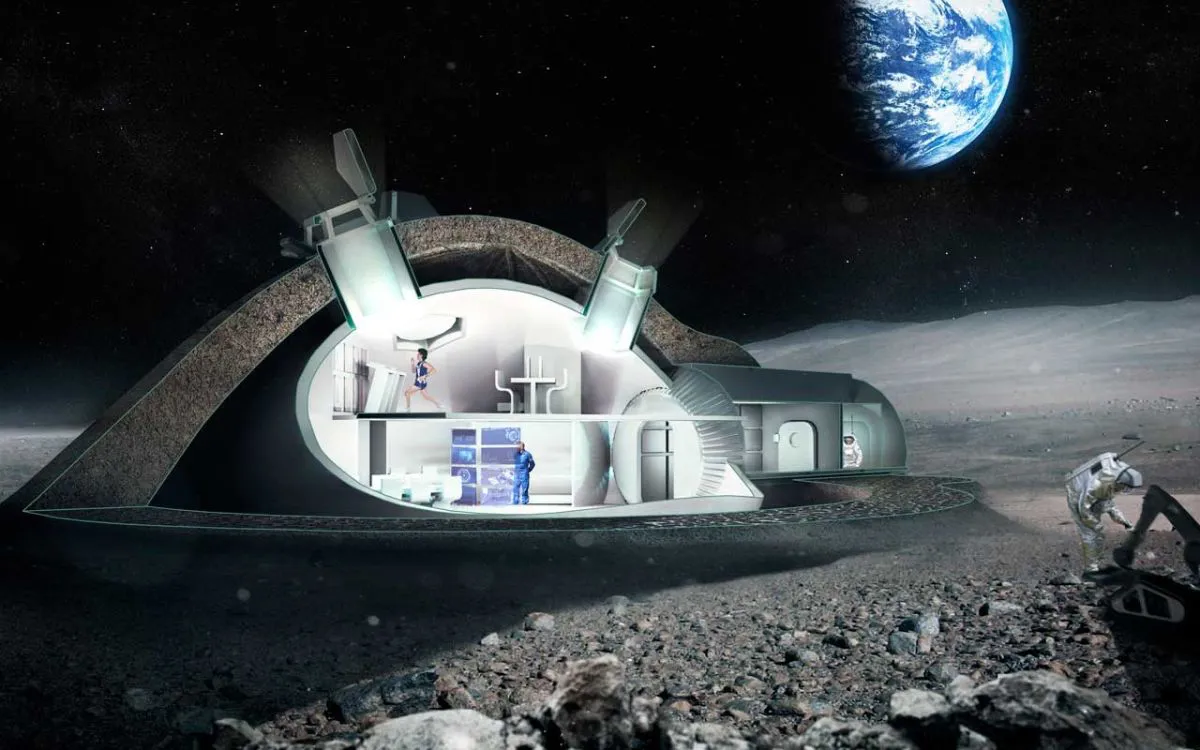
An inside look at one idea the European Space Agency is exploring in its formulation of a "moon village" that incorporates 3D printing.
The moon has resources that should make space more accessible. For example, NASA has claimed that if it can harvest the moon's water, the space agency can use it to help make drinking water, oxygen and rocket fuel — although this remains unproven. Shooting for the moon fulfills a broader strategy to find and use resources off Earth, which could make space exploration cheaper because not everything is made on Earth and transported elsewhere.
Speaking of money, there's a potential lunar economy to consider. NASA has said that its moon strategy stimulates the commercial space industry and creates business opportunities in ways that could foster a lunar economy. The lunar economy currently stems from NASA working with private companies that provide commercial deliveries to support the space agency's mission. Essentially, NASA pays companies to take stuff to the moon. The space agency currently has 15 of these commercial lunar delivery contracts scheduled to be completed by 2028, according to NASA. However, once humans start colonizsing the moon, it could also open up valuable mining opportunities.
Moon mining has the potential to become a billion-dollar industry. The moon harbors resources like rare earth elements, which are mined for electronics on Earth, as well as a potential gold mine in its stocks of helium-3, which could eventually be used in nuclear fusion reactors to make near-limitless clean energy.
The new space race
While the initial space race was between the U.S. and the Soviet Union in the mid-20th century, nations are once again racing for control of the final frontier.
RELATED STORIES
Although the U.S., China and Russia are the main competitors in the "new space race," more than 80 countries now have a presence in space, according to Royal Museums Greenwich in the U.K. Beyond commercial interests, access to space plays an increasingly important role in a nation's security — and so could the moon.
Robert Braun, head of the space exploration sector at Johns Hopkins University's Applied Physics Laboratory, recently described the moon as the "ultimate high ground." In a video released by the university, Braun said many nations are heading to the moon because there's a "nexus of security, exploration and economic objectives."
If the U.S. is to win this second race for the moon, then the upcoming Artemis missions will need to remain on schedule. China wants to land its own astronauts on the moon before 2030, which is at most two years after the first Artemis lunar surface missions, assuming they are a success.

Patrick Pester is the trending news writer at Live Science. His work has appeared on other science websites, such as BBC Science Focus and Scientific American. Patrick retrained as a journalist after spending his early career working in zoos and wildlife conservation. He was awarded the Master's Excellence Scholarship to study at Cardiff University where he completed a master's degree in international journalism. He also has a second master's degree in biodiversity, evolution and conservation in action from Middlesex University London. When he isn't writing news, Patrick investigates the sale of human remains.
You must confirm your public display name before commenting
Please logout and then login again, you will then be prompted to enter your display name.