Get the world’s most fascinating discoveries delivered straight to your inbox.
You are now subscribed
Your newsletter sign-up was successful
Want to add more newsletters?
Join the club
Get full access to premium articles, exclusive features and a growing list of member rewards.
An account already exists for this email address, please log in.
Bungled Boeing Starliner mission was the highest order of mishap that put stranded astronauts at risk, report says
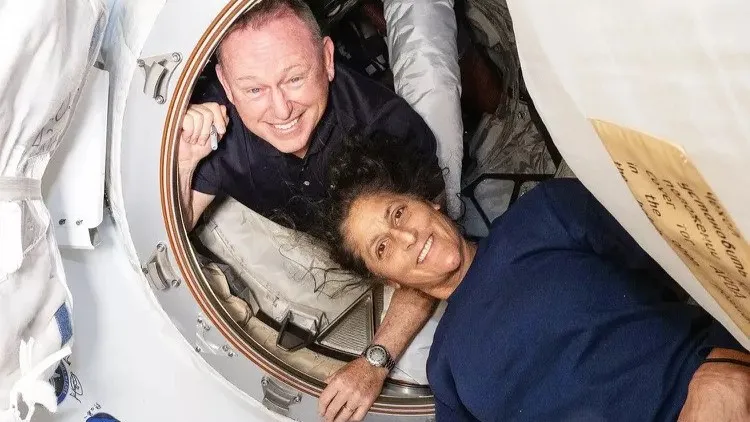
The 2024 Starliner mission, which left astronauts Butch Wilmore and Suni Williams stranded in space for nine months, has received NASA's worst mishap classification in a damning report.
NASA has put the failed 2024 test flight of Boeing's Starliner capsule in the same category as the Challenger and Columbia shuttle disasters and the Apollo 13 mission, a new report released by the agency reveals.
The space agency has classified the bungled flight, which left two NASA astronauts unexpectedly stranded in space for nine months from 2024 to 2025, as a "Type A mishap" — the most severe classification in NASA safety management.
Events are classified as Type A mishaps if they cause the death or permanent disability of a crewmember, if the spacecraft or its hull comes apart, if the craft makes an unplanned deviation from its flight, or if damages incurred by the mission exceed $2 million.
Key to the 282-page report's findings are criticisms of faulty engineering, lax oversight, and poor coordination between those responsible for the mission. Nonetheless, NASA has said it will continue to work with Boeing to test Starliner, with the aim of returning it to crewed flight in the coming years.
"The most troubling failure revealed by this investigation is not hardware. It's decision-making in leadership that, if left unchecked, could create a culture incompatible with human space flight," NASA Administrator Jared Isaacman said at a news conference today (Feb. 19). "To be clear, NASA will not fly another crew on Starliner until technical causes are understood and corrected."
According to Isaacman (who was sworn in as NASA administrator on Dec. 17, 2025, and was not with the agency during the mission), the Starliner test should have been declared a Type A mishap as soon as it became clear that the spacecraft's faulty thrusters put the crew in jeopardy more than a year ago. "The record is now being corrected," he added. "There will be leadership accountability."
Doomed from the start
Starliner's woes began not long after it blasted off on its inaugural crewed test flight from Florida's Cape Canaveral Space Force Station on June 5, 2024. After the spacecraft entered orbit, a number of faults appeared, including five helium leaks and five failures of the reaction control system (RCS) thrusters.
Sign up for the Live Science daily newsletter now
Get the world’s most fascinating discoveries delivered straight to your inbox.
This forced engineers to troubleshoot issues from the ground. Tests conducted at Starliner's facility in White Sands, New Mexico, revealed that during the spacecraft's climb to the International Space Station (ISS), the Teflon seals inside the five faulty RCS thrusters likely got hot and bulged out of place and, as a result, obstructed the propellant flow, according to NASA.
NASA and Boeing's tests ran from days, to weeks, to months, as Butch Wilmore and Suni Williams, the flight's astronauts, remained stranded aboard the ISS.
A photo of Boeing's Starliner capsule above the Earth as it approached the International Space Station.
(Image credit: ESA/NASA-S.Cristoforetti)
A hot-fire test conducted while the craft was docked to the ISS on July 27, 2024, showed that the thrust was back at normal levels, but NASA engineers were still concerned that the problem could reappear during the craft's descent back to Earth. They were also worried that the helium leaks could knock out some of the craft's orbital maneuvering and attitude control system (OMAC) thrusters, which maintain the spacecraft on a safe flight path.
Boeing built the Starliner capsule as a part of NASA's Commercial Crew Program, a partnership between the agency and private companies to ferry astronauts into low Earth orbit following the retirement of NASA's space shuttles in 2011. As of last year, the company went roughly $2 billion into the red to address numerous setbacks in the development of Starliner.
Despite the scathing report, Isaacman said the space agency would continue to work with Boeing to fix Starliner's issues and return it to crewed flight, adding that "America benefits by having multiple ways to take our crew and cargo to orbit." NASA and Boeing are continuing to test Starliner's RCS thrusters at White Sands Space Harbor in New Mexico, and they plan to launch a cargo-only Starliner mission to the ISS as soon as April.
"Pretending unpleasant situations did not occur teaches the wrong lessons," Isaacman said. "Failure to learn invites failure again and suggests that, in human spaceflight, failure is an option. It is not."
Ben Turner is the features editor at Live Science. He covers physics and astronomy, among other topics such as tech and climate change. He graduated from University College London with a degree in particle physics before training as a journalist. When he's not writing, Ben enjoys reading literature, playing the guitar and losing at chess.
You must confirm your public display name before commenting
Please logout and then login again, you will then be prompted to enter your display name.